Rubber roofing in Centreville: one wide sheet over porches, additions and garage tops
Plenty of Centreville houses were built in the 1980s and 1990s with a flat patch somewhere: a screened porch, a sunroom, a rear addition. EPDM is a plain, repairable sheet for those patches. Here is how it works, what can go wrong at the edges, and where we would not use it.
Why a flat patch on a 1980s house is the usual EPDM job
The 1980s are Centreville's biggest decade, with about 9,300 homes, and the 1990s follow with about 8,200. A house that old may have had its main roof replaced already, but the porch or addition roof is often the piece nobody touched. That is a pattern to check, not a fact about your house.
Where a house in the neighborhoods along Route 28 and Route 29, from Sully Station to London Towne, has such a patch, it tends to be a few hundred square feet of low slope where a single sheet of rubber can do the job.
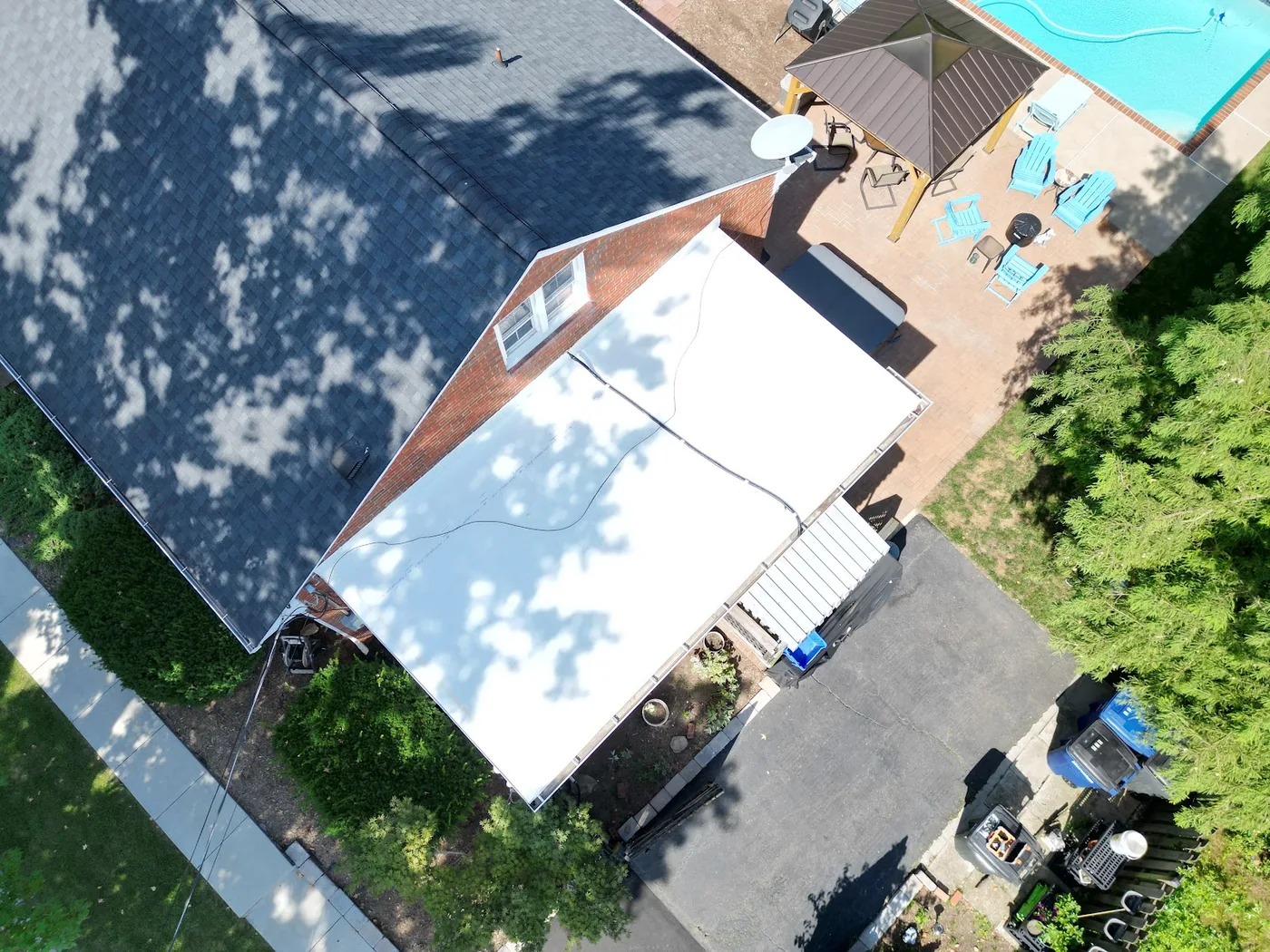
What we look at on the roof before quoting
- How the sheet meets the wall. A corner that has shrunk away or a flashing that was only caulked tells us the leak is a detail, not the field.
- Where downspouts from the main roof land. A pipe that dumps onto a flat roof wears the surface and drives water at the wall.
- Whether any seam is open at the edge, and whether the sheet feels soft or spongy underfoot, which can mean wet insulation below.
- What grows or drops on it: leaves, moss, branches, grease from a nearby grill.
- Foot traffic. A hatch, a satellite dish or a utility line means someone walks here, and that changes the thickness we suggest.
- What the neighbors can see, since your association may care about color or edge trim.
Four details that decide whether rubber lasts
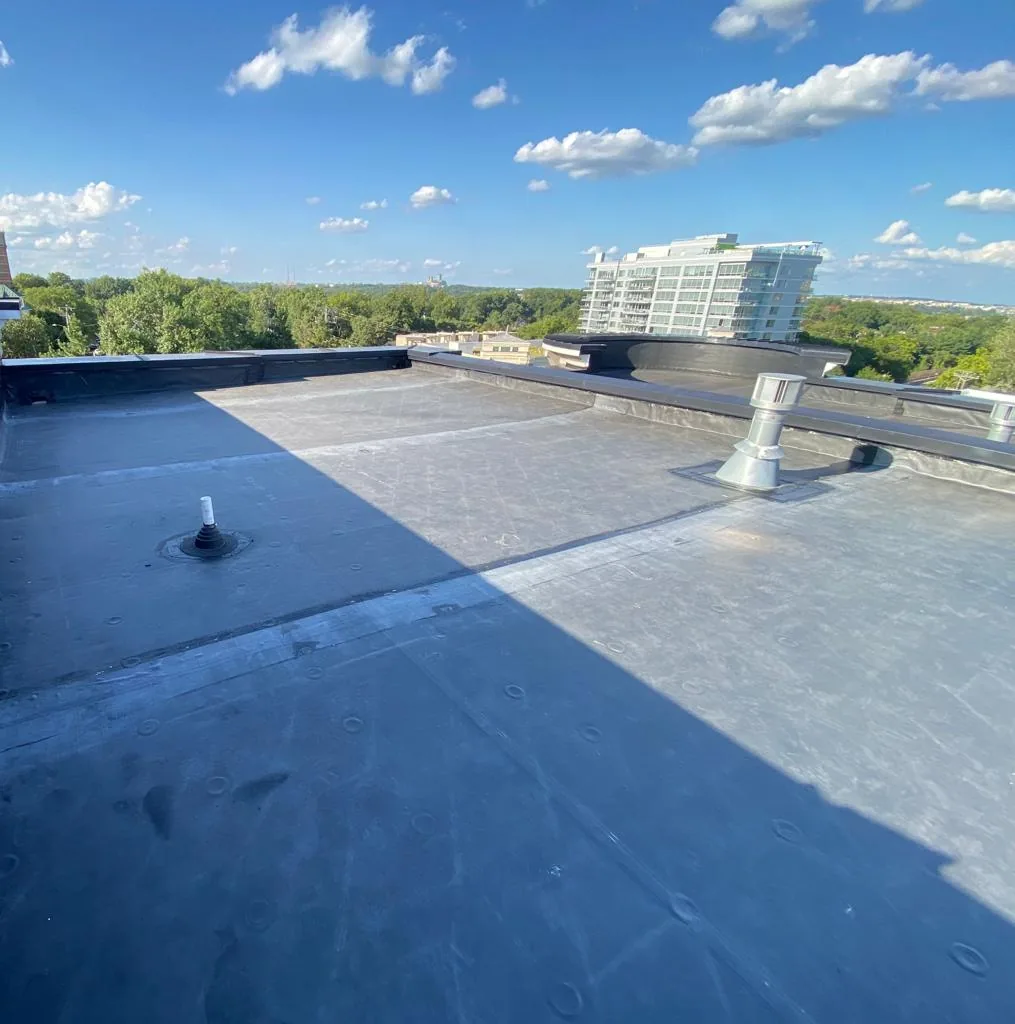
EPDM is cured rubber, so it is never heat-welded. Seams take primer and tape or splice adhesive, and the best seam on a small roof is no seam at all. One maker lists rolls up to 50 feet wide, and another sells sheet up to 10 feet wide with factory-applied tape, so a porch or sunroom top can often be covered in one piece. After that, four things matter.
- Seam preparation, because dust, talc from the sheet or damp surfaces are the usual causes of an open seam.
- Edge allowance. Rubber moves with temperature and one maker lists typical shrinkage of about half a percent for 45 mil sheet, so terminations are detailed to give.
- Keeping oils and fats off the surface, which a maker says to isolate from the membrane.
- A smooth, clean, dry deck, since sharp edges and voids telegraph through or cut the sheet.
Two typical Centreville EPDM projects
A screened porch roof on a 1980s house in Virginia Run
The porch is about 10 by 16 feet and the roll roofing has lifted at the siding wall. We would strip it, replace any soft plywood, and glue down a single sheet with new wall flashing. The owner sees photos of the deck before it is covered and a clean flashing line at the siding, and we would ask the association about color first.
A sunroom addition near Stone Road in London Towne
The sunroom roof is about 12 by 12 feet and leaks only in heavy rain, always at one corner. We would open that corner, look for rot and a failed boot, and decide between a repair and a new sheet. The owner sees the framing exposed in a photo, and a plain answer on which route we recommend.
When we would steer you elsewhere
- The roof gets grease or petroleum from an exhaust: PVC or another chemical-rated sheet.
- A condominium or townhouse roof needs light color and welded seams: TPO is the natural comparison.
- The plane is steep and visible from the street: shingles or metal.
- The deck has deep voids, rot or sharp edges that nobody will fix: any membrane will fail.
Permits: Centreville has no town government, so Fairfax County Land Development Services is the building official. County guidance lists replacing roof shingles as not needing a building permit, lists roof repairs as permit work, and notes that fire-rated townhouse decking can also trigger one. We confirm your scope before we start. If your home is inside the Centreville Historic Overlay District, the county Architectural Review Board handles exterior alterations. Our roof leak repair guide and flat roof maintenance notes help with the first steps.
Frequently Asked Questions
Does a Centreville association care what color my rubber roof is?
Possibly, so ask before ordering. A flat roof is usually hidden from the street, but communities such as Virginia Run and Newgate have associations, and each can have its own rules. Standard EPDM is black. A white EPDM product exists, with one data sheet listing 0.77 initial reflectance. If your covenants mention roof color, get the answer in writing before ordering.
Do acorns and fallen limbs puncture a rubber roof over my deck?
They can, especially on thin sheet. EPDM comes in 45 and 60 mil from one maker, and another also lists 90 mil, and puncture resistance rises with thickness. A roof under trees is a better candidate for the heavier sheet, plus a habit of sweeping it off each fall. A ladder foot or a dropped tool can be as common a cause as a branch, so a walk pad where people will step is worth having.
Would ballast stones make sense on my garage roof?
Rarely on a house. Ballasted systems hold the sheet down with stone, which adds weight, and one maker says to confirm the deck load limit with the designer first. Most small residential roofs are glued down instead, which keeps the weight low. If an older garage was framed light, we would not add stone without someone checking the structure. An attic or crawl look from below usually tells us enough to say no.
Does a 30 year guarantee mean my porch roof will last 30 years?
Not by itself. One maker lists guarantee terms of 15 to 30 years, with the thickest sheet for the longest, and the EPDM Roofing Association, a trade group, cites 38 years for well-installed, maintained roofs. Those are interested parties talking, with no independent median to set beside them. A guarantee also depends on approved details and installation, so it is a written document to read, not a lifespan promise.
If the flat roof joins my shingles, do the shingles have to come off too?
Not always. We usually replace the flat section and rebuild the flashing where it meets the sloped roof, then judge the shingles beside it. If they are near the end of their life, redoing the joint now can save opening it again later. Fairfax County's guidance lists shingle replacement as work that does not need a building permit, but we still confirm your scope with Land Development Services.
Rubber roof visits from Virginia Run to Newgate
Reston Roof, based in Reston, visits Centreville addresses reached by Interstate 66 and Route 29, from the Sully Station side to Newgate. Electric service here can come from Dominion or from NOVEC depending on the address, so if a line is involved, check your bill for the right utility. The service areas page lists the rest.
Porch, sunroom or garage roof giving trouble in Centreville?
Send the rough size, the age of the roof and a photo of the wall joint. We will say whether rubber fits. Call (571) 453-6515.
Book a Phone Consultation