EPDM rubber roofing for Alexandria rowhouses, porches and rear additions
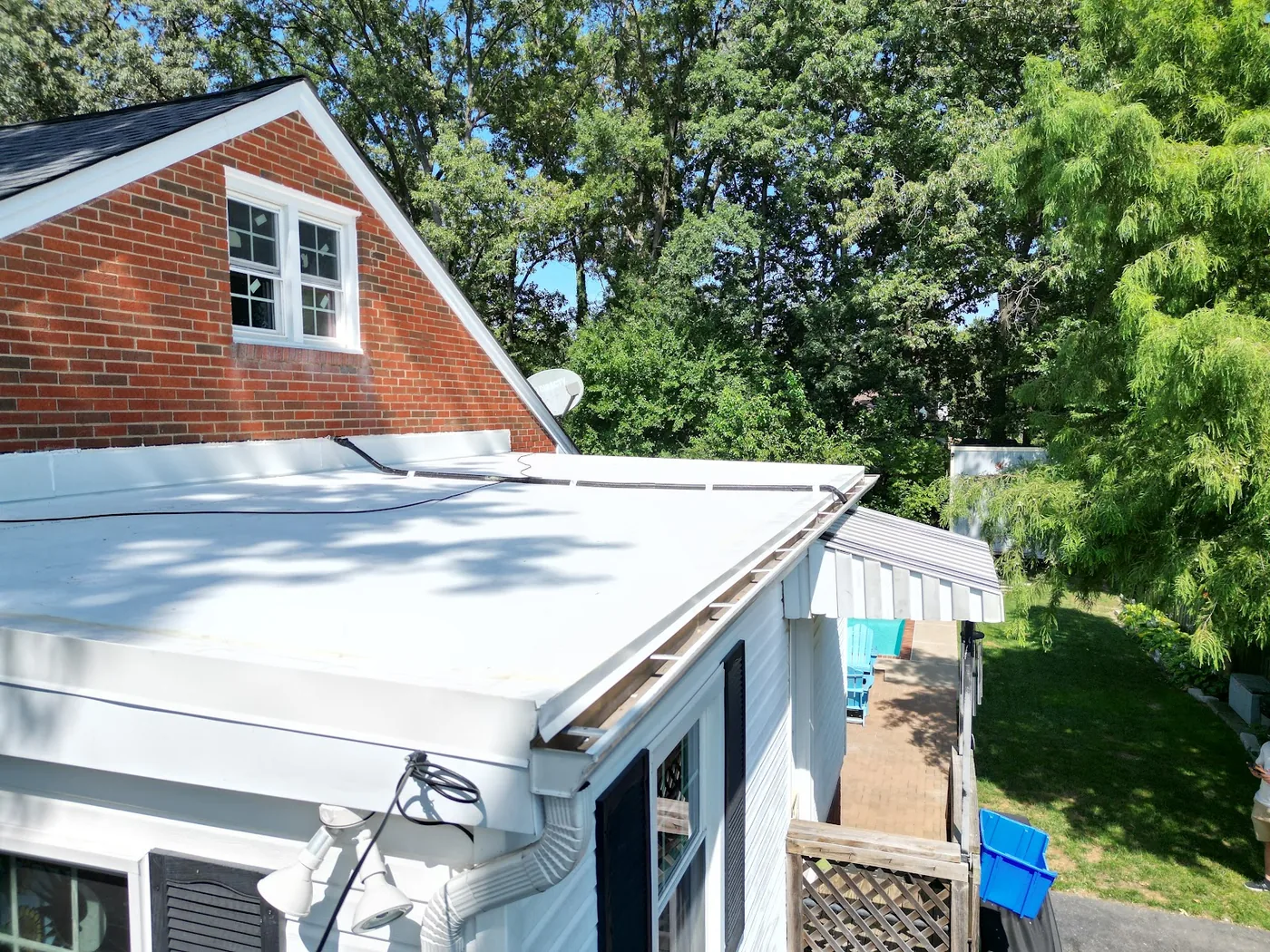
About one in five Alexandria homes is attached, roughly 16,800 rowhouses and townhouses, and some have a small flat roof somewhere: over a rear addition, a back porch or a bay. One rubber sheet can cover a roof that size with few or no field seams.
Three questions before anyone orders rubber
Is the roof really flat? Single-ply sheets need a design slope of at least a quarter inch of rise per foot. Anything steeper and visible, like the front slope of an Old Town house, belongs to shingles, slate or metal.
Can anyone see it from the street or the alley? Inside the Old and Historic Alexandria and Parker-Gray districts, visibility from a public right-of-way, alleys included, is what sends roofing to BAR staff. A rear flat roof can be in plain view of the alley behind it.
What drains it? A scupper, a drain or a downspout. Water still standing 48 hours after rain is the trade's red flag, and we correct the slope before we lay any sheet.
What we check on the roof
- The ceiling below, for brown rings that show where water gets in.
- How many roofing layers are on the deck, and whether any are wet.
- Flashing where the roof meets a parapet, party wall or brick chimney.
- The scupper, drain or downspout, and whether leaves have been collecting there.
- Soft spots in the deck near the edges, where water usually lingers.
- The condition of existing seams, tape or adhesive.
- How we reach the roof: a ladder from the alley, a window, or a narrow side yard.
Rubber specifics that matter on a small roof
EPDM is cured synthetic rubber, black unless a white product is chosen. Makers roll it up to 10 feet wide with factory seam tape, or in widths up to 50 feet, so a rear addition roof can often go down in a single piece. Where seams do exist, they are joined with primer and tape or splice adhesive, and trade writers trace most failures to dirt, talc or damp on the lap. A seam is only as good as the surface under it.
Rubber also moves. One maker's data shows a typical shrinkage near half a percent for 45 mil sheet, with a limit of 1 percent, which is why corners, parapet edges and flashing details get the most attention. Where grease or cooking oil will reach the roof, rubber is the wrong choice and PVC is the better fit.
Not all of the city's rowhouse streets are regulated
| Area | What the City and state records say | BAR review |
|---|---|---|
| Old Town, around King Street and Washington Street | Laid out in 1749, brick and frame dwellings, Federal period buildings emphasized | Regulated district |
| Uptown (Parker-Gray) | Predominantly small row houses and townhouses, Italianate and Queen Anne styles | Regulated district |
| Del Ray, near Mount Vernon Avenue | Platted 1894, annexed 1930, modest houses from the 1890s to 1941 | National Register district, not BAR regulated |
| Rosemont | More than 450 houses, developed from 1908 to 1914, mostly built by 1930 | National Register district, not BAR regulated |
Not regulated by BAR does not mean no rules. A homeowner association, or the permit office, can still have a say, so check your covenants and ask the permit office before work starts.
Two typical EPDM jobs in Alexandria
A rear flat roof on an Uptown rowhouse
The roof is about 12 by 15 feet over a two-story rear addition, drained by one scupper, with a parapet shared with the neighbor. A brown ring appears on the kitchen ceiling after hard rain. Because the roof can be seen from the alley and exceeds 25 square feet, we would call BAR staff before ordering and ask Code Administration about a permit. Rowhouse decking may need to be fire-rated, so any deck replacement beyond a patch becomes a permit question too. The work is lifting the old roofing, checking the deck, adding tapered insulation if water sits, laying a 60 mil sheet in one piece, and fitting fresh flashing and a new scupper liner. The owner sees photos of the open deck and a written scope.
A sunroom roof on a 1920s Rosemont house
A side sunroom has a flat roof of about 10 by 12 feet that leaks where it meets the house wall. Rosemont is not BAR regulated, so our questions go to the permit office and to any association. We would renew the wall flashing, test the deck for softness, and recommend a white sheet if the owner wants a cooler room below. The owner decides between that and standard black, and we write down why.
Where the approvals sit
The City of Alexandria runs its own Permit Center, so Fairfax County does not review roofs inside the City. Call Code Administration at 703-746-4200. Alexandria's pages print no roofing rule outside the historic districts. State code exempts replacing 100 square feet or less of roof covering, and exempts replacing 256 square feet of roof decking in houses and townhouses unless the decking must be fire-rated. The City's published historic-district policy has also called for a permit above 100 square feet of roofing, and we treat that as something to confirm, not assume.
A mailing address that says Alexandria can sit in Fairfax County. Our Fairfax County permit guide covers those parcels, and the Alexandria roofing overview explains how to tell which side you are on.
Frequently Asked Questions
My Old Town rowhouse has a flat rear roof that I can see from the alley. Does BAR care?
BAR staff may. Replacement roofing visible from a public right-of-way, alleys included, goes to staff review at 25 square feet or more, while the Board itself does not review flat and low-slope roofs. A patch under 25 square feet is ordinary maintenance. Staff decide visibility on a site visit, so call 703-746-3833 with photos before you buy materials.
Can I choose white rubber instead of black for my flat roof?
White EPDM exists, and one published product lists 0.77 initial solar reflectance, while standard black sheet is not a cool roof. A lighter roof helps a sunroom or addition stay cooler, and the Board's guideline sheet recommends light colors on flat roofs. In a regulated district, ask BAR staff about color if the roof can be seen. Elsewhere the choice is yours, subject to any association rule.
How do you handle the shared parapet between two rowhouses?
The parapet is the weak point on many rowhouse flat roofs, because rubber shrinks a little over time and pulls at its edges. Old flashing comes off, the wall gets checked for loose masonry, and the sheet ends at the wall with the maker's accessories rather than relying on caulk. If the wall is shared, the neighbor should hear about the work beforehand, since ladders and staging may cross the line.
Can a leaking porch roof be patched instead of replaced?
Often a patch makes sense: repairs use primer, a patch and seam tape on a clean, dry surface. The catch is condition. If the sheet is brittle, seams have lifted in several places, or a moisture check finds wet insulation, patching only delays a larger job. We inspect, photograph the defects, and give you both options with the reasons, so you can decide with the facts in hand.
Should a small rowhouse roof get 45 mil or 60 mil rubber?
Major makers sell 45 and 60 mil sheet, and one also sells 90 mil. Thicker sheet weighs more and resists punctures better, which helps where someone climbs onto the roof to reach a unit or clear a drain. For a roof nobody walks on, 45 mil can be reasonable. We decide from foot traffic, overhanging limbs and the condition of the deck, and write the choice into the scope.
Related Services
Rowhouse calls we take in and around Alexandria
Reston Roof is based in Reston and travels to Alexandria for rowhouse porches, additions and garage roofs. Most of our work is residential roofing. The service area page lists every community we visit.
Describe the flat roof behind your house
Tell us its size, what drains it and where the ceiling stains. We will say whether rubber suits it and which offices to call first. Reach us at (571) 453-6515 or book a call.
Book a Phone Consultation