Rubber Roofing for Arlington's Older Houses: EPDM on Additions, Dormers and Garages
A bungalow's main roof gets the attention, but the flat spot behind the kitchen is what leaks. This page explains where cured rubber sheet suits those small roofs, and where it is the wrong call.
Arlington's Older Houses and Their Flat Spots
Census estimates for 2020 to 2024 show 40,846 Arlington homes, or 33.5 percent, built before 1960, including 15,935 from the 1940s alone. Older houses are the story in neighborhoods like Lyon Park, where Craftsman bungalows of the 1920s give way to Colonial Revival houses of the 1930s and 1940s, and Ashton Heights, platted in 1921. Aurora Highlands adds modest single-family homes, twins and duplexes. Westover's buildings date mostly from 1939 to 1948.
Houses like these often pick up extras over the decades: a kitchen pushed out the back, a sleeping porch closed in, a dormer with a flat top. Each of those can be a small low-slope roof with its own age and its own leak history. Detached houses are only 24.8 percent of the county's homes, so this is a smaller market than apartments, but it is the one where a rubber sheet earns its keep.
Talk to Reston Roof
Phone ConsultationThree Leaks, Three Likely Answers
The stain appears on the ceiling beside the addition's back wall
Start with the flashing where the roof meets the siding. We open it, check the deck and rebuild the termination before we blame the sheet. Replacing the whole membrane over a bad wall detail only repeats the leak.
Water sits in the garage roof's low corner after every storm
That is a drainage question, not a membrane question. We find the low point, see whether the deck has sagged and ask where the water is supposed to go.
The old covering is cracked and the dormer top is soft underfoot
Soft boards mean the deck has been wet for a while. The roof comes down to the deck, bad boards are replaced and a new sheet goes over clean, smooth sheathing. If the same flat dormer sits on a steep, visible roof, ask whether metal or shingles would look better from the street.
What Makes Rubber Sheet Good for Small Roofs
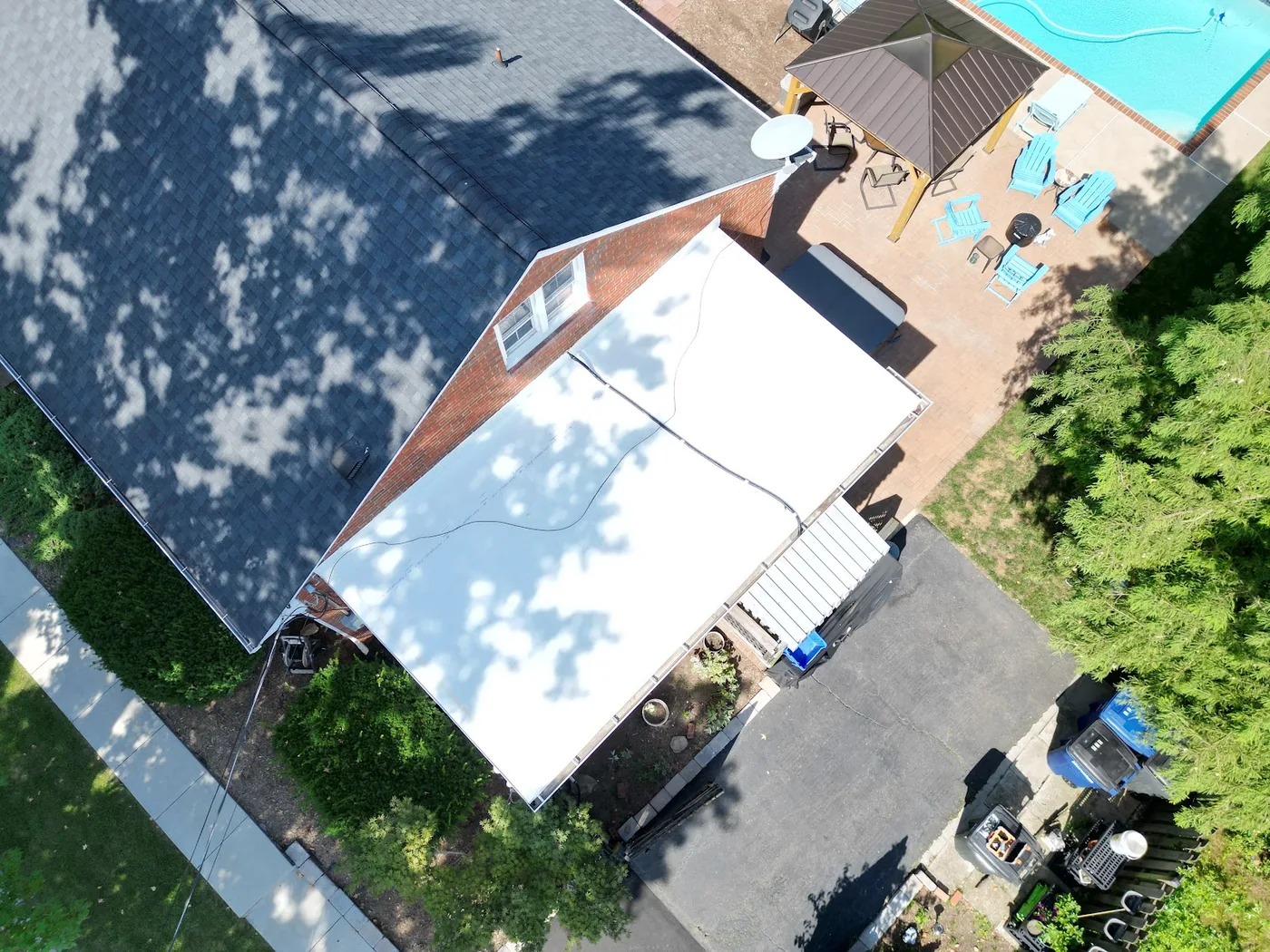
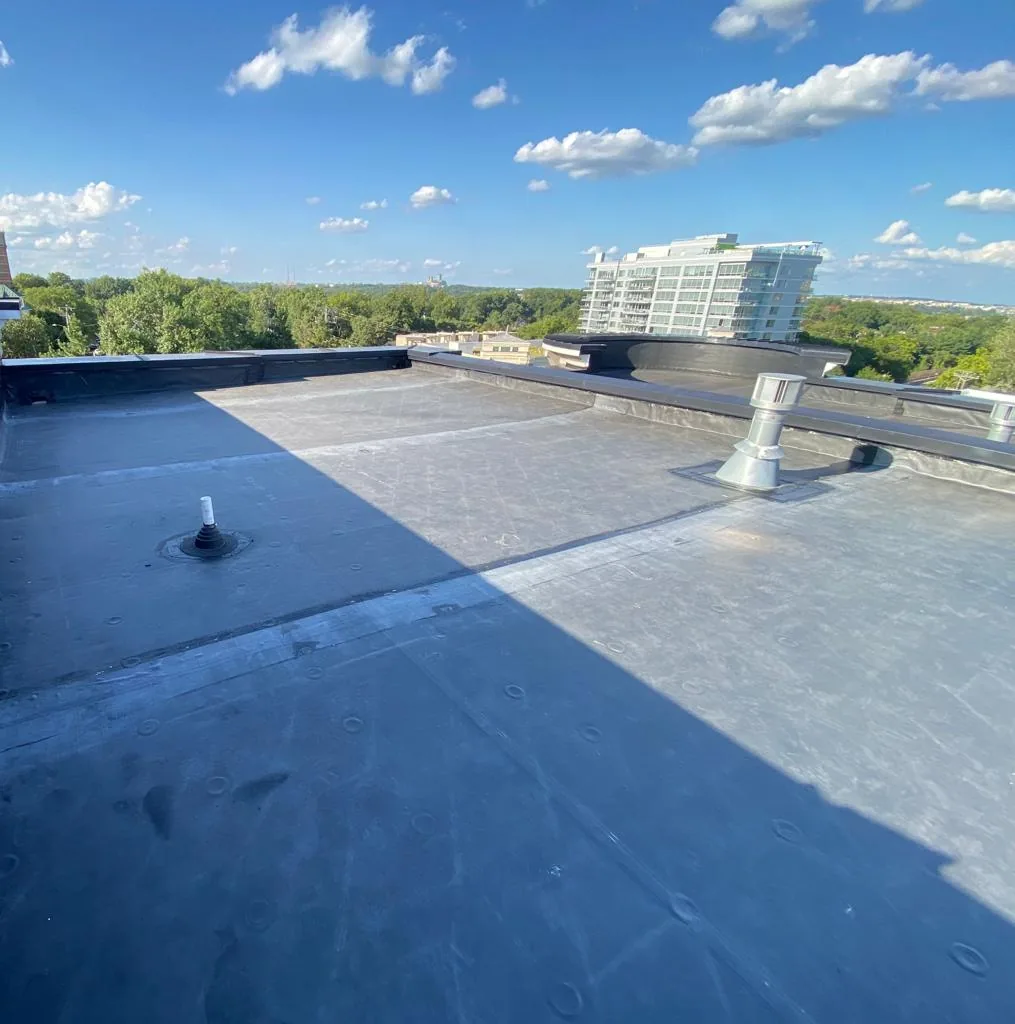
EPDM is cured synthetic rubber, and makers roll it in very wide sheets: one lists widths to 50 feet, another goes to 10 feet with factory seam tape already applied. On a roof 12 by 15 feet, that can mean no seam across the open area at all. The joins that remain are at the walls and edges, so the care goes there.
The limits matter as much. Grease, cooking oil and animal fat attack the rubber, so a roof below a kitchen vent belongs to PVC. A large, flat condo roof with a lot of welded detail may suit TPO better. Sharp edges and voids in the deck have to be corrected before a sheet goes down, and the old roof must be dry and carry fewer than two layers if we are to lay over it.
Permits and Review for a Small House Roof
Permits for any Arlington address come from Arlington County through Permit Arlington. Its residential roof table is about the decking, not the membrane: no decking change means no permit, and so does replacing under 256 square feet of decking. More than 256 square feet needs a permit. The table does not apply to a first-time roof on new construction, and townhouse roofs with fire-retardant-treated decking need a permit whatever the amount. Confirm what applies with Inspection Services before work starts; the table's last row, new plywood over existing decking, is a call to 703-228-3800.
Review is a separate question. Lyon Park, Ashton Heights, Aurora Highlands, Westover, Cherrydale and Lyon Village are on the National Register, which the county calls honorific, and the county pages we read describe no roof review in them. Maywood is different. It is the one residential neighborhood that is a Local Historic District, with Colonial Village, Buckingham Villages and Cambridge Courts among the garden-apartment complexes the county also lists.
Two Rubber Roofs We Would Scope
A kitchen addition on a 1920s bungalow off Glebe Road, roughly 12 by 15 feet. The roll roofing has split where it meets the siding, and a maple overhangs one corner. We would strip the old covering, probe the deck, replace soft boards and adhere one sheet across the whole surface, with new flashing at the siding and a drain path that clears leaves easily. Since the work is a replacement and the addition is old, we would check the county's decking rule first. The owner sees the old layers come off and a note on keeping the drain clear in autumn.
A detached garage behind a 1940s Colonial Revival near Langston Boulevard, about 20 by 22 feet. Water collects in one corner for days, and the fascia is stained below it. We would measure the fall, correct the low spot if the framing allows and set the sheet over a clean cover board. A new drain or scupper would give the water a defined way off. The owner receives photos of the deck and a written scope, and a short note on how to check the roof from the ground after storms.
Trees, Limbs and Small Roofs
The county's 2023 study measured tree canopy at 35.2 percent, up from 31.7 percent in 2014, against a goal of at least 40 percent. On July 29, 2023, trees came down on at least eight houses, including on S. Fillmore Street and N. Cleveland Street. On August 10, 2026, a storm line left nearly 2,500 homes and businesses without power in places such as Dominion Hills, Cherrydale and Maywood, and a large tree blocked Wilson Boulevard by Bluemont Park. The reports we read describe trees and power lines, not rooftops, but a low roof sits where a falling limb lands.
After a storm, look from the ground for cuts, lifted edges and debris, and do not drag limbs across the sheet. A puncture can be taped as a first step, and we document damage with photos for your claim. See storm damage roof repair and roof flashing repair. Nearby, Alexandria, Falls Church and McLean have their own EPDM pages.
Frequently Asked Questions
My bungalow's rear addition has almost no slope. Can a rubber roof still work?
Often, yes. The Virginia residential code sets the floor for EPDM at a quarter inch of fall per foot, about 2 percent, and the sheet has to be installed the way the maker says. A roof that is dead flat or sags in the middle is a framing and drainage problem first. The fall is worth checking with a level before anyone quotes, and a deck that has to change should be said plainly.
Does the county's roof table mean a rubber roof on my addition never needs a permit?
No. The table covers replacing a roof covering, and it does not apply to a roof installed for the first time, such as the one on a brand-new addition. For a replacement, no decking change or under 256 square feet of decking means no permit, more than 256 square feet means a permit, and new plywood over existing decking means calling 703-228-3800. We confirm with Inspection Services before we start.
Where does a rubber roof usually leak first, and is it the seam?
Seams can fail, since they are made with primer and tape or adhesive, and trade writing blames dirt, talc and damp surfaces. But we look first at the walls, edges and penetrations. Rubber shrinks a little as it ages, with makers publishing a 1 percent limit, and that pull lands on terminations and flashings. A stain inside a room often traces to the wall flashing, not the open field of the sheet.
Can my old rubber roof be patched, or does it need replacing?
Patching is a standard repair: clean, dry surface, primer, then a patch or seam tape. Whether it makes sense depends on the age of the sheet and the condition of its seams, and on whether the insulation below is wet. A moisture survey is the usual way to learn that. If the damage is one puncture, we patch it. If wet insulation is spreading, patching only hides it.
Does a National Register neighborhood like Lyon Park limit what roof I can choose?
The county calls the National Register an honorific list, and the county pages we read describe no roof review there. Maywood is the one residential neighborhood that is a Local Historic District. Our reading of the county's wording is that a same-material replacement is exempt there and a change of material needs a Certificate of Appropriateness, so call Historic Preservation at 703-228-3838 first. A homeowner association is a separate matter.
Related Services
- Welded white sheet on bigger low roofs: TPO in Arlington
- Roofs under kitchen exhaust: PVC in Arlington
- Pitched houses: metal in Arlington
- Everything we do in the county: Arlington roofing overview
Back Addition Dripping Again?
Give us the rough size, how old the roof is and where the stain appears. We will plan a visit, check the wall details and drain, and put a scope in writing. Phone (571) 453-6515.
Book a Phone Consultation