EPDM Rubber Roofing in McLean, VA: Starting From the Stain on the Ceiling
A wet ceiling under a porch, a garage link or a rear bump-out is a common place for an EPDM question to start. Here is how we decide between a repair and a new rubber sheet, and when EPDM is the wrong call.
If You See This, Here Is Where We Look
- A stain that follows a wall. We start at the wall flashing and the termination bar, since a sheet that has shrunk or lifted at the edge is the usual culprit.
- A stain under the middle of the roof. We look for a puncture, an opened seam or wet insulation, and we test before we decide.
- A puddle that stays after the sun returns. The fall to the drain is wrong, so tapered insulation or a new drain comes before any sheet.
- Grease or oil near a kitchen vent. EPDM is the wrong sheet there, because makers say to keep fats and oils off it. We would point you to PVC instead.
- A dark roof the family dislikes. White EPDM exists, and so do TPO and a metal option, depending on slope.
Talk to Reston Roof
Phone ConsultationThe Small Roofs on McLean's Houses
Census figures for the McLean community put detached houses at about 80 percent of its homes and townhouses at about 10, with a median build year of 1977. A house that old may well have had something added. The rubber-sheet candidates are the small ones: a porch roof, the flat link between house and garage, the top of a bay, a sunroom, the rear of a townhouse.
Franklin Park, off Old Dominion Drive, was platted in the 1920s according to its neighborhood association, and houses of that age can collect small rear and porch roofs. Pimmit Hills, with its Falls Church mailing addresses but county permits, was built from 1950, and about three in four of its homes are detached. We do not assume what is on any roof in either place. We climb up and look.
What the Rubber Does, and What It Does Not
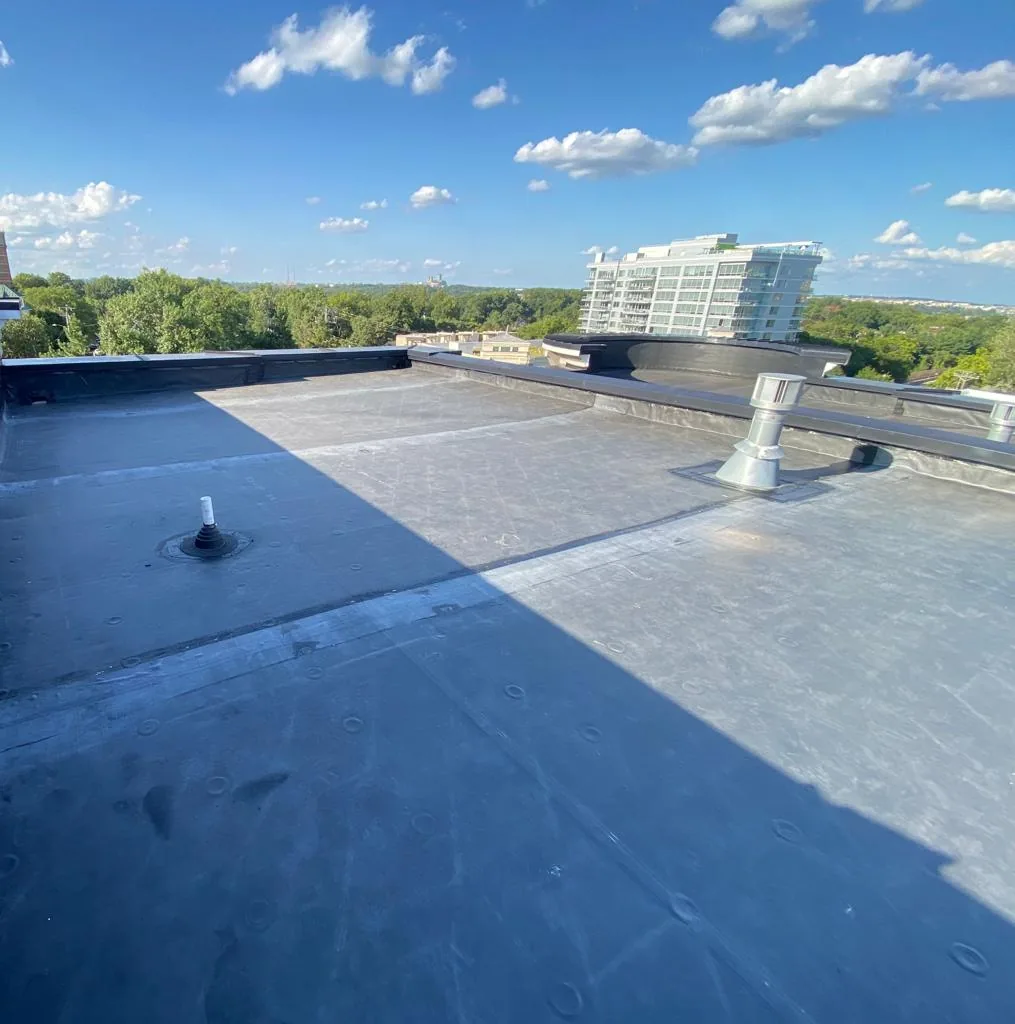
EPDM is a cured synthetic rubber sheet. It is not heat-welded like TPO. Seams are made with primer and tape, so they depend on a clean, dry, undisturbed surface, and the quickest way to lose a seam is to rush it. Sheets are made wide, from 7.5 feet up to 50 feet, so on a small roof we try to avoid seams in the open field altogether.
The thing to respect is movement. Rubber shrinks slightly over time, a typical half percent in a 45 mil sheet, with one percent as the maker's limit, so we leave slack at corners and secure terminations well. Black is the standard color and is not a cool roof, though a white EPDM exists. The makers also publish guarantee terms up to 30 years on thick sheets, and a trade association cites expected lives in the high 30s for well-kept roofs, but those are published claims and not promises we make for your roof.
Please keep one more limit in mind: sharp edges and voids in the deck telegraph through a thin sheet, so a rough substrate gets fixed before it is covered. On a lot off Dolley Madison Boulevard or Chain Bridge Road we also plan where the delivery truck stops, so the street stays passable.
Two Small Rubber Roofs, Described as Typical Jobs
A 1960s rambler with a flat link to its garage. The connector roof is about 12 by 18 feet and the sheet beneath has opened along one seam. The ceiling inside the link is stained at one end. We would test for wet insulation, strip the old covering, patch any soft decking, and lay one 60 mil sheet from the house wall to the edge, so no seam sits in the middle. Wall flashing and drip edge finish it. The owner sees the old sheet leave and photos of the dry deck.
A large 2000s house with a flat roof over a three-sided bay. The sheet is black, it is visible from upstairs windows, and the homeowners dislike the look. Here we would talk about white EPDM or TPO, ask the homeowners association or architectural committee, if any, whether a color change needs approval, and check the bay flashing first. The owner sees samples held against the shingles and a written note on what we found.
Trees, Gusts and a Flat Roof
Downed trees blocked Kirby Road at Autumn Chase Lane and Douglas Drive at Benjamin Street on the night of September 3 to 4, 2026, when gusts topped 60 mph, and about 1,500 McLean customers lost power in a July 2021 storm.
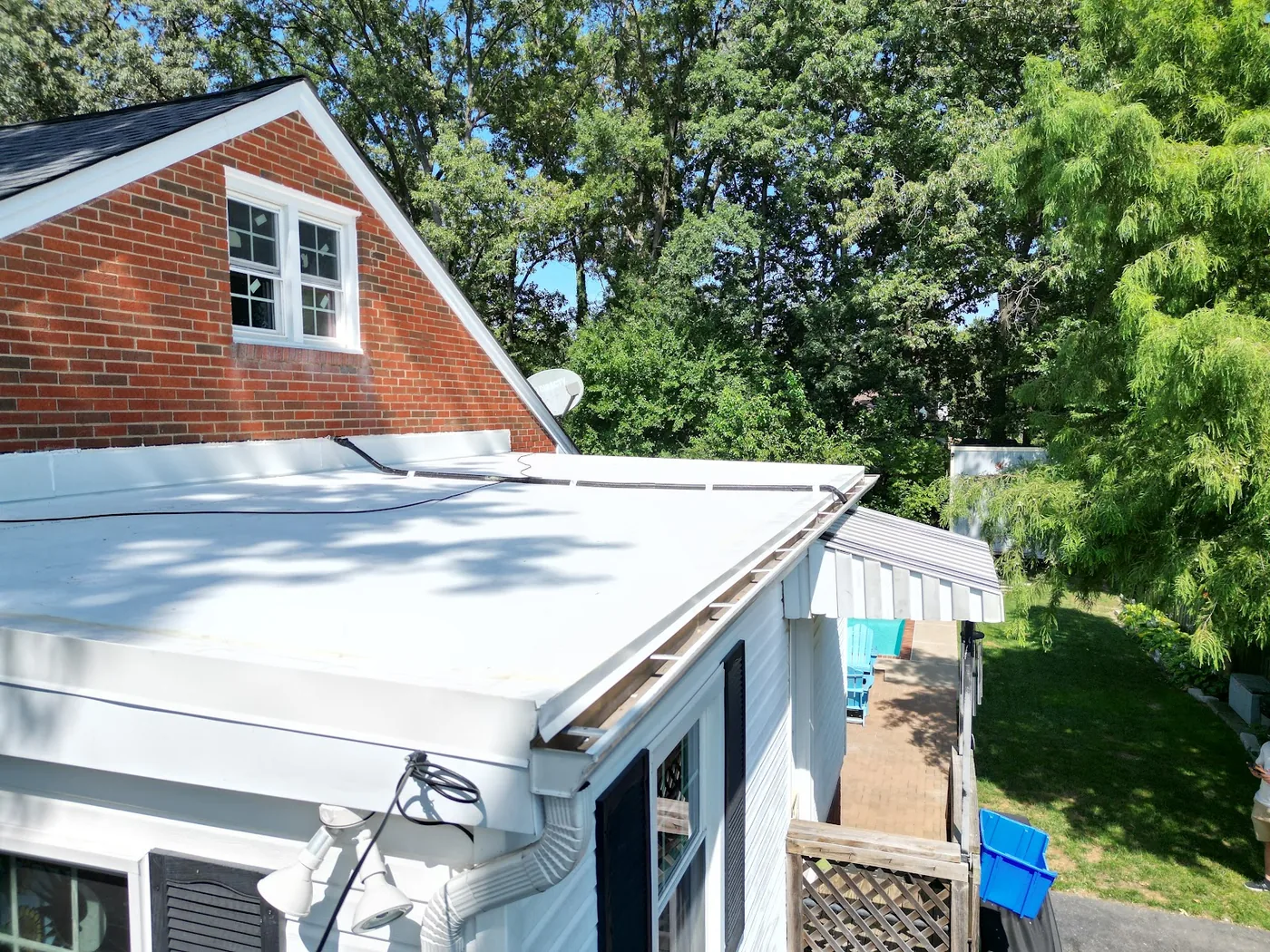
Still, a flat roof reacts to branches in a way a pitched one does not: debris stays instead of sliding off. After a storm, clear the roof if you can do it safely from a window or ground, and call us if you see water inside. If a power line is down, call Dominion Energy first and stay away from the area.
Which Office Cares About a Rubber Roof Repair
McLean is unincorporated, so Fairfax County Land Development Services is the only building office. Its guidance lists roof repairs and chimney repairs as permit work, while replacing under 256 square feet, or nine boards, of roof plywood is exempt unless the plywood must be fire rated, which matters on townhouses. We confirm your exact scope with the county before we start.
Neither the McLean Citizens Association nor the McLean Community Center reviews roofs. Inside the Langley Fork Historic Overlay District, a crossroads village at Georgetown Pike and Chain Bridge Road, the county Architectural Review Board handles exterior alterations, and we check the parcel to see whether your house is in it. For flat roof leaks in general, our flat roof repair guide and our note on weather damage in Northern Virginia are good first reads.
Rubber Roof Questions in McLean
Does white EPDM exist, or am I stuck with black on a roof the neighbors can see?
White EPDM exists. One maker's white sheet lists an initial solar reflectance of 0.77, far above standard black sheet, which is not a cool roof. A white sheet has to be specified on purpose, since black is the default. The Virginia energy code does not require a cool roof in Fairfax County, so the choice is about heat, looks and any association rules, and we price both colors when asked.
How many seams would a 12 by 16 foot porch roof have?
Often none across the open roof. Makers sell sheets from about 7.5 feet to 50 feet wide, so a roof that size can be covered in a single piece. Seams then appear only where the sheet meets walls, corners and curbs, and those are formed with flashing pieces. We confirm the exact layout after measuring, because a bay or a chimney can change it.
Can you patch a leaking rubber roof, or does it have to be replaced?
Often a patch is all that is needed. A puncture, a failed seam or a loose wall flashing can be repaired with primer, patch and tape applied to clean, dry rubber. A sheet that is cracked across its field, or insulation that is wet below, points to replacement. A moisture check tells us which. Roof repairs also appear on the Fairfax County permit list, so we confirm that too.
Why does the rubber at the edge of my porch roof look pulled tight against the wall?
EPDM shrinks a little over its life. One maker lists a typical change of about half a percent in a 45 mil sheet, with a limit of one percent. That small movement is why edges and wall terminations are where trouble shows first. A tight, bridged sheet at a corner is usually fixed by re-doing the termination and adding slack, not by replacing the whole roof.
Our porch roof sits under a big oak. Does that change the sheet you would pick?
It can. Standard EPDM comes as thin as 45 mil, and a heavy limb or a roofer's boot can puncture it more easily than a 60 mil sheet. Wet leaves also sit on a flat drain and keep water on the roof. Where branches overhang, we lean toward the thicker sheet, a drain guard and a note to clear the roof after storms.
Related Services
Other membranes and metal, for the same kinds of roofs:
Rubber roofing in neighboring areas:
Water showing up under a McLean porch or garage link?
Send us the street, the age of the house and where the stain sits relative to the walls. We will tell you whether it reads as a flashing repair or a new sheet, and what we need to inspect to be sure. Call (571) 453-6515.
Book a Phone Consultation