TPO Roofing in McLean, VA: White Membrane for the Flat Parts of a House
Most McLean roofs are pitched, so TPO is a specialist choice here. It fits the flat or nearly flat sections: the addition off the kitchen, the porch, the dormer top, the rear of a townhouse.
A Quick Sort: Which Parts of a McLean Roof Suit TPO
TPO is a heat-welded, fabric-reinforced sheet, usually white or tan, made for roofs with little or no pitch. Before anything else we sort the roof into sections, because one house often needs two different answers.
| Section of the roof | TPO? | Reason |
|---|---|---|
| Flat family-room or kitchen addition | Usually | Few seams on a small roof, if water can leave |
| Porch or sunroom roof | Often | Must still meet the minimum slope |
| Dormer flat top | Sometimes | Depends on access and the wall flashing around it |
| Steep main roof of the house | No | Single-ply is a low-slope system |
| Roof that cannot drain | Not yet | Fix the fall first, then choose the sheet |
Talk to a roofer by phone
Phone ConsultationWhere the Flat Roofs Are in a Town of Houses
McLean is unincorporated Fairfax County, and the 2020 to 2024 census survey counts about 17,800 homes in the community. Roughly 80 percent are detached houses and about 10 percent are townhouses. The median home dates from 1977, and 39 percent were built before 1970, while 22 percent came after 2000. So this is a market of houses, some added to, some rebuilt.
Low-slope roofs on a house tend to hide in a few places: over a bay or bump-out, above a garage connector, on a porch, across the top of a dormer. Houses along streets such as Old Dominion Drive and Lewinsville Road, like houses anywhere, can gain these sections as owners add rooms. Townhouse rows pick up a flat section at the rear.
How a TPO Job Runs, Step by Step
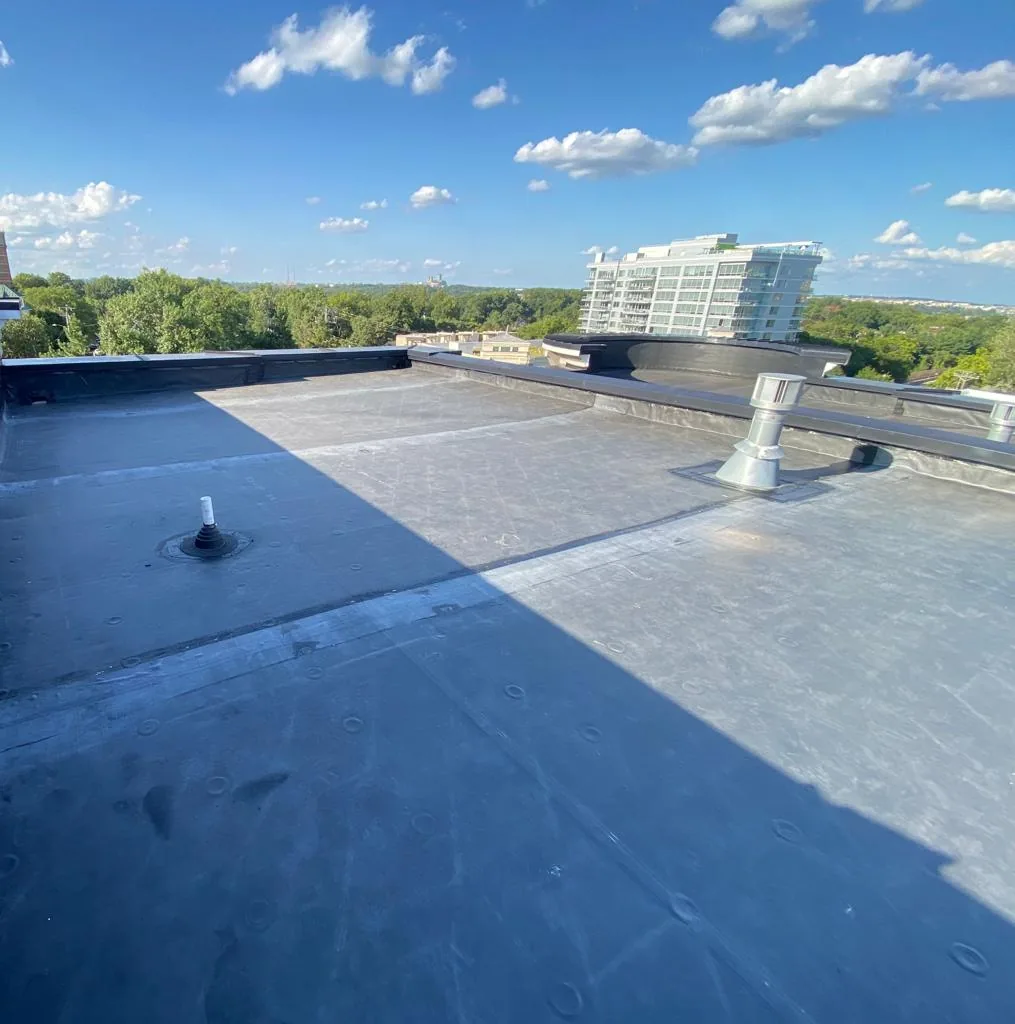
- We look at the roof and the rooms under it, photograph stains, and note where the old sheet or built-up layers have split.
- We test for wet insulation. A membrane is also a vapor barrier, so moisture trapped under a recover cannot escape.
- We strip to the deck. The residential code does not allow a recover over a wet roof or over a roof that already carries two applications, so a flat section with two old layers comes off entirely.
- We repair soft decking, then lay insulation, with a cover board where the system calls for one.
- The sheet is attached mechanically or with adhesive, depending on the system and the roof.
- Seams are welded with hot air, a lap of at least an inch and a half on one maker's system, and the weld edge is probed along its length.
- Walls, curbs and vents get flashings from the same maker, edge metal goes on, and we close with photos.
Thickness, Color and What the Spec Sheets Say
The usual sheet thicknesses are 45, 60 and 80 mil. At one maker those measure 0.018, 0.024 and 0.034 inch over the fabric, and lab puncture figures rise with thickness.
White is the familiar color. One maker's 2014 data sheet lists white TPO at an initial solar reflectance of 0.79 and tan at 0.71, while gray sits near 0.46. ENERGY STAR needs 0.65 when new for a low-slope roof, so gray would not make it, and the listing is product specific either way. Virginia's 2021 energy code does not require a cool roof in Fairfax County, so color is a choice about heat and looks, not a compliance step.
A manufacturer warranty may be available depending on the system, and its terms come in writing. Makers publish guarantee terms, not service lives.
Two Typical TPO Jobs in McLean
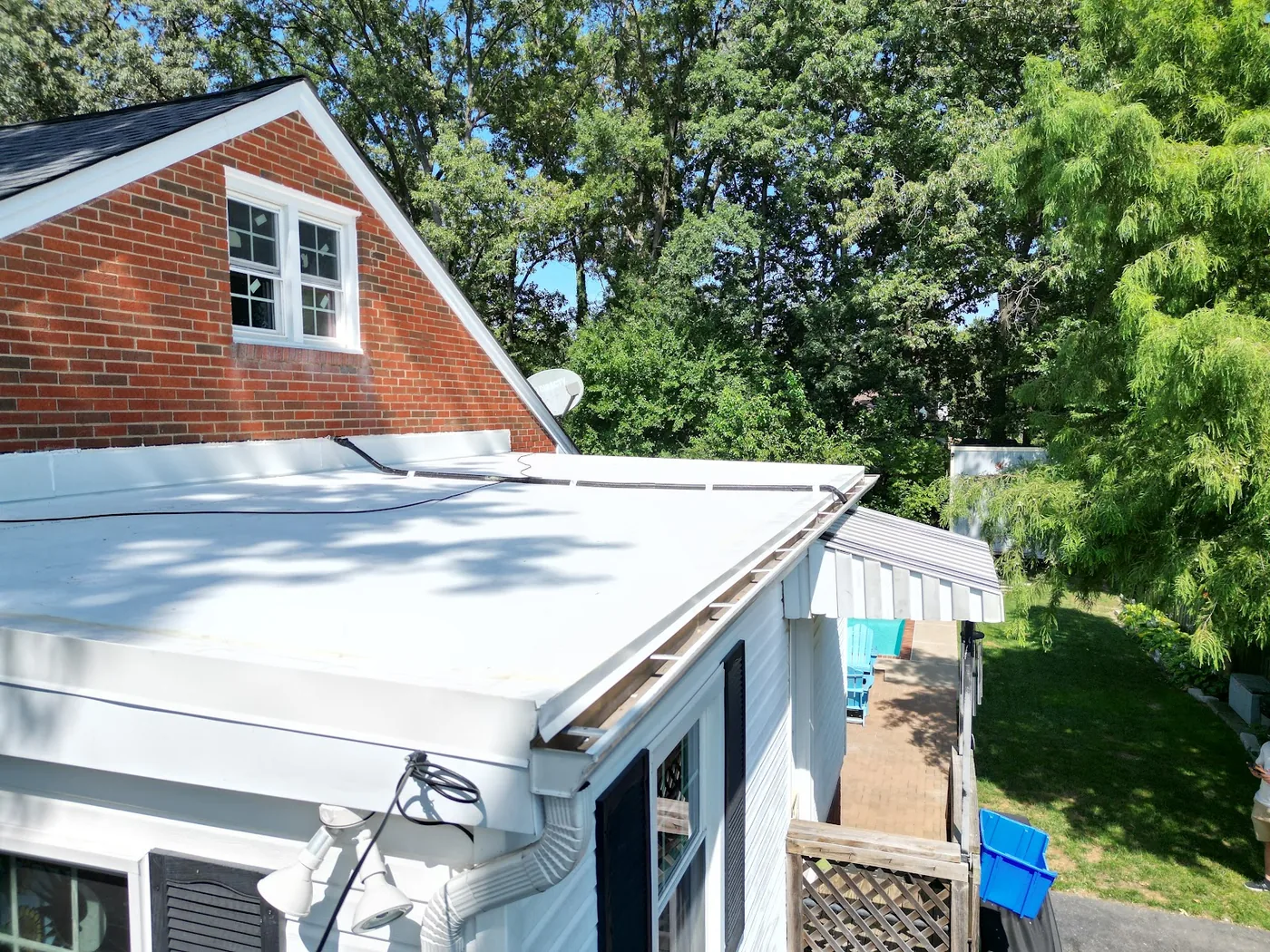
A 1970s detached house with a flat family-room addition
The addition is about 280 square feet and the ceiling stains along the brick wall after heavy rain. Two old layers sit on the deck and a corner holds water. We would remove both layers, replace any soft plywood, add tapered insulation toward a scupper, and weld a 60 mil sheet with new wall flashing and edge metal. The owner sees photos of the bare deck, a clear scope, and a dry ceiling to check after the next storm.
An end-of-row townhouse with a flat rear section
A bump-out roof of about 110 square feet has a plumbing vent and a party wall on one side. The sheet has pulled from the wall. Because plywood under townhouse roofs can be fire rated, we would confirm the decking question with the county first. The likely answer is a new sheet with a rebuilt wall termination. The owner sees a short job, a note for the neighbor on the other side of the wall, and closing photos.
Permits, Langley Fork and Who Does Not Review Your Roof
McLean has no town or city hall. Fairfax County Land Development Services is the building official, and the McLean Citizens Association and the McLean Community Center are civic groups, not permit or design-review bodies. County guidance lists replacing roof shingles as work that does not need a building permit, but it lists roof repairs among the work that does. A leak repair on a flat section can therefore need a permit when a shingle swap would not. We check your exact scope with the county before we start.
One county overlay touches McLean: the Langley Fork Historic Overlay District, a crossroads village where Georgetown Pike meets Chain Bridge Road. Which addresses fall inside depends on the parcel, so for any house near that crossing, check the parcel first. If your community has an association or architectural committee, get its approval before work. Our guide to Fairfax County roofing permits walks through the county side.
Wind, Trees and Access
Thunderstorms on June 12, 2026 carried gusts up to 70 mph and passed from just west of McLean, according to FFXnow, and on the night of September 3 to 4 downed trees blocked Kirby Road at Autumn Chase Lane and Douglas Drive at Benjamin Street. Those reports describe outages and blocked roads, not roof damage. After a blow like that we look at the edges and flashings of any membrane roof first, because loose terminations let wind lift a sheet. If a line is down, call Dominion Energy before anyone climbs a ladder.
TPO Questions From McLean Homeowners
Is TPO only a commercial product, or can it go on the flat roof of a McLean house?
It can go on a house. The building code sets a minimum slope of a quarter inch per foot for single-ply roofs, and small flat sections such as additions, porch roofs and dormer tops often meet it. TPO sheets come in widths up to 12 feet, so a small roof needs few seams. It is the wrong product for the steep main roof of a house, where shingles or metal belong.
How thick should the sheet be on a family-room addition?
Makers offer 45, 60 and 80 mil sheets. Thicker sheets show higher puncture and impact numbers in laboratory tests, and some makers allow longer guarantee terms on them. For a roof that people never walk on, a thinner sheet may be enough. Where limbs fall or a vent gets serviced, we usually talk about 60 mil. We settle it after seeing the roof and its drainage.
Is a white roof required in Fairfax County, and does white TPO qualify for anything?
A cool roof is not required for code compliance here, because the 2021 Virginia energy code applies its roof reflectance rule only to warmer climate zones. Some white and tan TPO products are ENERGY STAR listed, but the listing is product specific. Treat any savings on the power bill as a bonus, not a given.
Why do you ask whether my townhouse roof deck is fire rated?
Fairfax County guidance exempts replacing a small amount of roof plywood from a permit, but not when the plywood must be fire rated, as it can be on townhouses. If we find soft decking under a flat townhouse section, whether it is fire rated decides if we call Land Development Services first. We check that before we price any decking work.
What happens if rainwater sits on a TPO roof for days?
Water that remains two days after rain in drying weather is generally treated as a drainage problem, and it can shorten the life of any membrane. Some makers limit what their guarantee covers when water ponds. A correct fall to a drain or scupper matters more than the sheet. If your roof holds water, we look at tapered insulation or a new drain.
Related Services
If a welded white sheet is not the answer for your roof, compare:
TPO pages for neighboring areas:
A flat section over your addition or porch is leaking?
Tell us the age of the house, where the stain shows and whether the roof holds water after rain. We will say whether it sounds like flashing, a worn sheet or a drainage fix, and what we need to see to be sure. Call (571) 453-6515.
Book a Phone Consultation