TPO roofing for Tysons condo, townhouse and commercial flat roofs
Tall buildings tend to carry low-slope roofs, and Tysons has a lot of tall buildings. The Census Bureau's 2020 to 2024 estimates put about 78 percent of the area's 15,436 homes in buildings of five or more units, and only about 18 percent in houses or townhouses. TPO, a white heat-welded membrane, is one of the natural fits for that mix.
Three Tysons roofs, three different conversations
The membrane is the same sheet in each case. What changes is who signs the contract and what has to be settled first.
The condo or apartment building
The median year built is 1995, and most buildings went up between the 1980s and the 2010s. Their roofs belong to an association or an owner, not to the person in the top-floor unit. In a condominium, Virginia law defines the common elements as everything outside the units, and the executive board normally decides how those are repaired. In an apartment building, the owner or the management company decides. Residents are mostly renters here, about two thirds of occupied units, so the people hearing the noise are often not the people signing the work order.
The townhouse row
The census count shows 1,424 attached homes. A townhouse usually has a pitched main roof, but the rear kitchen extension, the covered entry or the upper deck can be flat. That is TPO territory, and also where the fire-rated decking question below comes up.
The low commercial roof
On a smaller office or retail building, for example along Leesburg Pike, Chain Bridge Road or the streets around Tysons Corner Center and Tysons Galleria, several rooftop units can share one flat roof. Wide membrane sheets are handy there, because every curb and pipe is another place to flash.
From reserve study to finished roof
For a condominium the usual path looks like this. Your documents may vary it.
- The board's reserve study lists the roof. State law calls for a study at least every five years and an annual review.
- Someone walks the roof and writes down what is wet, split or ponding.
- The board gets a scope in plain words, with photographs, so members can follow it.
- We confirm the permit question with Fairfax County Land Development Services.
- The roof is stripped or recovered, flashed, welded and tested for water.
- The board receives photographs of the layers and the finished details.
How a board pays for the work is its own decision, and we stay out of that choice.
What makes TPO behave on a big flat roof
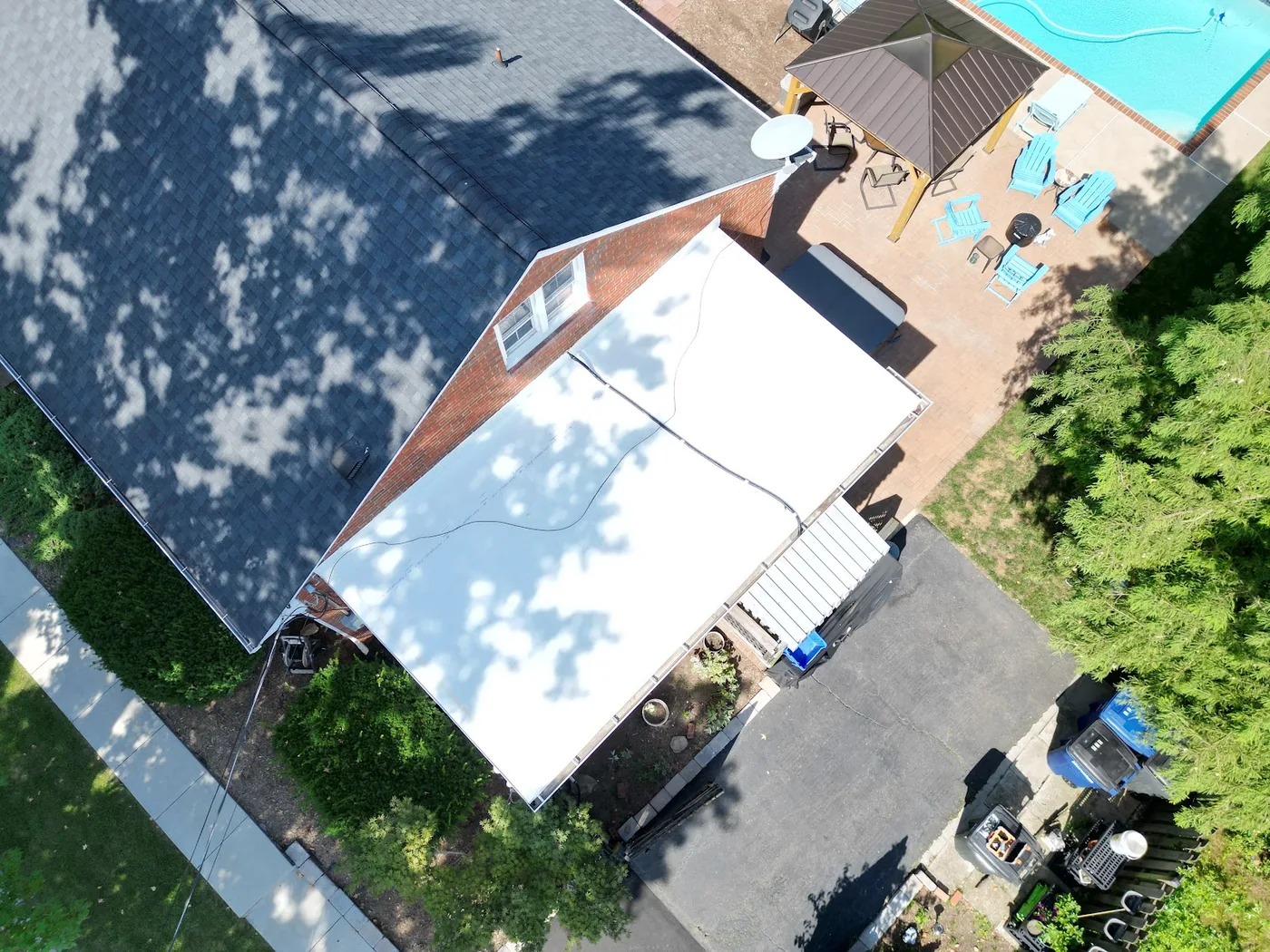
TPO is a thermoplastic sheet with a polyester scrim inside. Because it softens under heat, the seams are fused with a hot-air welder instead of taped. One maker's sheet calls for a weld at least 1.5 inches wide and for weathered laps to be cleaned before welding. A weld that was not cleaned is the usual suspect when a seam opens, so the edges should be probed and photographed to show what was checked.
Water is the other half. Roofing trade guidance treats water still standing after 48 hours of drying weather as a sign the roof is not draining, and a maker may read that differently in its warranty. On a roof with sagging decking or clogged scuppers, new membrane does not cure the problem, so we look at tapered insulation or added drains.
Color matters too, with a limit. White TPO from one maker's 2014 data sheet starts around 0.79 solar reflectance, and ENERGY STAR is listed product by product. Climate Zone 4A, which covers Fairfax County, has no cool-roof requirement in the 2021 energy code. White is a choice, not a code duty.
Two typical TPO projects in Tysons
A rear flat roof on an end-unit townhouse
The roof is about 12 by 16 feet over a kitchen addition on a 1990s townhouse. A brown stain keeps coming back at the wall where the old membrane meets the siding. We would strip the old layers, check the decking, put in new insulation and a 60 mil TPO sheet, and carry the flashing up the wall. Decking in a townhouse may need to be fire rated, so the county should be asked before work starts whether the scope changes anything. The owner sees photographs of the bare deck and a water test at the drain.
A low office building on a street like Jones Branch Drive
The building has about 6,000 square feet of older single-ply with split seams around two rooftop units. A moisture survey finds one wet corner. We would cut out and replace the wet insulation, then recover the roof with welded TPO if the layers underneath allow it. Re-covering is not permitted over wet material or where two roofs are already stacked, so the answer comes from what we find. The manager receives photographs of the cut-outs and of each rooftop curb after flashing.
Permit questions for Tysons TPO work
Tysons is an unincorporated part of Fairfax County, not a town, so Fairfax County Land Development Services is the permit office whatever the mailing address says. McLean and Vienna addresses are both used here. County guidance lists roof repairs on commercial buildings as permit work and treats replacing less than 100 square feet of roof covering as the exception, so a commercial re-roof above that size is a question we put to LDS and do not guess. Apartment and condominium buildings are normally classed R-2, which probably sits outside the state exemption for houses and townhouses, but confirm with LDS for your building. Our Fairfax County roofing permits guide walks through the county's side of the process.
When TPO is not the answer
- The roof cannot drain and nobody will fix the slope or add a drain.
- A kitchen exhaust or other source of grease reaches the membrane. TPO makers differ on chemical resistance, so we read the product sheet. PVC may suit better, as on our Tysons PVC page.
- The roof is a small porch or garage top where rubber is simpler. See EPDM in Tysons.
- The roof is a visible steep slope on a house. That is a metal or shingle question.
Frequently Asked Questions
I own one unit in a Tysons condo. Can I hire you to redo the building's flat roof?
Not on your own. In most condominiums the roof is a common element, so the executive board or the association's manager decides what is done and who does it. A unit owner can help by photographing ceiling stains and sending them to the board. If the board asks us for a scope, we are glad to walk the roof with the manager. Your governing documents decide the details.
How does a reserve study affect when a TPO roof gets replaced?
Virginia law has the board run a reserve study at least once every five years for the components it must repair or replace, and review it each year. A roof that the study puts a few years out is the time to get a condition report, so the work can be planned and funded instead of rushed after a leak. We can describe what we see on the roof, but the budget is the board's call.
Will a white TPO roof on a Tysons building lower our cooling bill?
A white sheet reflects more sun than a dark one, and certain white and tan TPO products are ENERGY STAR listed, which asks for 0.65 initial reflectance. Fairfax County sits in Climate Zone 4A, where the 2021 energy code does not require a cool roof. We do not promise a dollar saving, because it depends on the insulation below and how the building is used.
Does a townhouse flat roof in Tysons need a permit to recoat or re-roof?
County guidance treats house and townhome roof repairs as permit work, while replacing roof shingles is not. A flat membrane roof does not fit neatly in that list, and townhome decking can be required to be fire rated. Ask Fairfax County Land Development Services about your exact scope before work starts.
How many years will a TPO roof last on a high-traffic roof with rooftop equipment?
No single number applies. Makers publish guarantee terms, reaching up to about 20 to 30 years depending on sheet thickness and system, and a guarantee is not a lifespan. A roof that technicians cross all year, with clear drains and walk pads, lasts differently from one nobody visits. The details are planned around how the roof will really be used.
Where we take TPO calls around Tysons
From our base in Reston we take membrane roof calls in Tysons and the neighboring areas of McLean, Vienna and Falls Church. Every area we cover is on the service areas page.
Is a board or manager asking about the roof?
Tell us the building type, roughly how large the roof is and where it leaks. The reply covers whether TPO is a sensible start. Phone (571) 453-6515.
Book a Phone Consultation