PVC roofing in Tysons for roofs with exhaust, grease and crowded equipment
A flat roof in a mixed-use district is a work surface. Fans vent onto it, technicians walk it, and an older building may carry flashing from a previous generation of roofing. PVC fits when the question is not only how big the roof is, but what touches it.
What touches your Tysons roof, and the usual response
| What reaches the roof | Typical response |
|---|---|
| Kitchen exhaust grease or oil | Read the maker's chemical guidance for the exact membrane, and look at how the fan discharges. |
| Rubberized asphalt flashing from an older roof | Remove it, or separate it from the PVC with metal or a compatible sealant. |
| Foam or bitumen insulation facers | Ask the maker. We do not assume it is safe. |
| Technicians and window crews | Lay marked walk pads and pick a thicker sheet. |
| Standing water | Fix slope or drains first, or the new roof inherits the old problem. |
Why Tysons has roofs like this
Most of the area's buildings are multi-unit or commercial, and the center of it is retail and offices. Tysons Corner Center and Tysons Galleria draw shoppers to roads such as International Drive and Tysons Boulevard, and the buildings around them put equipment on their roofs. We make no claim about which roofs hold exhaust fans. We know only that where one does, the membrane choice changes.
The area's age mix matters as well. The median home was built in 1995, and about a quarter of Tysons homes date from before 1980, so some roofs may have been recovered or flashed more than once over their lives.
How a PVC seam is made, and how we show it
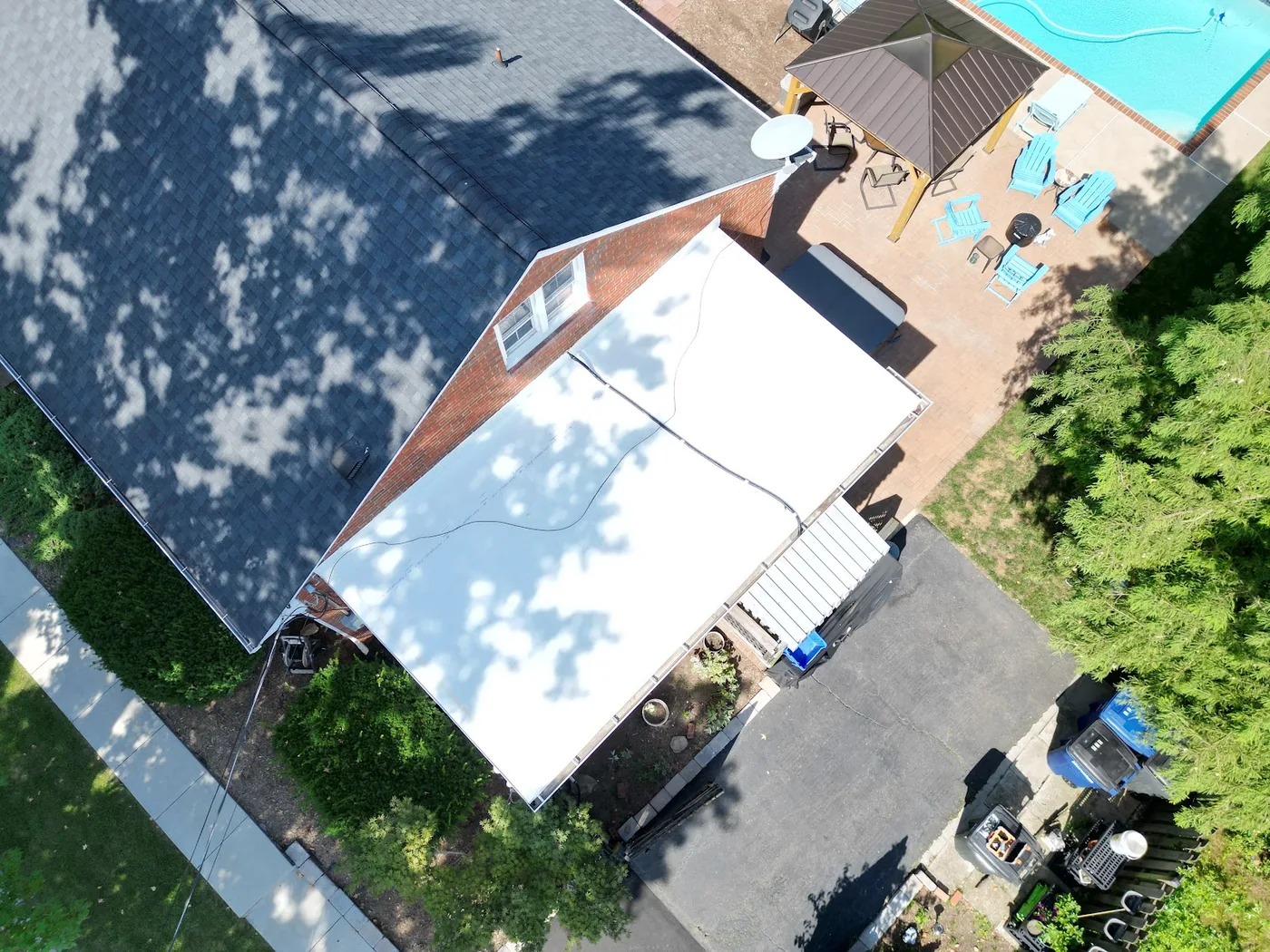
PVC is a plasticized sheet, often with a polyester scrim, and the laps are fused with hot air. One maker makes the bottom ply gray so a proper weld is visible. Weathered or dirty PVC has to be cleaned first. After welding, the edges should be probed and photographed, because an unprobed seam is a guess.
The sheet is not forever. A maker's guarantee term, such as up to 25 years from one and up to 30 on certain terms from another, is paper protection, not a promise about the roof. Terms come in writing from the maker, and the roof's day-to-day life depends on drainage and care.
Two typical PVC projects in Tysons
A single-story retail building with a kitchen fan
The building is about 5,000 square feet on a street like Boone Boulevard, and the old membrane near the exhaust curb has gone soft and stained. After a moisture survey, we would remove wet material, rebuild the curb flashing and weld a 60 mil PVC sheet with walk pads from the access hatch. The manager sees photographs of the cut-outs, the probed seams and the finished curb, and the grease route is worth reviewing with the restaurant's operator.
A low roof over a lobby on a 1980s building
The roof is roughly 2,500 square feet with a dozen pipes, two drains and old rubberized flashing at every curb. We would pull the old flashing, install prefabricated boots where the maker allows, and keep the PVC separated from anything that could draw out plasticizers. Because the roof is commercial, we would raise the question of the county's permit threshold with Land Development Services before starting.
Permits, owners and who we call
Tysons is unincorporated, so Fairfax County Land Development Services issues permits, and their office is in the Herrity Building on Government Center Parkway. The county's commercial guidance lists roof repairs as permit work and lists replacement of less than 100 square feet of roof covering as the exception. Re-roofing a larger commercial roof is something we would confirm with LDS rather than assume. State code exempts unlimited roof covering replacement only in Group R-3, R-4 and R-5 buildings, and apartments and condominiums are normally a different group, so do not assume the exemption applies.
For a condominium, the board decides; for an apartment building or a retail property, the owner decides. Our warranty guide helps owners read what a maker will and will not cover.
Frequently Asked Questions
A tenant's kitchen fan vents onto our roof. Does PVC solve the grease problem?
It helps, but it is not magic. One maker calls its PVC inherently resistant to oils and grease, and another lists enhanced chemical resistance, yet resistance depends on the product and the exposure. We would read the maker's chemical guidance for your exact membrane, look at how the exhaust is discharged, and keep walk pads and cleaning in the plan.
Can new PVC go over the old rubberized flashing on our building?
Not in direct contact. A major maker warns that rubberized asphalt can pull plasticizers out of flexible PVC, leaving it brittle or cracked, and says to separate the two with metal or a compatible sealant. In practice we remove the old flashing where we can and do not assume a product pairing works until the maker's guidance confirms it.
What is a prefabricated PVC roof, and does it help on a crowded roof?
One maker fabricates custom sections with factory-welded seams, which reduces how many seams get welded on the roof. That can help where pipes, curbs and equipment crowd the surface. It does not remove the need for careful flashing, and a prefabricated system works only if the field measurements are right, so measuring twice before anything is ordered is worth the time.
How often should a PVC roof be checked after installation?
One maker's data sheet recommends looking at flashings, drains and termination sealants at least twice a year and after each storm. That is a reasonable habit for any single-ply roof. A short visit with photographs, plus clearing drains and removing debris, catches small problems before they reach the insulation or the ceilings below.
Why choose PVC over TPO if both are white and heat-welded?
Usually because of what reaches the roof, not color. Both are welded, and both come in white. PVC is the one makers describe as resistant to oils and grease, while TPO products vary. If nothing greasy touches the roof, TPO can be just as sensible. Price depends on the roof's size, penetrations and access, so compare written scopes rather than assuming one sheet costs less.
Where we take PVC calls
Reston Roof is based in Reston and takes PVC calls across Tysons, near the Greensboro and Spring Hill Metro stops, and in neighboring McLean, Vienna and Falls Church. The service areas page lists the rest.
Not sure what is touching your roof?
Send photos of the fans, curbs and old flashing. The reply covers whether PVC deserves a look or another membrane fits. Phone (571) 453-6515.
Book a Phone Consultation