PVC roofing in Falls Church, VA: for roofs that take exhaust, pipes and foot traffic
PVC is the membrane we reach for when a flat roof has more going on than weather: kitchen exhaust, a crowd of pipe penetrations, or old patched flashing. In Falls Church that mostly means condominiums, apartment buildings and small commercial roofs, so this page is written for owners and boards.
Five questions we ask before recommending PVC
1. What vents onto this roof?
A kitchen hood, a dryer vent or a grill pad puts grease and oil on the membrane. That is the clearest case for PVC, where one maker states resistance to oils, fuels and grease. If nothing vents there, a simpler membrane may do the job, and we will say so.
2. What does the new sheet touch?
Rubberized asphalt mastic on an old wall flashing can draw plasticizer out of PVC, so the two are kept apart or the old material is removed. Whether any other insulation in contact with the sheet needs a separator is something we confirm with the maker for each system.
3. How many penetrations are there?
Every pipe, curb and conduit is a flashing detail, and leaks tend to start at details rather than in the open field of the roof. A roof with dozens of them is where factory-welded sections and molded boots pay off.
4. Who walks up there?
Mechanics reach rooftop units by the same path every time, and that path wants walk pads so the membrane is not scuffed.
5. Who decides?
A condominium roof is decided by a board and its manager, a retail roof by its owner, and a house roof by the homeowner. The scope is written for whoever has to sign it.
Why those questions land on these streets
Inside the City of Falls Church, 37.8 percent of units sit in buildings of 50 or more units and another 15.8 percent in buildings of 2 to 49 units, so roughly 54 percent are in multi-unit buildings. Across the line in Fairfax County, about 44 percent of the units around Seven Corners and Bailey's Crossroads are in large buildings too, as are about 44 percent in the Merrifield area, along Leesburg Pike, Arlington Boulevard and Columbia Pike. Shopping centers such as Seven Corners Center on Arlington Boulevard and Eden Center on Wilson Boulevard show the kind of commercial building that also needs a roof plan.
Two typical PVC projects in Falls Church
A one-story retail building with a restaurant tenant
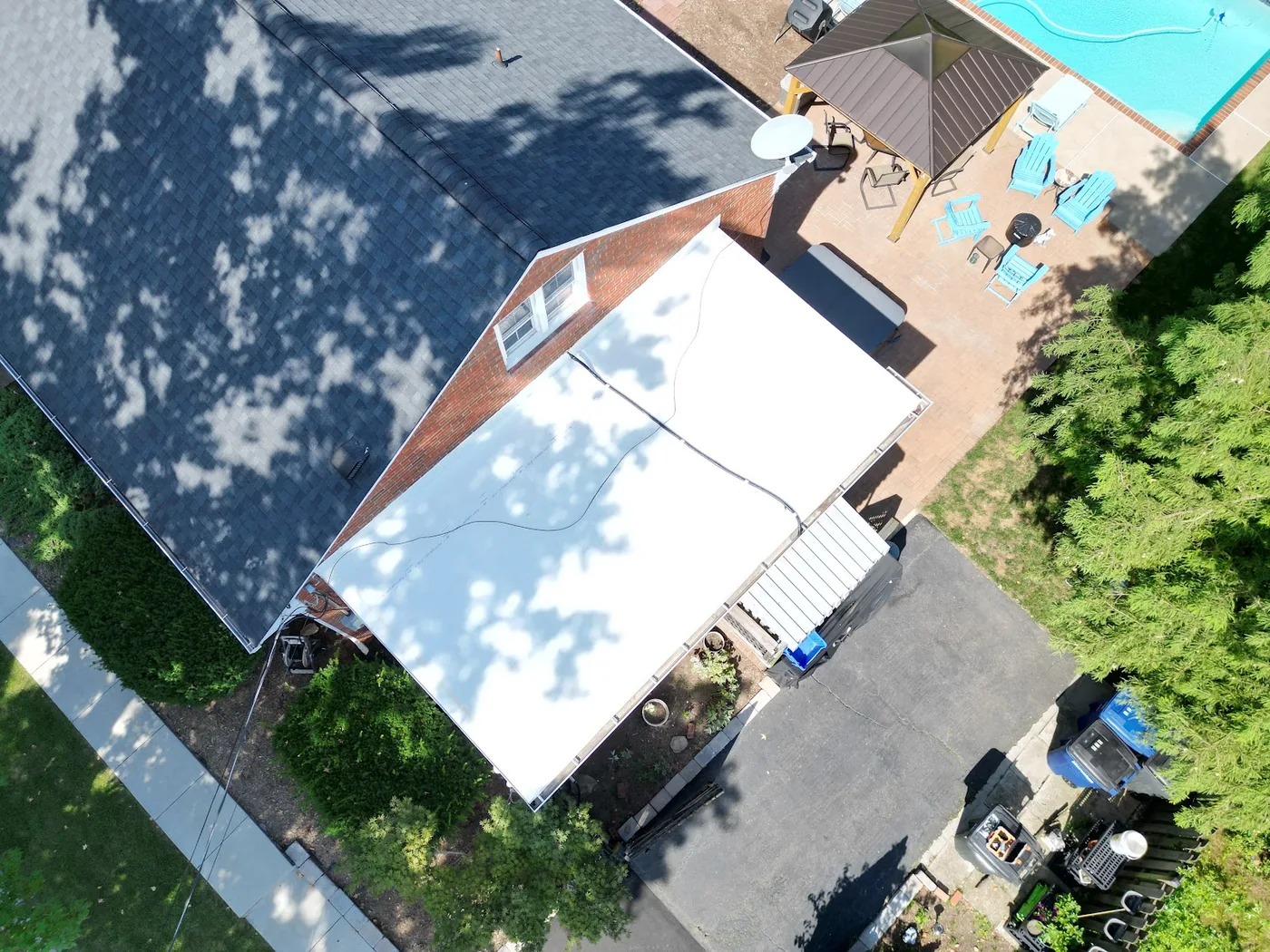
The roof is about 4,000 square feet and flat, with a kitchen hood fan near the back and grease staining spread downwind from it. The wall flashing is old mastic that has been patched more than once. We would test for wet insulation, remove the old flashing instead of covering it, install insulation and an 80 mil PVC sheet, weld the seams and put walk pads from the roof hatch to the fan. The owner gets a photo log and a written note on how often the fan needs cleaning.
A garden-style condominium roof near Bailey's Crossroads
The building has a low-slope roof with plumbing vents, two exhaust fans and a stair bulkhead. Because the address is in the county area, Fairfax County Land Development Services answers the permit question, not the City. We would use prefabricated sections to cut the number of seams made on the roof, prefabricated boots for every vent and keep the new sheet off any rubberized flashing. The board receives a written scope and a schedule of the units affected.
Permits when the building is not a single-family house
The City's own pages are written for single-family dwellings, saying an owner may replace a roof without a permit unless rafters or a major portion of the decking are replaced. They do not address condominium or apartment roofs, so for a multi-unit or commercial building we ask City Code Administration, 703-248-5080, how the building is treated rather than assume the house rule applies.
State code exempts unlimited roof covering replacement only in Group R-3, R-4 and R-5 buildings, subject to a wind-speed condition, and exempts 100 square feet or less in every group. Which group a building falls into is the building office's call. For Seven Corners, Bailey's Crossroads, Idylwood, West Falls Church and the Merrifield area, the office is Fairfax County Land Development Services at 703-222-0801. A parcel check, not the mailing address, decides which office. See our permits guide for the county side.
What a PVC sheet is made of
PVC is plasticized polyvinyl chloride with a reinforcing fabric inside, welded at the laps with hot air. Makers publish thicknesses from 40 to 80 mil, and one data sheet describes its gray bottom layer as a visual check that the weld fused. Published guarantee terms run up to 25 years from one maker and 15 to 30 years from another, and a guarantee is not a service life. Our warranty guide explains how to read one, and the commercial maintenance checklist covers upkeep.
PVC is more than the roof needs where nothing special is happening on it: a bare porch or garage deck is simpler under EPDM, and a large clean roof is a fair match for TPO. A pitched house wants metal or shingles.
Frequently Asked Questions
Is PVC immune to grease from a restaurant fan?
No roofing sheet is immune. One maker describes its PVC as inherently resistant to oils, fuels and grease, and another lists enhanced chemical resistance, which is a different claim. Resistance depends on the chemical and how much of it lands on the roof. We compare the maker's chemical chart with what the kitchen actually discharges, and we ask whether the exhaust fan can be fitted to catch drips.
Can new PVC touch old rubberized asphalt flashing?
Not directly. One maker warns that rubberized asphalt can pull plasticizers out of flexible PVC, leaving it brittle and cracked. The fix is to separate them with metal or a compatible sealant, or to remove the old flashing. Older low-slope roofs sometimes have patched edges, so we look for black rubbery mastic at walls and curbs before choosing the new sheet and its details.
Why would a roofer order factory-welded PVC sections for a Falls Church building?
Some makers fabricate custom sections with factory-welded seams and ship them to site, which cuts down the seams made on the roof. Pipe boots and other accessories come prefabricated. It suits a roof with many penetrations and tight access. Not every roof needs it, and a standard roll often does the job.
How are the seams on a PVC roof joined?
PVC sheets are joined by hot-air welding the overlap, which fuses the layers into one. Welded laps are inspected along their edges for gaps or lifted corners, and a split seam is repaired by welding a patch over it. We photograph the seams at closeout so the next inspection has something to compare against.
What should a condominium board ask a roofer before approving PVC?
Ask for a written scope, a moisture survey result, photographs of the deck once the old roof is off, the exact membrane and thickness, the guarantee document and the building office's answer on permits. Ask who inspects the welds. All of those are reasonable to expect in writing, and a board should hear it when another membrane would serve its building better.
Where we take PVC calls around Falls Church
Reston Roof is based in Reston and serves Northern Virginia, DC and the Maryland suburbs. For PVC we take calls from the City and from the county areas with a Falls Church address. The service area page lists the rest.
Send us the busy roof
Tell us what vents onto it, how many pipes come through it and who manages the building, and we will say whether PVC fits. Call (571) 453-6515 or book a call.
Book a Phone Consultation