PVC single-ply roofing for Vienna buildings that are not houses
PVC is the specialist of the four membranes. In Vienna it fits a small share of roofs: condos and apartments, mixed-use buildings and shops, and the occasional roof under a kitchen exhaust. For a house with a flat porch, TPO or EPDM usually does the job.
Walking the Town: where PVC comes up
Along Maple Avenue
Maple Avenue is Route 123 through the Town and its main commercial corridor. A building here with a restaurant, a kitchen exhaust fan or a lot of rooftop equipment is where PVC's resistance to oils and grease becomes a real reason to choose it. A plain low-rise office with no exhaust usually does not need it.
Around Church Street
Church Street was the original main street and business district, and the Vienna Town Green, the Freeman Store and Museum and the Vienna Railroad Station sit nearby, with the W&OD Trail crossing downtown. The Town's Board of Architectural Review looks at exterior modifications to non-single-family buildings in designated design review districts. Whether a flat-roof membrane change counts is a question for the Town, not an assumption.
Condos and apartments
About 625 homes in the Town, roughly 11 percent, are in buildings of five or more units. Those roofs can carry many vent pipes, skylights and walkways, which is where factory-made boots and accessories earn their keep.
Houses
Most Vienna houses will not need PVC. If your flat porch or addition roof sits under no exhaust, TPO or EPDM usually meets the need, and we will say so.
Welded in the field or made in sections
PVC sheet is hot-air welded, and one maker's sheet has a gray underside so a proper weld shows visually. Dirty or weathered PVC must be cleaned before welding. One maker reports seam strength at 100 percent of breaking strength, and another reports test samples tearing in the sheet rather than the seam.
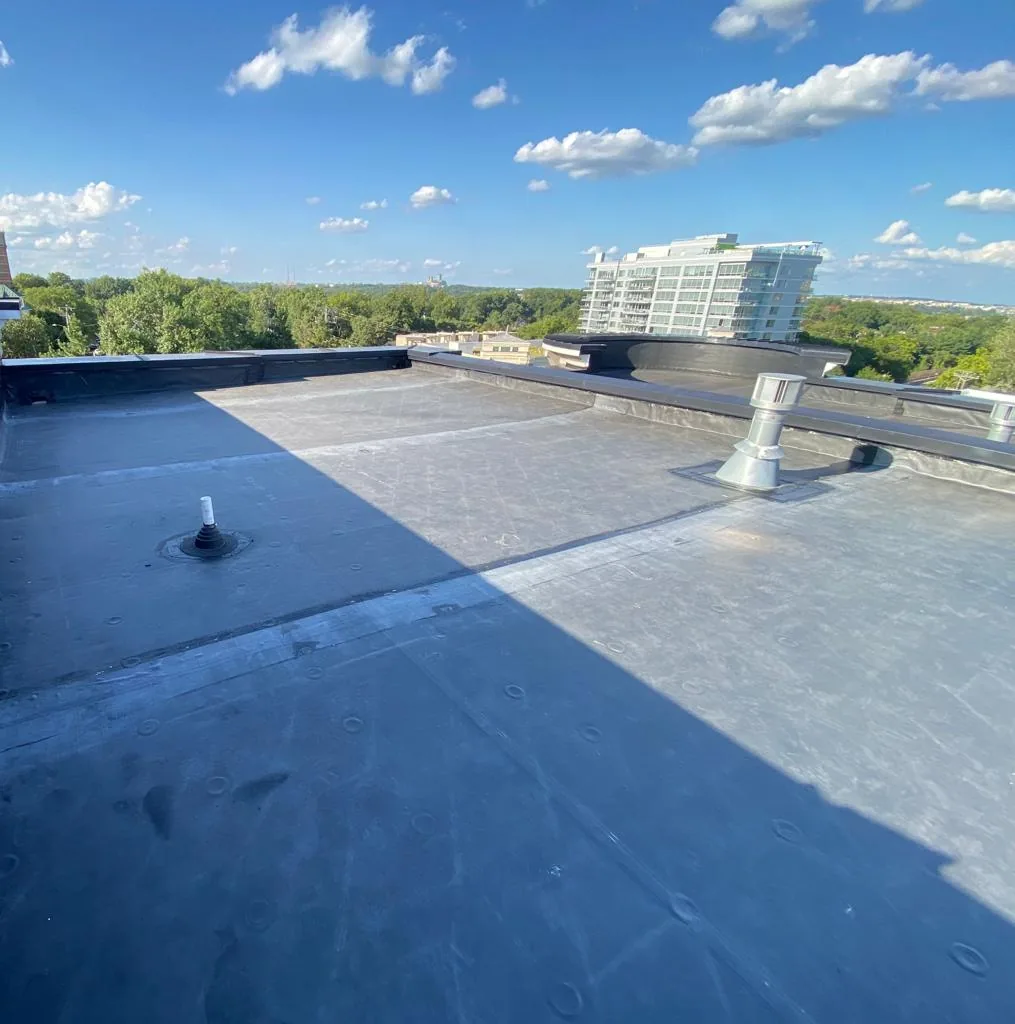
Some makers fabricate custom sections with factory-welded seams, which cuts the welding done on the roof. Other lines are fastened or adhered and welded on site. Which approach suits a building depends on its penetrations and access, and on what the maker offers.
When PVC is the wrong choice
- If dark rubbery flashing compound touches the roof, then separate it or remove it first, because it can embrittle PVC.
- If foam board insulation or bitumen will touch the sheet, then ask the maker, and get the answer in writing.
- If water stands for more than about two days after rain, then fix drainage before choosing any membrane.
- If there is no chemical exposure and the budget is tight, then TPO or EPDM often meets the need and PVC is not worth chasing.
A maintenance rhythm that fits Vienna weather
- Spring: clear drains and scuppers of leaf debris, check flashings and sealants.
- Early fall: repeat, before leaves return in earnest.
- After a hard storm: walk the roof. The overnight thunderstorm that sent gusts to 69 miles per hour around Tysons is the kind of event worth a look, though reports did not name Vienna roofs.
- Whenever a trade visits: photograph the roof before and after anyone services rooftop equipment.
Dominion Energy serves most Fairfax County residents, and outages after storms often come with tree and line damage, so check the roof from the ground first.
Two typical Vienna PVC projects
A small mixed-use building with a kitchen exhaust fan
The flat roof is about 2,400 square feet, with a restaurant exhaust fan near the back and grease staining around its base. The old membrane is near the end of its life. We would survey for rubberized flashing, choose a PVC with a chemical statement that covers kitchen exhaust, replace wet insulation, weld the sheet and flash the fan curb. The owner gets photos of the curb detail and the weld probe.
A three-story condo building with many penetrations
The roof is about 5,000 square feet with a dozen vent pipes, a few skylights and a walkway to the roof hatch. The board wants one contractor and few visits. We would order matched boots and accessories, schedule around residents, put walk pads on the hatch route and brief the board in writing on access. Permit scope is checked with the county first.
Permits change once the building is not a house
Virginia's building code exempts replacing any amount of roof covering on houses and similar R-3, R-4 and R-5 buildings, subject to a wind-speed condition, but for every building group it exempts only 100 square feet or less. A shop or apartment-style condo building re-roof above that is generally not exempt under the state rule, though the building official decides, and replacing more than 256 square feet of decking is not exempt even on houses.
Fairfax County is the building official inside the Town of Vienna. The Town's Planning and Zoning staff review zoning, and a change to roof height needs Town approval. Permit questions go to Fairfax County Land Development Services on 703-222-0801. See our permit guide and our note on choosing a flat roofing company.
Frequently Asked Questions
Why would a Maple Avenue shop or restaurant roof use PVC instead of TPO?
Mostly because of what lands on the roof. One maker describes its PVC as inherently resistant to oils and grease, and another lists enhanced chemical resistance. A TPO maker also states resistance to restaurant exhaust for its sheet, so the answer depends on the exact sheet and the exposure. We ask for the maker's chemical statement for your roof before choosing, rather than assuming either material wins.
Can PVC touch the old rubberized asphalt flashing on my flat roof?
No. One maker warns that rubberized asphalt can pull plasticizers out of flexible PVC, leaving it brittle and prone to cracking. The fix is to separate the two with metal or a compatible sealant, or to remove the old flashing. We look for dark rubbery flashing compounds during the survey, since they are easy to miss from the ground.
Does a condo association in Vienna need a county permit for a PVC re-roof?
Possibly. Virginia's building code exempts replacing any amount of roof covering on houses and similar R-3, R-4 and R-5 buildings, subject to a wind-speed condition, but for every building group it exempts only 100 square feet or less. A shop or apartment-style condo building re-roof above that size is generally not exempt under the state rule. Fairfax County is the building official inside the Town, so we confirm the scope with the county, and with the Town for zoning, before we start.
What does a PVC roof need after it is installed?
Regular looks. One maker's data sheet recommends inspecting flashings, drains and termination sealants at least twice a year and after each storm, and that cadence suits any single-ply roof. Keep drains clear, report new rooftop equipment before it is installed, and have anyone servicing exhaust fans take care not to scuff or spill. Photos of each visit also help a building's records.
How thick should PVC be on a small commercial roof?
Makers sell roughly 40 to 80 mil, depending on the line: one maker offers 50, 60 and 80 mil, another 60 and 80, and a third lists an 80 mil sheet. Thicker sheets resist punctures better where technicians walk to service equipment. A roof that sees little traffic may not need the thickest option. We match the sheet to traffic, penetrations and the warranty the maker offers for that system.
PVC roof calls from Vienna and the Tysons side
Reston Roof, based in Reston, looks at PVC roofs in the Town, in Tysons, where about three in four homes are in large buildings, and across Northern Virginia, DC and the Maryland suburbs. A Vienna mailing address can sit outside the Town, as Vienna Metro does, and then the county alone handles permits. Addresses along Lawyers Road or Courthouse Road still get a parcel lookup, because the mailing city is not the test. The full service area list has the rest.
Own a shop, condo building or kitchen roof in Vienna?
Tell us the roof size, what vents or exhaust sit on it and what the old surface is. We will say whether PVC deserves a quote. Call (571) 453-6515.
Book a Phone Consultation