Rubber roofing in Wolf Trap: is the old sheet worth saving?
Most of Wolf Trap's houses were built in the 1970s and 1980s, and a rubber porch, bay or garage roof added over the decades may now be at the age where owners start asking whether to patch it or start over. This page walks through the check we run on an old EPDM roof, the typical jobs that come out of it and the point where we would send you to a different material.
Five steps before anyone says patch or replace
- Find where water really enters. A stain inside rarely sits under the hole. Wall edges, drains and seams come first, the open field last.
- Count the layers and test what is under them. Wet insulation or a second old covering changes the answer, and the residential code bars a recover over a water-soaked roof or one that already carries two coverings.
- Look at every seam. Lifted tape, dirt trapped in the lap and open ends are the usual story on a rubber roof.
- Check the edges. Rubber shrinks a little with age, and a sheet pulled tight against a wall or curb tells us the flashing is under strain.
- Bend the sheet. A supple sheet takes a patch. A stiff or crazed one does not hold new tape for long.
If steps three and five come out well, a repair is a fair answer. If step two finds soaked board, the roof is coming off however good the seams look.
What age means for rubber, and for Wolf Trap's houses
The census estimates put almost six in ten Wolf Trap homes, about 59 percent, in the 1970 to 1989 window, and roughly 760 more in the 1990s. A rubber roof laid on an addition in 1996 is 30 years old this year. The trade association for EPDM, which has a stake in the answer, says aged sheets with 17 to 32 years of service were found watertight and puts the expected life of a well-built, well-kept roof at 38 years. One maker's guarantee terms, a different thing from service life, run from 15 to 30 years depending on thickness. So a 30-year-old sheet is neither doomed nor safe, and the test above decides.
A rubber roof can simply be what a previous owner chose for a porch or a garage, so each roof is judged on its own condition. Standard EPDM is black, which absorbs heat, and white versions exist for owners who want a lighter surface. In Fairfax County a light roof is a preference, not a code duty.
What you see, and what it usually means
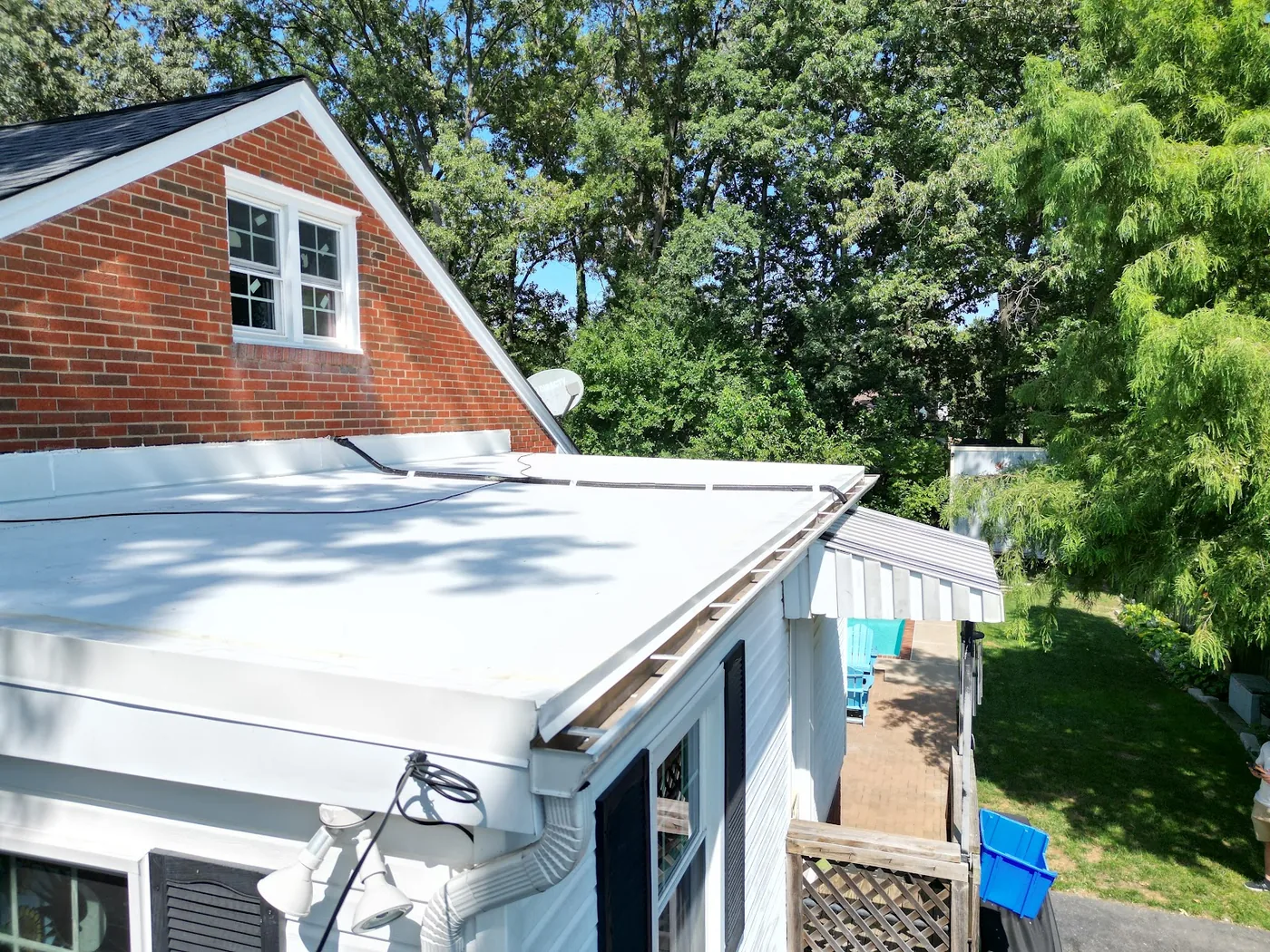
- Seam tape lifted along a wall, sheet otherwise soft: a repair is a reasonable option.
- Edge rubber torn or stretched tight above a door or window: the flashing needs rebuilding, which may be a small job or a clue the whole sheet has moved.
- Spongy feel underfoot: wet insulation or deck, so replacement, with the soaked layer cut out.
- Black streaks below a vent: something is discharging onto the roof. Cooking grease and oils are what rubber cannot take.
- Gravel or old tar under the sheet: layer count comes first, and the stone has to be swept or covered before a new membrane goes on.
Two typical Wolf Trap EPDM projects
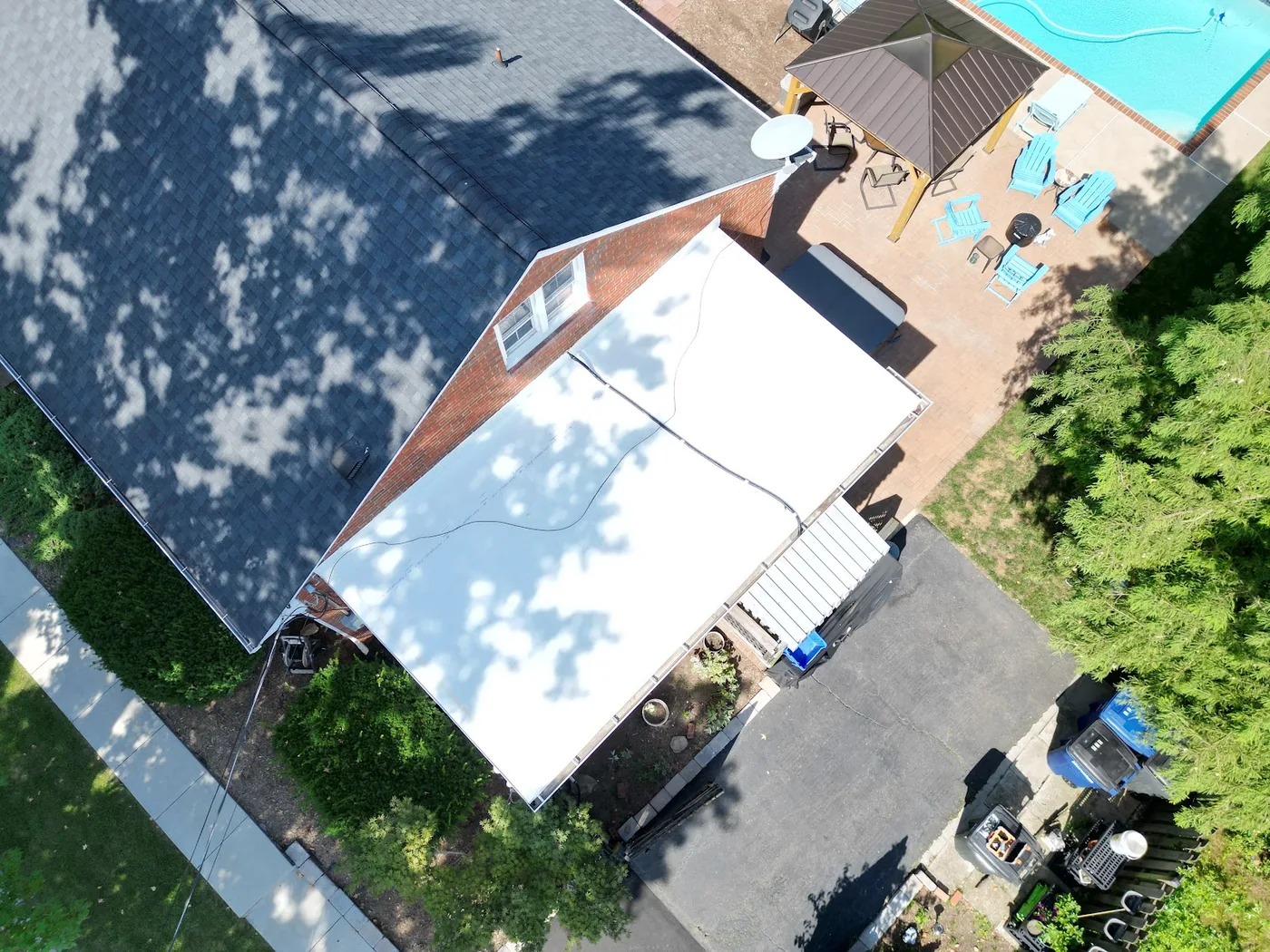
A 1990s rubber roof over a bay extension
The roof is about 150 square feet. A six-foot run of seam tape has lifted where the sheet meets the house wall, and rain runs in during wind. The rest of the sheet is soft and dry. We would clean the lap, prime it, press new tape and then set a termination strip along the wall. The owner sees photographs of the old seam, hears what the dry-sheet test showed and is told this is a repair that does not promise the sheet's remaining life.
A porch roof with a torn sheet and a soggy corner
The porch roof is about 180 square feet. A branch tore the sheet last season, and the deck near the drain gives underfoot. We would cut out the wet insulation and any soft plywood, put in new board, lay a 60 mil sheet in a single piece and finish the wall edge with fresh flashing. The owner gets photos of the deck before it is closed up and a note on keeping limbs and leaves off the surface.
Wind, limbs and who to call first
The wind history for the area is brief. On June 29, 2012, the derecho put a 71 mph gust on the Dulles gauge, and two days later a local newspaper reported thousands without power in Vienna and Oakton and roads shut near Beulah Road. On March 14, 2023, a wind advisory brought gusts above 50 mph. When a limb does land, call your electric company before going near a wire; Dominion Energy serves most county residents, but your bill names yours.
For the paperwork side, Wolf Trap is unincorporated Fairfax County, and Land Development Services is the building official. The county's list treats repairs and shingle replacement differently, so the scope should be confirmed with it first. The leak repair guide covers what to do while you wait for a dry day, and the permits guide explains the county's list.
Rubber Roof Questions From Wolf Trap Owners
How many years should I expect from a rubber roof put on in the 1990s?
Nobody can promise a number. A trade association for EPDM, which has an interest in the answer, reports aged sheets with 17 to 32 years of service still watertight and an expected life of 38 years for roofs that are well designed and maintained. One maker's guarantee terms run from 15 to 30 years by thickness. A sheet of that age may still be sound, so we test it rather than assume.
Can a lifted seam on a rubber roof be patched, or does everything come off?
Often it can be patched. The seam is cleaned, primed and re-taped, or a patch is set over the defect, on a surface that is dry. That works when the sheet is still supple and the insulation below is dry. If the sheet is brittle, torn in many places or sitting on wet board, patching only delays the leak.
How do you tell wind damage from ordinary age on a rubber roof?
Fresh punctures, clean tears and edges lifted along one side often point to a single event, while seams creeping open and a sheet pulled tight against walls point to age and shrinkage. Photographs of both patterns show which one a roof has, and that record matters for an insurance claim.
Does Fairfax County treat repairing a rubber roof differently from replacing it?
On paper, yes. The county's published list names roof repairs as permit work and shingle replacement as permit-free, while the state exemption for replacing roof covering on a house is described separately. A membrane project can land on either side of that line, so the exact scope should be confirmed with Land Development Services before work is scheduled, and the answer should not be assumed.
Is 45 mil enough for a roof I step on once a year to clear a gutter?
Often it is, if you step on a walk pad. Makers sell 45 and 60 mil, and one also sells 90 mil, with puncture resistance growing with thickness. A single yearly visit is light use. A roof you cross weekly, or one that collects branches, leans toward 60 mil. Who goes up, how often and with what decides the thickness.
Where we take rubber roof calls
Calls come from the Wolf Trap area and from Reston, Tysons, Great Falls and the rest of Northern Virginia. A roof near Trap Road or Towlston Road is no different to us from one off Beulah Road, since we start with the parcel and the sheet itself. When you write, a photo of any lifted seam and one of the wall edge speed things up. See the service area page for the full territory.
Old rubber roof, unsure whether to fix it?
Send the street, the rough age of the roof, where you see water and any photos of seams. That is enough to show whether a repair or a new sheet makes more sense. Call (571) 453-6515.
Book a Phone Consultation