TPO roofing in Wolf Trap: a welded white sheet for the flat parts of a house
Wolf Trap is a place of houses. The Census Bureau's 2020 to 2024 estimates count about 5,400 homes in the area, and 98.8 percent of them are detached. For roofing, that makes TPO a small-roof material here: the flat or barely sloped piece over a rear addition, a porch, a garage or a dormer top, sitting beside a pitched roof made of something else. This page covers which Wolf Trap roofs suit it, which do not and who reviews the work.
A thermoplastic sheet, fused at the laps
TPO is a plastic-and-rubber blend with a polyester fabric layer sealed inside. Because it softens under heat, the installer joins neighboring sheets with a hot-air welder instead of tape, and the lap becomes one piece. Makers sell it in 45, 60 and 80 mil, with white and tan the usual colors, and rolls run up to about twelve feet wide, so a porch or a small addition may need only a few seams.
Welding only works on clean material. A TPO roof that has weathered for years has to be scrubbed with the maker's cleaner before a repair weld will hold, which is why a proper TPO repair is a welded patch rather than a tube of sealant.
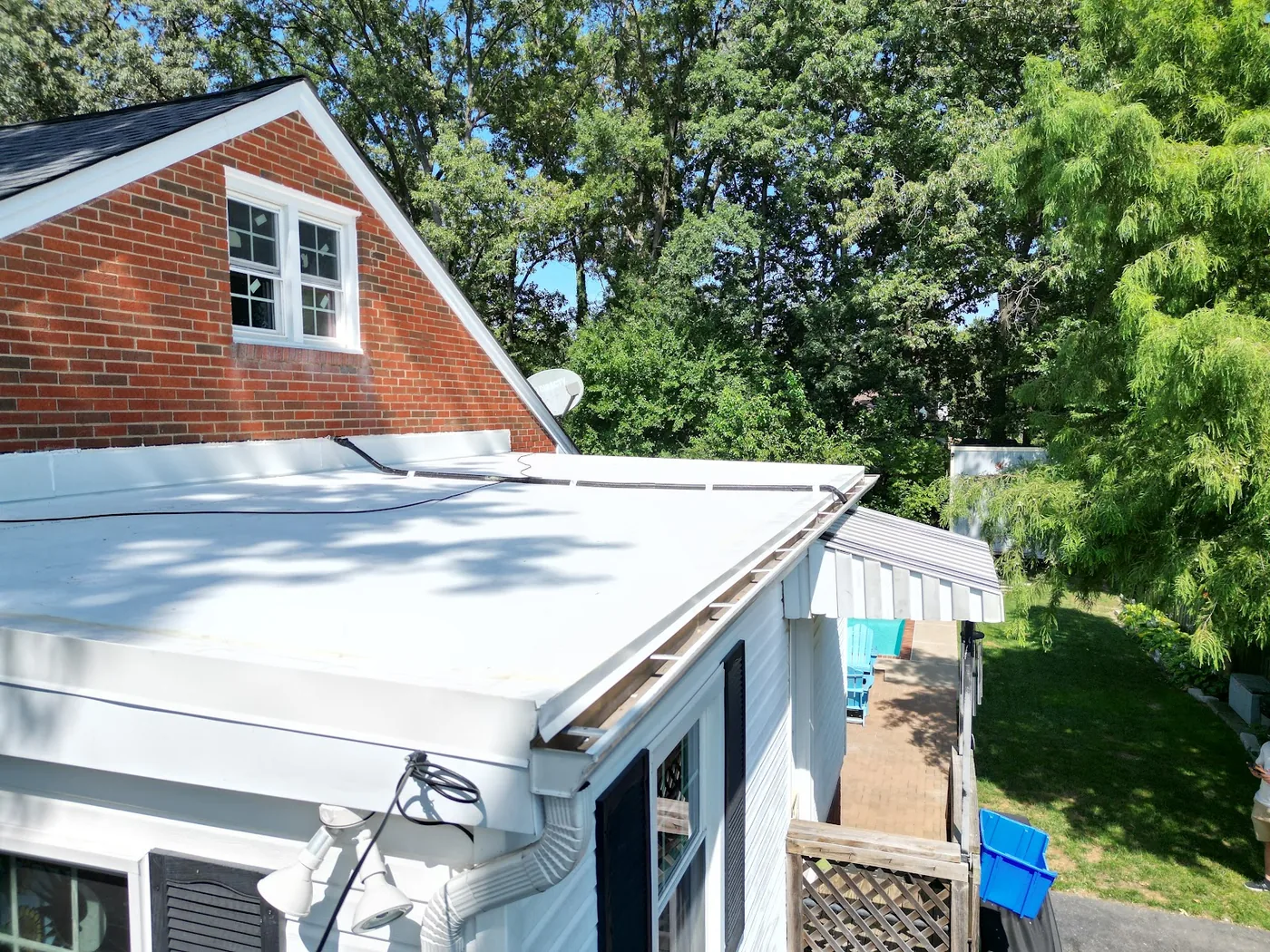
Does TPO fit the roof you have?
| The roof | Verdict | Reason |
|---|---|---|
| Flat porch or addition roof, light color wanted | Good fit | Wide sheets, few seams, welded laps |
| Low roof where water is still standing two days after rain | Fix drainage first | Ponding is hard on every membrane |
| Steep main roof on a two-story house | Wrong material | Single-ply is a low-slope system; shingles or metal suit a pitch |
| A roof people step across to reach a window or a unit | Fits, with pads | Scuffs and punctures start where feet land |
| A range hood or grill vent discharging onto the roof | Check the maker's chart | Grease resistance differs by product; see our PVC page |
A light roof is a choice here, not a rule. The 2021 Virginia energy code's cool-roof table covers climate zones 0 through 3 only, and Fairfax County sits in zone 4A. Whether a particular white or tan product carries an ENERGY STAR listing depends on the product and its color, so check the maker's listing for the exact product and color.
What a median year of 1980 does and does not tell us
The census estimates put the median year built at 1980. The 1970s are the largest decade, with about 2,025 homes, followed by the 1980s with about 1,170. Add the decades before 1980 and you reach roughly 2,740 homes, or 50.7 percent. Counted from today, a 1980 house is about 46 years old. These are survey estimates with real margins of error, so read them as round numbers.
The dates still help in two ways. A flat section that is original to a 1970s house is close to half a century old, so it has either been redone or deserves a close look. And TPO is younger than most of these houses, since a roofing institute dates its first ASTM standard to 2003. Any TPO on a house of that era is a replacement, and what lies under it may be tar, rolled roofing or another membrane, which is why we count layers and test for wet insulation before promising anything.
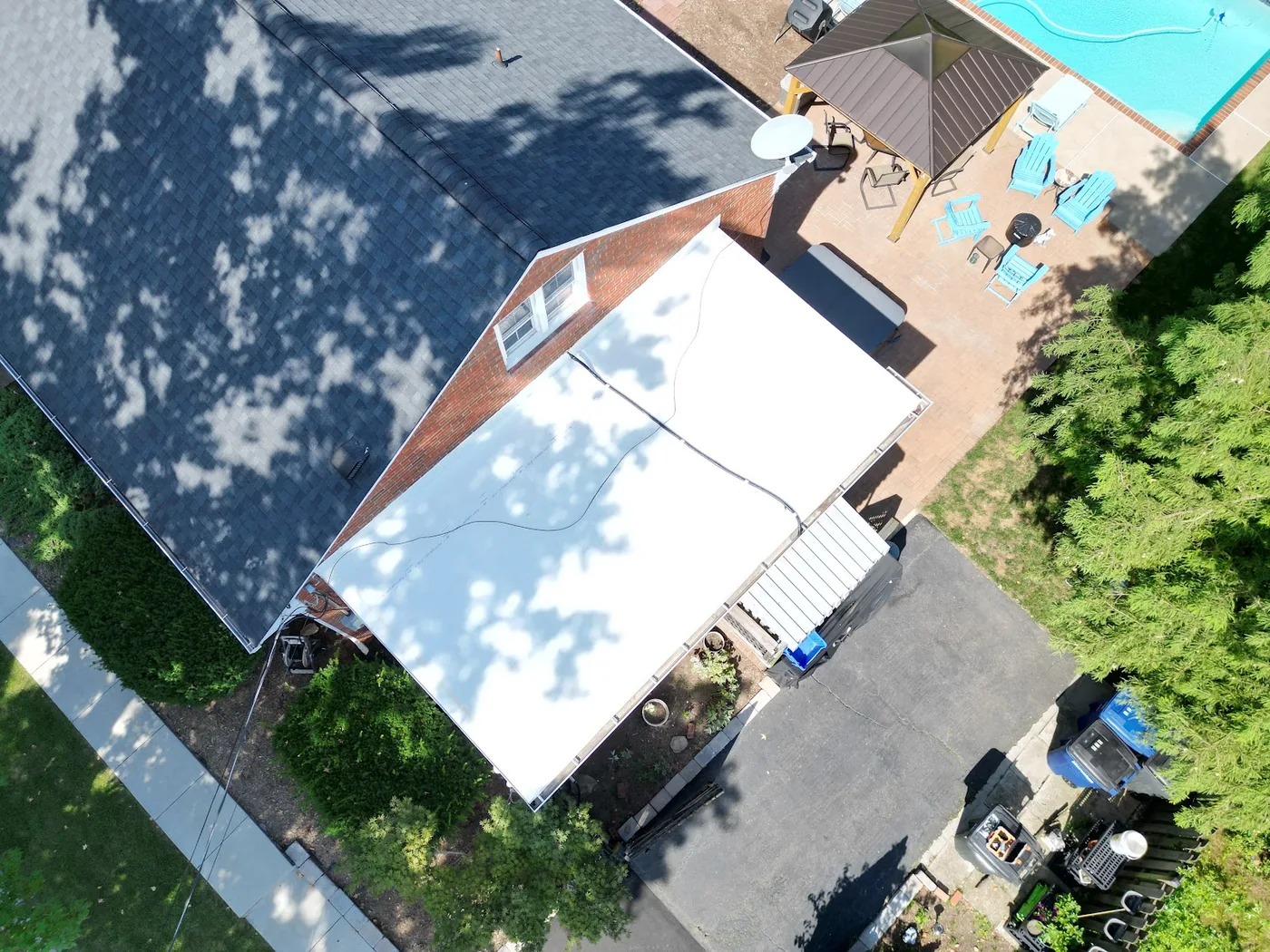
Two typical Wolf Trap TPO projects
A rear addition roof on a 1970s two-story house
The addition roof is about 200 square feet and almost flat, and one corner holds water for days. Old roll roofing has been patched more than once. We would strip to the deck, replace any soft plywood, test the insulation for moisture, lay tapered insulation so water runs to the drain and weld a 60 mil white sheet up the wall under new counterflashing. The owner sees the bare deck in photos before the sheet goes down and gets a sketch of where the drain and the walk pad sit.
A flat family-room extension with a chimney at one wall
This roof is about 320 square feet, with a masonry chimney rising through one edge and two plumbing vents. A stain appears near the chimney after hard rain. We would flash the chimney with welded corners and metal counterflashing, fit boots on the vents and settle on 45 or 60 mil according to how often anyone steps up there. The county lists chimney repairs as permit work, so whether the flashing alone counts should be settled with the county before a start date is set.
Who reviews it, and how we plan the visit
Wolf Trap has no town or city hall. It is a Census-designated place inside unincorporated Fairfax County, so Fairfax County Land Development Services is the building official even when an address reads Vienna. The county's list says replacing roof shingles needs no building permit and roof repairs do. A membrane over an addition falls between the two, so the exact scope should be confirmed with the office, and its answer sets the paperwork. Our permits guide shows how the pieces fit. The county's list of fifteen Historic Overlay Districts has none in Wolf Trap. If your street has a homeowners association, its approval is a separate step so check your documents.
For a visit, the roads that matter are Trap Road, Beulah Road and Towlston Road, with the Dulles Toll Road and Route 7 as the big connectors. A state widening of Route 7 closed Trap Road at Route 7 for a few days in April 2023, with Towlston Road as the detour. That is history now, but it shows how one closure pushes traffic onto its neighbors, so current road work is worth checking before a delivery of insulation board and rolls is booked. For slow leaks and the maintenance side of a flat roof, our flat roof maintenance article is a good companion.
TPO Questions From Wolf Trap Owners
Does TPO belong on a 1980 house, or is it only a commercial roof?
It suits low-slope roofs on any kind of building. On a house it covers the flat piece and never the main pitched roof. The Census count puts Wolf Trap at 98.8 percent detached houses, so a TPO job here is usually a porch, addition, garage or dormer top of a few hundred square feet, where wide sheets keep seams few. For the steep roof we would point you to shingles or metal.
A puddle sits on my flat porch roof for days. Will a new sheet cure it?
Not by itself. Roofing industry guidance treats water still standing two days after rain as a problem, and makers differ on how that affects a guarantee, so the fix starts with slope and drains. The fix may involve tapered insulation or a change to the drain or scupper before the sheet goes down. We check this before we quote, not after the new roof is wet.
How can I tell whether my flat roof is TPO, rubber or something older?
Look at color and seams. TPO is usually white, tan or gray, with flat welded laps. EPDM is black rubber, and its seams carry tape. Tar and gravel shows stones over black tar, and rolled roofing looks like a grainy sheet. Photos of the surface, an edge and a seam let us tell you which you have, and a roof of unknown age may need a probe for wet insulation.
My addition's flat roof needs a full replacement. Will Land Development Services want to see plans?
It depends on the scope. The county's published list names shingle replacement as permit-free and roof repairs as permit work, and a membrane over an addition sits between them. Replacing more than 256 square feet of decking is also outside the state exemption. The scope should be confirmed with the office before work starts, so you know whether a permit applies.
How do you choose between 45, 60 and 80 mil for a small roof?
Foot traffic and trouble spots decide. Makers sell all three, and lab puncture figures rise with thickness. A roof nobody walks on may do well with a thinner sheet. One with a hatch, an air handler or a chimney that gets serviced leans thicker, with walk pads where people step. We bring the options after measuring and seeing where feet will land.
Past the edge of the map
Wolf Trap shares its borders with Oakton, Vienna, Great Falls, Reston, McLean and Tysons, and flat-roof calls from any of them are welcome. A photo of the roof surface and one of the wall edge tell us more than a long description. The full service area list shows the rest of our territory.
Flat roof over an addition or porch?
Tell us the street, roughly how big the roof is, whether water stands on it and what is above and beside it. Those details show whether a welded sheet fits. Call (571) 453-6515.
Book a Phone Consultation