TPO for the flat parts of a Great Falls house, not for the whole roof
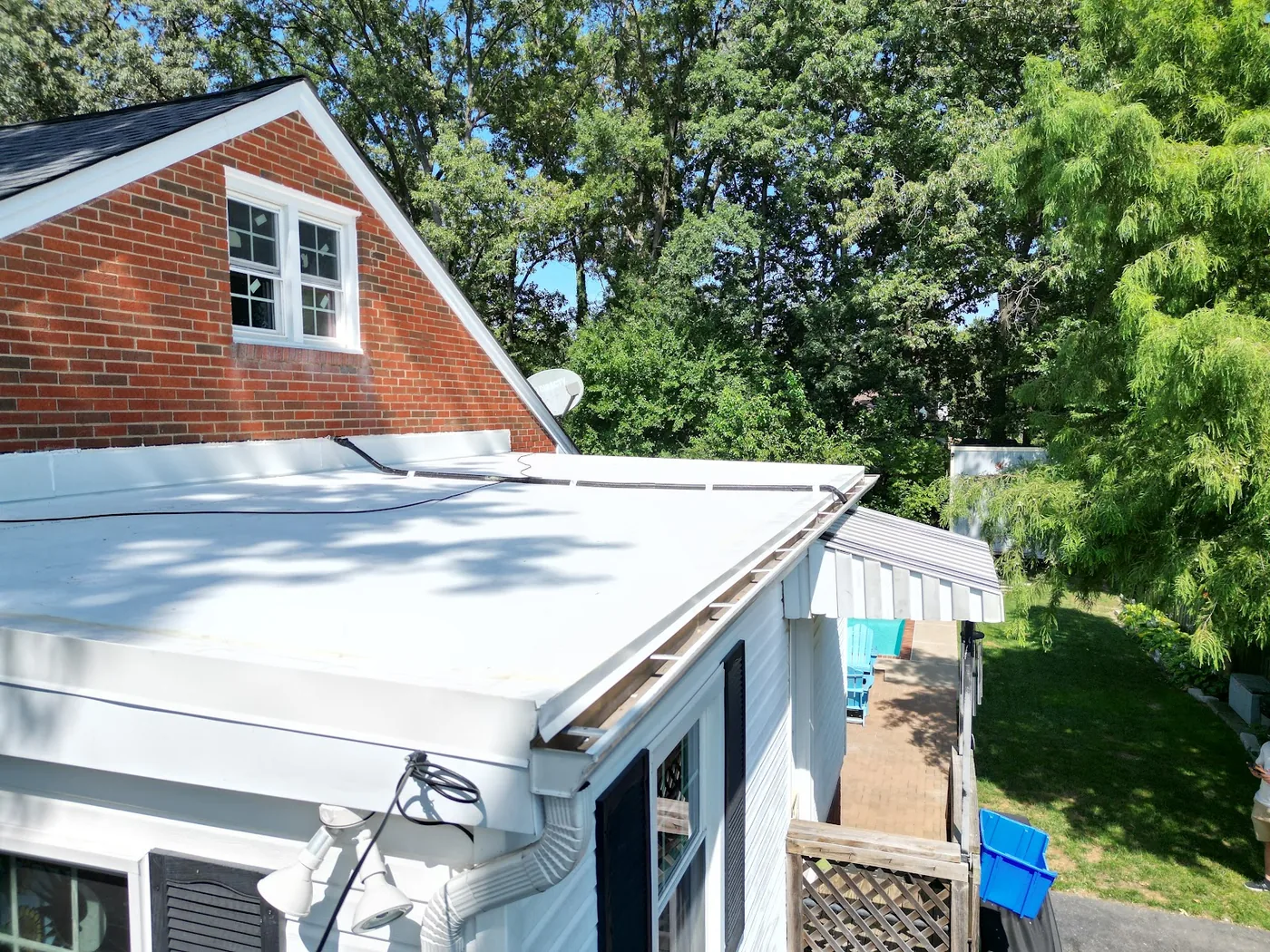
Most of a house roof is pitched, and TPO is not a steep-roof material. It is a white or tan sheet welded at the seams, made for the low parts: over a sunroom, a porch, a link to the garage or the top of a bay. Here is where it fits on these houses, where it does not, and who looks over the work.
Which roof section is it? A quick sort
| The roof section | TPO? | What we check first |
|---|---|---|
| Flat roof over a sunroom or screened porch | Usually a good fit | Whether water leaves the roof within a couple of days, and what layers sit under the old surface. |
| Low roof linking the house to a garage | Often a good fit | The tall wall it runs into, because the flashing up that wall is where leaks start. |
| Flat top of a dormer or bay window | Sometimes | Size and shape. A very small roof with odd corners may suit another material, and we compare. |
| The pitched main roof you see from the road | No | Shingles or metal are the right options for those planes. |
| A roof that keeps water for days | Not yet | Drainage first. A new sheet laid over a pond is still a pond. |
Houses from the 1970s to 1990s are old enough to have been altered
Great Falls is an unincorporated Fairfax County community, and the 2020 to 2024 census survey counts about 5,100 homes, of which 99.3 percent are detached houses. The median house was built in 1985. Around 70 percent come from the 1970s, 1980s and 1990s, and only 78 predate 1940. A membrane suits only the low-slope parts of such a house, such as a rear addition, a sunroom roof or a flat tie-in between two gables.
What the dates do suggest is a stock of houses old enough to have been altered. A sunroom, a screened porch turned into a family room or a garage connector each leaves a low roof behind, and those are the roofs a TPO sheet is built for. Getting to them means Georgetown Pike, Walker Road or Colvin Run Road, with Leesburg Pike at the southern edge of the community.
Three TPO details that decide how the roof ages
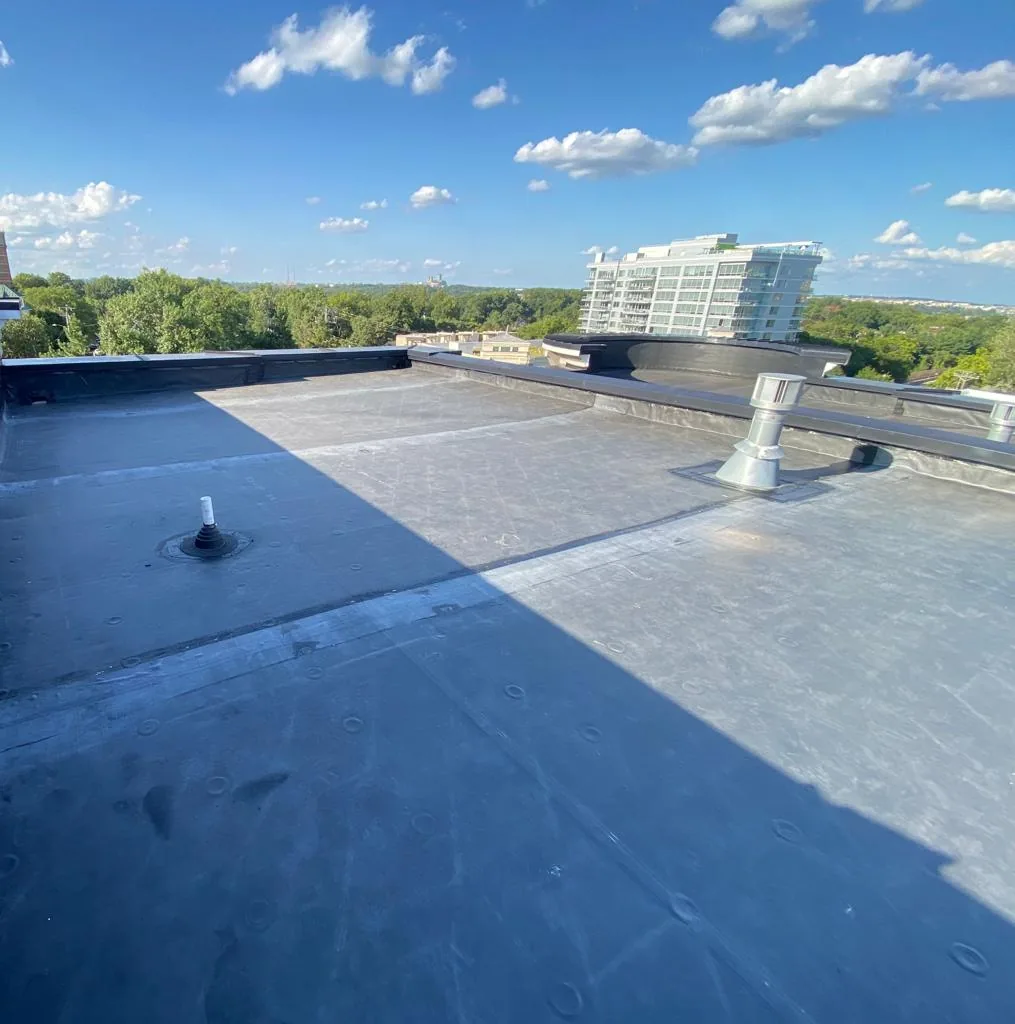
- Thickness. TPO is sold at 45, 60 and 80 mil. In one maker's lab figures the thicker sheets take more puncture force, and at some makers a longer guarantee term comes with them. A porch roof that nobody walks on can use less than a roof where you carry a ladder.
- The weld. Seams are joined with hot air, and the sheet must be cleaned first if it has weathered. One maker specifies a weld at least an inch and a half wide. Probing the edge of the weld after it cools is the usual check, because a clean-looking seam proves little.
- Ponding. Roofing trade guidance treats water that is still standing after about 48 hours as a drainage fault. Makers differ on whether it affects the guarantee, so read that clause before you sign.
TPO also has a shorter track record than EPDM rubber. A professional institute that studies roof performance notes that early formulations failed prematurely and that the first ASTM standard for it arrived in 2003. Current sheets are tested to tougher weathering requirements, though their field record is shorter than rubber's.
Two typical Great Falls TPO projects
A sunroom roof on a 1980s house, about 300 square feet
A brownish ring has appeared on the sunroom ceiling, and the single drain at the back corner clogs with leaf litter. The old sheet is cracked along the wall. We would open a few test squares, remove any wet insulation, correct the slope toward the drain with tapered board, weld a 45 mil sheet and flash it up the house wall. The owner sees photos of the bare deck before the new sheet goes down, a written scope, and a reminder to check the drain after the first autumn.
A low link roof between a house and its garage, about 120 square feet
Water has been getting in where the link meets the tall wall of the main house, and the owner has patched it twice. We would strip back the old flashing, inspect the deck edge, install a 60 mil sheet and flash high up the wall beneath its cladding. The owner sees photos of the wall detail and learns the one thing that matters most here: that flashing, not the open sheet, is where the roof will be tested.
Who looks at a membrane job here
Great Falls has no town or city hall. Fairfax County Land Development Services is the building official, whatever the mailing city says. The county's guidance puts shingle replacement outside the building permit list but roof repairs inside it. Since a flat roof job can read as either, the exact scope should be confirmed with the county before the first day, because a permit may apply.
Colvin Run Mill, near Colvin Run Road, has its own Historic Overlay District, and exterior work there goes to the county Architectural Review Board. It reads as a mill village rather than a neighborhood. Whether an ordinary house lies inside it is something we check by parcel. Our Fairfax County roofing permits guide explains the county side, and flat roof maintenance covers the upkeep afterward.
Questions About TPO on Great Falls Houses
Can TPO cover the small flat roof over my Great Falls sunroom, or is it meant for big roofs?
It works on small roofs too. Makers sell field sheets about 8 to 12 feet wide, so a sunroom roof can often be covered with only a few welded seams, and the perimeter is flashed up the walls. The real question is whether the roof drains. We look at the slope, the old layers and the drain before we recommend a sheet, and we tell you if a different material suits the space better.
Is replacing a flat membrane treated differently from swapping shingles at the county?
Possibly. Fairfax County guidance lists replacing roof shingles as work that does not need a building permit, while roof repairs appear on its permit list, and a membrane job is neither a plain shingle swap nor always a repair. Because the answer follows the scope, the exact scope is confirmed with Land Development Services before work starts.
Would TPO make sense on the pitched main roof of my house?
Almost never. TPO is a low-slope system, and one maker sells a separate high-slope formulation with extra flame retardant for steeper uses, which needs the maker's approval and rarely looks right from the street. For the pitched planes of a Great Falls house we would point you toward shingles or metal, and keep the membrane for the flat parts.
How do I find out whether the insulation under my old flat roof is wet?
Stains on the ceiling below are a hint, not a measurement. The usual way is to cut small test squares and look, and a moisture survey can map wet areas on larger roofs. It matters because a membrane is itself a vapor barrier, so wet insulation sealed under a new sheet stays wet. Residential code also bars a recover over a water-soaked roof, so soaked material comes out.
Does white TPO save energy on a Great Falls house, and does the county require it?
The county does not require it: Virginia's 2021 energy code applies its cool-roof rule only to the warmer climate zones, and Fairfax County is not in them. Certain white and tan TPO products are ENERGY STAR listed, but listing is product by product, and gray sheets can fall short. A shaded sunroom roof gains less than a sunny one, so color is a choice we talk through.
Related Services
If TPO is not the right sheet for your roof:
TPO in neighboring places, and further reading:
Where we come from to reach you
From our base in Reston we take calls across Great Falls, from the village around the Great Falls Library on Georgetown Pike out toward Riverbend Park on the Potomac River. A few photos of the flat section and the ceiling below it are often enough to start. The service area page lists the rest of our territory.
A flat roof leaking beside a tall wall?
Tell us the address, roughly how big the low section is and where the stain shows inside. We will say whether a welded sheet suits it or whether another material is the better call. Phone (571) 453-6515.
Book a Phone Consultation