EPDM in Leesburg: short answers first, then the roof check
EPDM is the black rubber sheet, and on a small roof it can be the simplest membrane there is. The catch is what it dislikes: oils, rough substrates and neglected seams. This page shows how that plays out on Leesburg houses.
Four quick questions about rubber roofing
Can one sheet cover my roof?
Often close to it. One maker sells rolls up to 50 feet wide by 100 feet long, and another offers sheets up to 10 feet wide with factory seam tape. A garage top or porch roof can end up with few field seams, and seams are where much of the trouble with rubber roofs starts.
Is black a problem?
Black is the standard color and a black sheet is not a cool roof. White EPDM exists, and one published product lists an initial reflectance of 0.77. If a light roof matters to you, ask for that product by name or look at another membrane.
Does rubber shrink?
A little. One maker's sheet data lists typical movement of about half a percent on 45 mil, within a limit of one percent. That is why edges, corners and wall flashings get extra attention.
How are seams joined?
With primer and seam tape, or splice adhesive. Rubber is cured, so it cannot be heat-welded the way TPO and PVC can. Cleanliness and curing time make or break each lap.
What we look at on the roof before quoting
- The substrate: it should be clean, dry and smooth, with voids over a quarter inch filled and no sharp edges.
- Anything that drips oil or fat onto the roof, from a kitchen vent to a grill beside the wall.
- Where water goes. The slope should be at least a quarter inch per foot, and any corner that holds water gets tapered insulation.
- Branches over the roof, and where leaves pile up.
- How many pipes, vents and wall tie-ins the sheet has to wrap.
- Soft deck, and whether the old roof has one layer or two.
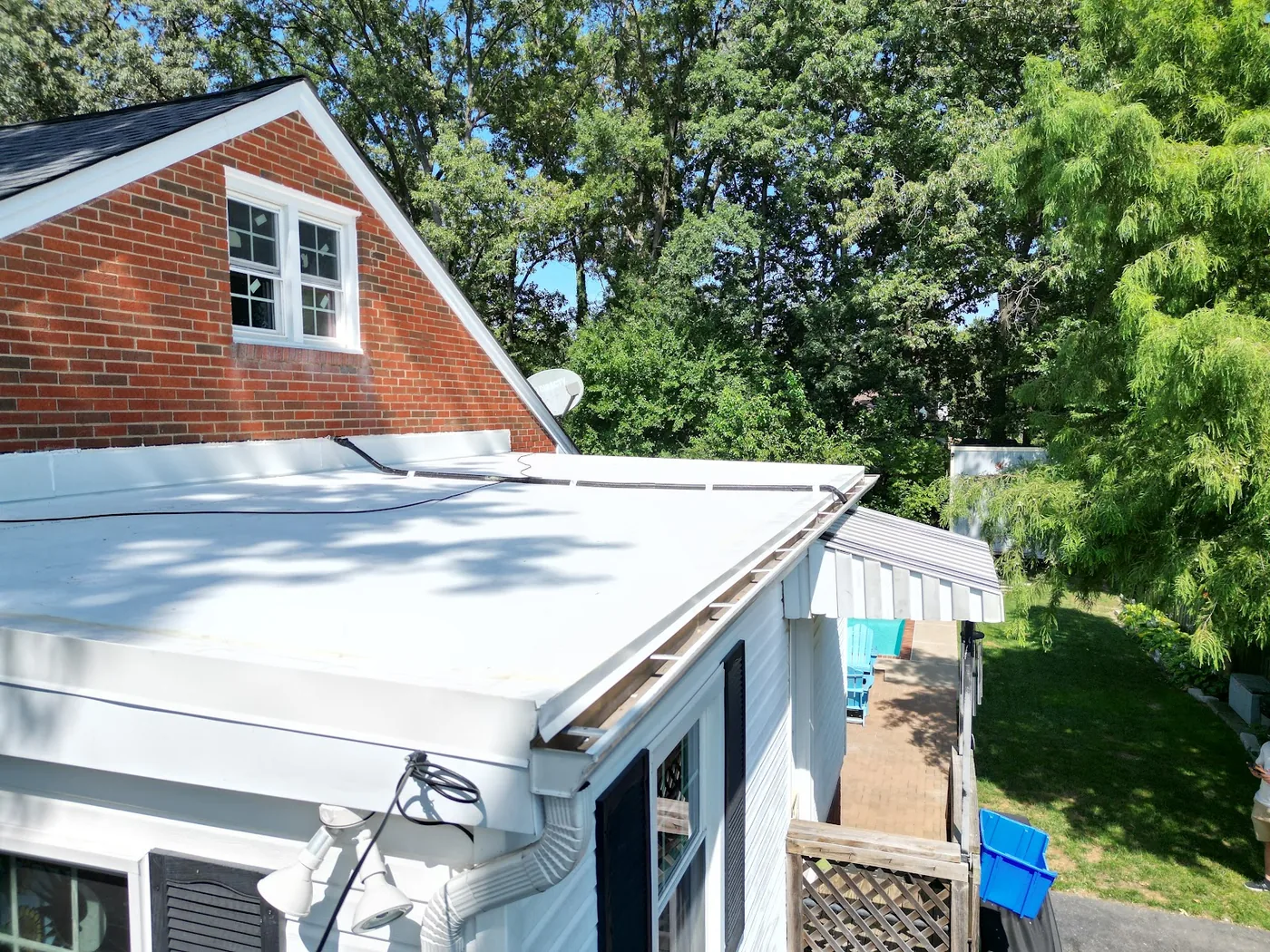
Trees and a thin black sheet
On February 7, 2020 the National Weather Service confirmed an EF-0 tornado in Leesburg, on a 3.3 mile path with winds up to 85 miles per hour. The reporting named damage between Lawford Drive and Nickels Drive and along Governors Drive and Country Club Drive in Greenway Farm and Linden Hill, with large limbs down and trees uprooted. In the Exeter townhouse community, roofing and gutters ended up in the streets.
Falling wood is the enemy of a 45 mil membrane. An urban canopy study using 2007 imagery found about 27 percent of the town under trees, most of it on residential land. If big limbs hang over a flat roof, we talk through trimming, a thicker sheet and a patch plan together. After a storm, whichever of Dominion Energy or NOVEC serves your address handles downed lines. Please call them before you climb.
Two typical Leesburg EPDM jobs
A garage top under an old oak
The roof is about 22 by 24 feet on a 1990s colonial, with one puncture near the scupper and a corner where leaves hold water. We would strip the old covering, check the deck, lay tapered insulation toward the scupper and cover the roof with one 60 mil sheet, so there is no field seam in the middle. Edge metal and the wall flashing finish it. The owner sees a photo of the puncture and a written suggestion to trim the limb above it.
A detached workshop with a low-slope roof
The building is roughly 12 by 16 feet behind a house. Because it is not a house, the state exemption for house roof covering may not apply, and replacing more than 100 square feet of covering is generally not exempt. We would ask Loudoun before we start, fasten or adhere the sheet as the maker allows, and leave the owner a one-page note on how to clear the drain.
Permits and the historic overlay
Loudoun County issues every building permit in the Town of Leesburg, so it is the office we ask about decking and scope. The Town handles zoning and historic review. Confirm with the Town whether a like-for-like re-roof needs a zoning permit before work starts.
Inside the Old and Historic District the Town requires a Certificate of Appropriateness for exterior work, and its own FAQ reads a little differently from its permit page, so the safe step is a call to the preservation staff. Our TPO versus EPDM article compares the two membranes, and the flashing installation guide explains why wall tie-ins matter so much.
Frequently Asked Questions
Do overhanging limbs ruin an EPDM roof, and does a thicker sheet help?
Limbs and falling debris are a puncture risk for any thin membrane, and the standard sheets start at 45 mil. Makers also sell 60 mil, and one sells 90 mil, which adds puncture resistance and weight. Thickness does not replace trimming, so we suggest an arborist visit if branches hang over the roof. Small punctures are patched with primer and tape on a clean, dry surface.
Can EPDM sit under a kitchen vent or beside a grill?
Not safely. One maker's precautions say greases, animal fats, vegetable and mineral oils and petroleum products must be kept off the membrane. If a kitchen exhaust or a cooking area discharges onto the roof, another membrane with published oil resistance is the better fit, and we will say so rather than sell you rubber. A plain porch or garage roof has no such exposure.
What is the difference between ballasted, adhered and fastened EPDM?
Ballasted sheets are held by stone and need a structure that can carry the weight, which a designer must confirm. Adhered sheets are glued to the substrate with bonding adhesive. Fastened sheets are screwed through plates into the deck. Makers list all three. Small house roofs are usually adhered or fastened, but the choice depends on the deck, the wind exposure and what the maker will stand behind.
Will the seams be the first thing to leak?
Trade press says seam trouble accounts for much of what goes wrong with EPDM, usually from dirt, talc left on the sheet, damp surfaces, thin primer or short curing. Those are workmanship problems, not fate. A very wide sheet also lets a small roof have few or no field seams, and we suggest an edge and corner check after the first season.
Can a flat porch roof in the Old and Historic District be changed to rubber?
Call the Town's preservation staff at 703-771-2773 before anything is ordered. The Town's design guidelines say most roofs in the district are steep, with shed and porch roofs the exception. Replacing a roof in kind can be a staff-level Certificate of Appropriateness, while a change of material can go to the Board of Architectural Review. We do not promise approval.
Small flat roofs in and around Leesburg
We look at rubber roofs on garages, porches and workshops in the Town, plus Ashburn, Lansdowne and Lucketts, which are unincorporated Loudoun ground where the county alone handles zoning and building. Purcellville, farther west, runs its own historic district process. For jobs near King Street and the Loudoun County Courthouse downtown, the delivery window needs planning before the truck leaves. See the service area page.
Small roof, big oak?
Send us a photo of the roof from the ground, the overhanging branches and the drain. We will tell you whether rubber fits. Call (571) 453-6515.
Book a Phone Consultation