TPO roofing in Leesburg: the flat parts of 1980s to 2000s homes
Most Leesburg homes were built after 1980, and many of them are townhouses. A low-slope section can turn up on a house like that, and this page is about when white single-ply membrane is the right answer for it.
Where low-slope roofs tend to sit in Leesburg
Census five-year estimates for 2024 put the median Leesburg home at 1993. About 63 percent of the town's units date from 1980 to 2009, 43 percent are detached houses and 29 percent are attached, townhouse-type homes. Only about one unit in ten was built before 1970. Flat and low-slope sections vary building by building.
Townhouse rows in Exeter and Potomac Crossing
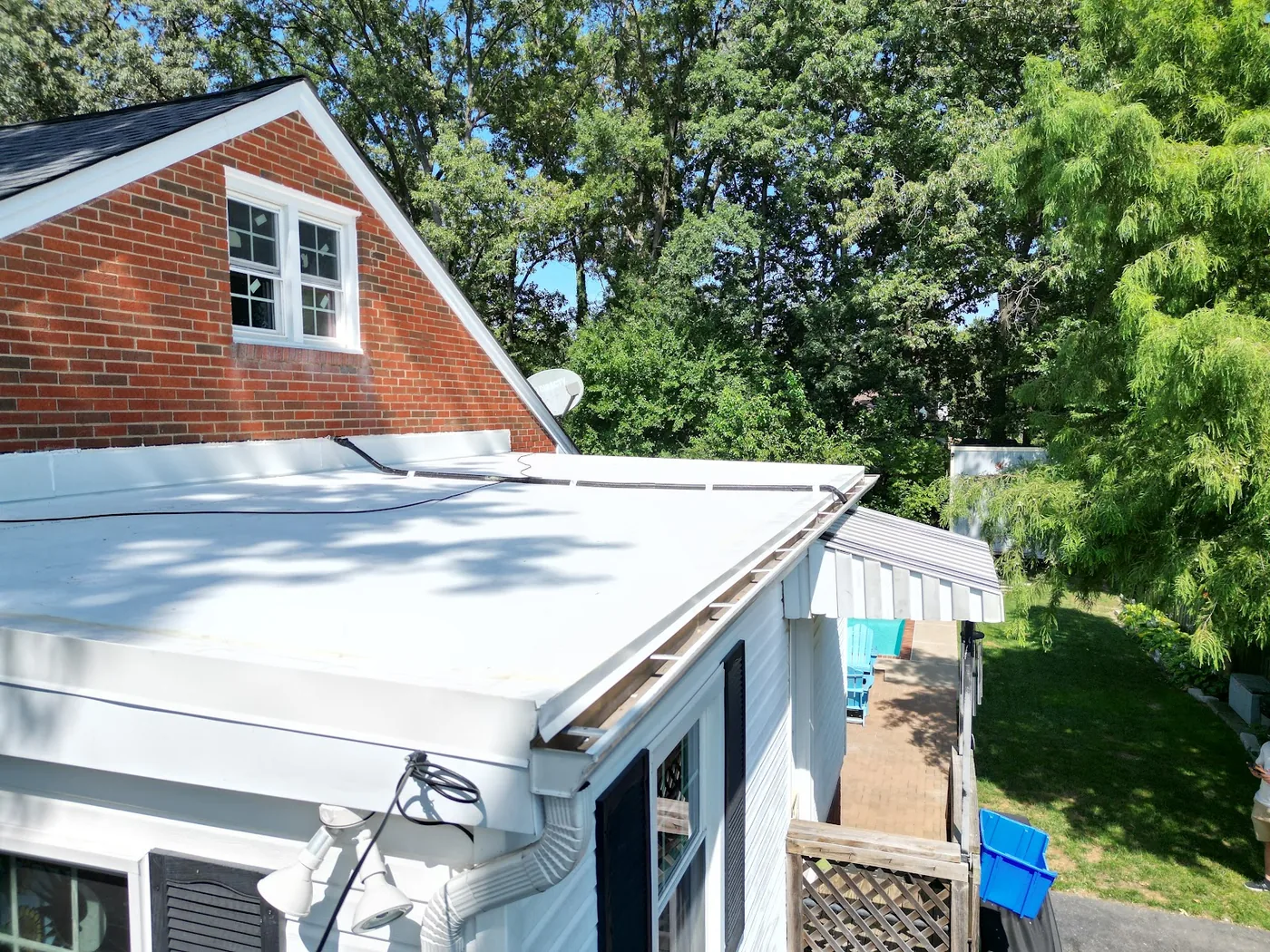
Exeter pairs 430 townhouses with 399 single-family homes, all built between 1984 and 1999, and Potomac Crossing mixes 385 townhomes with 536 houses built from 1988 to 2006. Rear bump-outs, small entry roofs and bay tops are the places a flat membrane can appear on homes like these. A shared wall means the flashing detail is where much of the risk sits.
Colonials with garages in Tavistock Farms
Tavistock Farms, in southwest Leesburg, opened in the mid 1990s with center-hall colonials, attached garages and some townhomes. A sunroom, mudroom or garage-top roof with a very low pitch would be the candidate for TPO there, while the main shingle roof stays as it is.
Buildings of five or more units
Roughly 24 percent of the town's units sit in buildings with five or more units, and buildings that size can have low-slope roofs. Battlefield Parkway runs along the east side of town and crosses Edwards Ferry Road, Fort Evans Road and Potomac Station Drive, which is worth keeping in mind when planning material drop-offs.
A TPO job in seven steps
- Find where water gets in. We probe the deck for soft spots and note every drain, vent and wall tie-in.
- Decide between recover and tear-off. A new covering over the old one is only an option when the old roof is dry and carries fewer than two layers, and on small sections we usually strip to the deck.
- Lay insulation, with a cover board if the design calls for one.
- Roll the membrane. Sheets typically run 8 to 12 feet wide, so a small roof needs few seams. It is fastened or adhered as that maker specifies.
- Weld the laps with hot air, cleaning weathered membrane first, then probe the edges.
- Flash walls, vents and edges with the same maker's parts.
- Walk the roof with you, photograph it, and look at the drains after the first rain.
TPO, or something else?
| If the roof is | Then |
|---|---|
| A pitched plane you see from the street | TPO is a low-slope product. A visible pitched roof wants shingles or metal, and steeper TPO uses need a high-slope sheet and maker approval. |
| A tiny porch or shed top where black is fine | EPDM comes in very wide sheets and can cover a small roof with almost no seams. |
| Under a kitchen exhaust fan or oil-laden air | Check the maker's chemical chart, and look at PVC, whose makers publish stronger resistance claims. |
| Holding water for days after rain | Fix drainage first. A common roofing-industry yardstick is no standing water 48 hours after rain, and guarantee wording on ponding varies by maker. |
| Walked on every week | Add walk pads. Thin sheets scuff and puncture where service crews step. |
Two typical Leesburg TPO jobs
A kitchen bump-out on a 1990s end-unit townhouse
The flat roof is about 150 square feet. An old coating has cracked and the flashing against the siding wall has pulled away, leaving one corner of the plywood soft. We would strip to the deck, replace the bad plywood, lay insulation, and mechanically attach a 60 mil white sheet with welded laps. The wall flashing is formed as its own piece. The owner sees photos of the wet corner, a written scope, and a note on whether the county needs to hear about the decking.
A one-story office suite with two rooftop units
The roof is about 1,800 square feet, with a drain at the low corner and a service path between two air handlers. A recover is possible only if a moisture check finds the insulation dry. If it is wet, we tear off that area. Walk pads go along the service path, and the owner gets the maker's instructions for the sheet before work begins. Because this is a commercial roof, the building permit question is a firm one, not a maybe.
Who signs off, in the order they appear
Inside the Town of Leesburg, the Loudoun County Department of Building and Development issues the building permits and inspects. Its counter is in the Government Center on Harrison Street SE. The Town's Community Development counter, on Catoctin Circle SE, handles zoning and historic review instead. Neither office publishes a roof-specific permit rule we could find, so Virginia's state code is what applies.
That code exempts replacing roof covering on a house in many cases, but not replacing more than 256 square feet of decking, and a commercial roof is not exempt once more than 100 square feet of covering is replaced. Fire-rated decking on a townhouse can also change the answer. We confirm the exact scope with Loudoun before we start. If the property is in the Old and Historic District, call the Town's preservation staff first. Our Loudoun County roofing guide and flat roof maintenance article add background.
Frequently Asked Questions
Can a townhouse bump-out roof get TPO without redoing the shingles beside it?
Usually yes. A flat or low section is a separate roof plane with its own deck, flashing and drainage, so it can be replaced on its own and tied into the neighboring shingles with proper flashing. On attached homes we also look at the shared wall and at whether the decking is fire-rated, because that can change who needs to be told. We check both on the roof before we quote.
How wide is a TPO weld, and how do you know it is good?
One large maker's instructions call for a hot-air weld at least one and a half inches wide at each lap. Weathered membrane is cleaned before it is welded, and the finished edge is probed with a tool to find any gap. Probing is how crews check their own work, and a manufacturer inspector may also look when a guarantee is involved. Ask to see the maker's instructions for the exact sheet.
Is every white TPO sheet ENERGY STAR listed?
No. Listing is by product and color. The program asks low-slope roofs for an initial solar reflectance of at least 0.65 and 0.50 after three years, and one maker's 2014 data sheet showed white and tan above that line but gray at 0.46 initial. Ask for the current listing of the exact sheet you are offered, and treat any claim that all TPO qualifies with suspicion.
How long does a TPO roof last?
Nobody has a verified median, so we will not promise one. Manufacturers publish guarantee terms, which for TPO run from 5 years up into the 20 to 30 year range depending on sheet thickness and system. A guarantee is not a service life. A professional institute notes that early formulations failed young while TPO roofs now exceed 20 years in service. Drainage, welds and flashing decide the rest.
Which office do I call before replacing a flat roof on a Leesburg house?
Start with Loudoun County Building and Development at 703-777-0220, because Loudoun issues building permits inside the Town. Neither the Town nor the county publishes a roof-specific permit rule we could find, so the state code applies and your exact scope decides. If the house is in the Old and Historic District, call the Town's preservation staff at 703-771-2773 first. It is worth making these calls before any work starts.
Flat-roof calls from Leesburg and the Loudoun side
We take TPO questions from townhouse and house owners in the Town, and from Ashburn and Lansdowne, which sit outside the Town in unincorporated Loudoun. For those two the county alone handles zoning and building. Parcel location decides, not the mailing city. The Dulles Greenway toll road ends at the Leesburg Bypass, which matters when planning delivery routes. See the service area page.
Have a flat section that leaks?
Tell us the street, roughly how big the flat part is and whether it shares a wall with a neighbor. A photo of the flashing helps. Call (571) 453-6515.
Book a Phone Consultation