TPO roofing in Sterling: townhouse backs, additions and small flat roofs
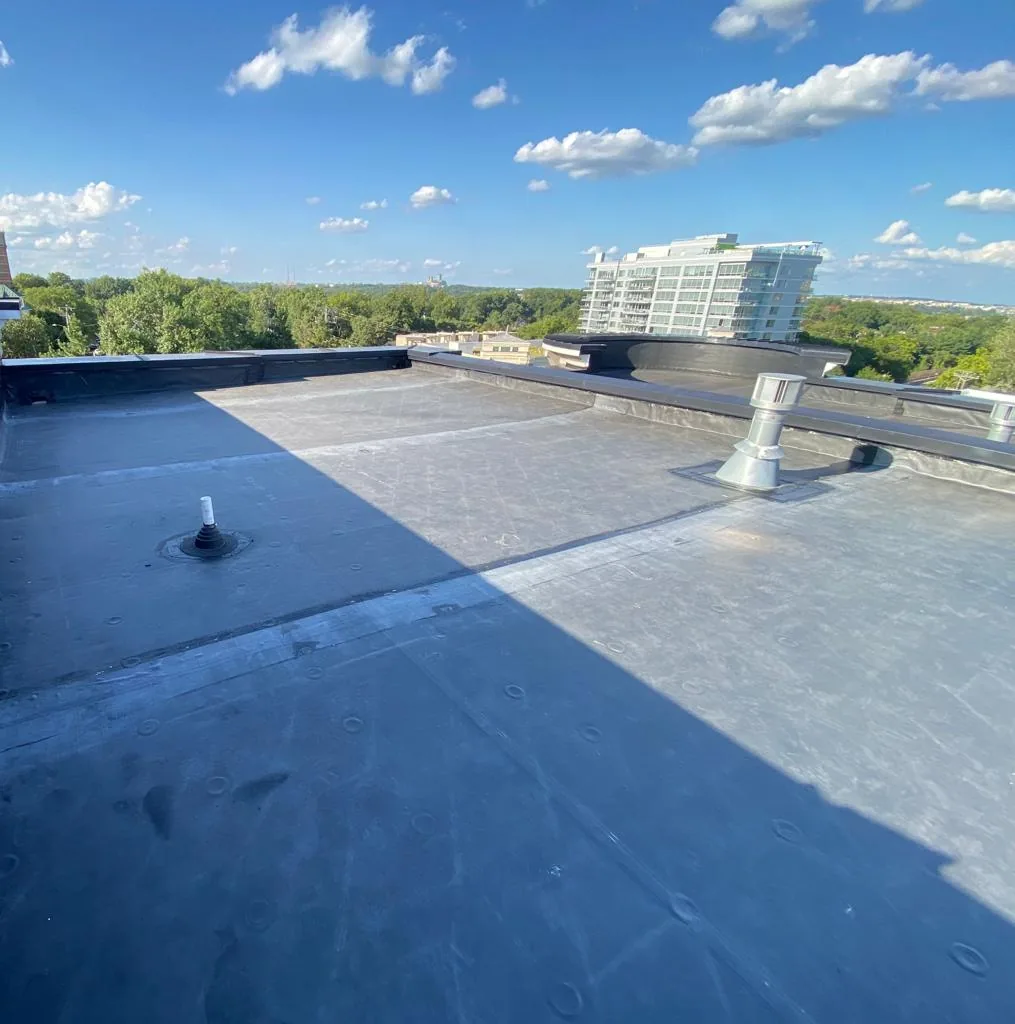
Most Sterling roofs sit on houses and townhouses, so TPO here usually means one small flat section. Here is where the membrane fits, where it does not, and what Loudoun County asks.
Who needs a membrane in a house market
The Census Bureau's 2020 to 2024 American Community Survey counts 10,102 homes in the Sterling census place: 50.2 percent detached, 31.4 percent townhouse-type and 14.4 percent in buildings of five or more units. The median year built is 1982, and the 1980s are the largest decade with 2,935 homes. That mix points to townhouse backs, additions and garage tops as the usual TPO candidates.
Our reading is that a house of that age often has a porch, addition or garage whose roof went on later, sometimes at a low slope, and that roof can be a different age from the shingles beside it. Those small roofs, plus the occasional condo building, are where TPO comes up.
Six areas with Sterling addresses, six different questions
Several are separate census places with Sterling mailing addresses. Loudoun permits them alike; the housing and the associations differ.
| Area | What the census and local records show | What it means for a flat section |
|---|---|---|
| Sterling Park | Land bought in 1961, first homes sold in 1963 by the Broyhill family; no single association verified | Older houses where a later porch or addition may carry its own low roof |
| Sugarland Run | 3,738 homes, 38.1 percent attached, median year built 1983 | Attached homes with any flat section; the Architectural Review Committee wants an application before a roof replacement |
| Countryside | 3,558 homes, 30.4 percent attached, median 1986 | Rear porches and garage tops; check association rules first |
| Cascades | 4,721 homes, 38.0 percent attached, median 1995 | Attached homes with a median build year of 1995; ask the association, since no roof rule was verified |
| Lowes Island | 3,954 homes, 40.8 percent attached, median 1997 | Newer attached homes; same advice, check with the association first |
| Dulles Town Center | 2,318 homes, 61 percent in buildings of five or more units | Condo buildings, where the house permit exemption may not apply |
When a membrane is the wrong answer
- If the surface is a steep, visible roof plane on a house, then shingles or metal fit better, because single-ply is a low-slope system.
- If the slope is under a quarter inch of fall per foot, then the design has to change first, since that is the code floor for thermoplastic sheet.
- If water still stands two days after a rain, then fix the drainage before buying any membrane.
- If grease from a restaurant fan lands on the roof, then ask the maker for a chemical statement covering that exposure, and consider PVC.
- If the roof is a tiny porch you want covered in one piece, then EPDM may suit it better.
Two typical Sterling TPO projects
A rear kitchen bump-out on an end townhouse
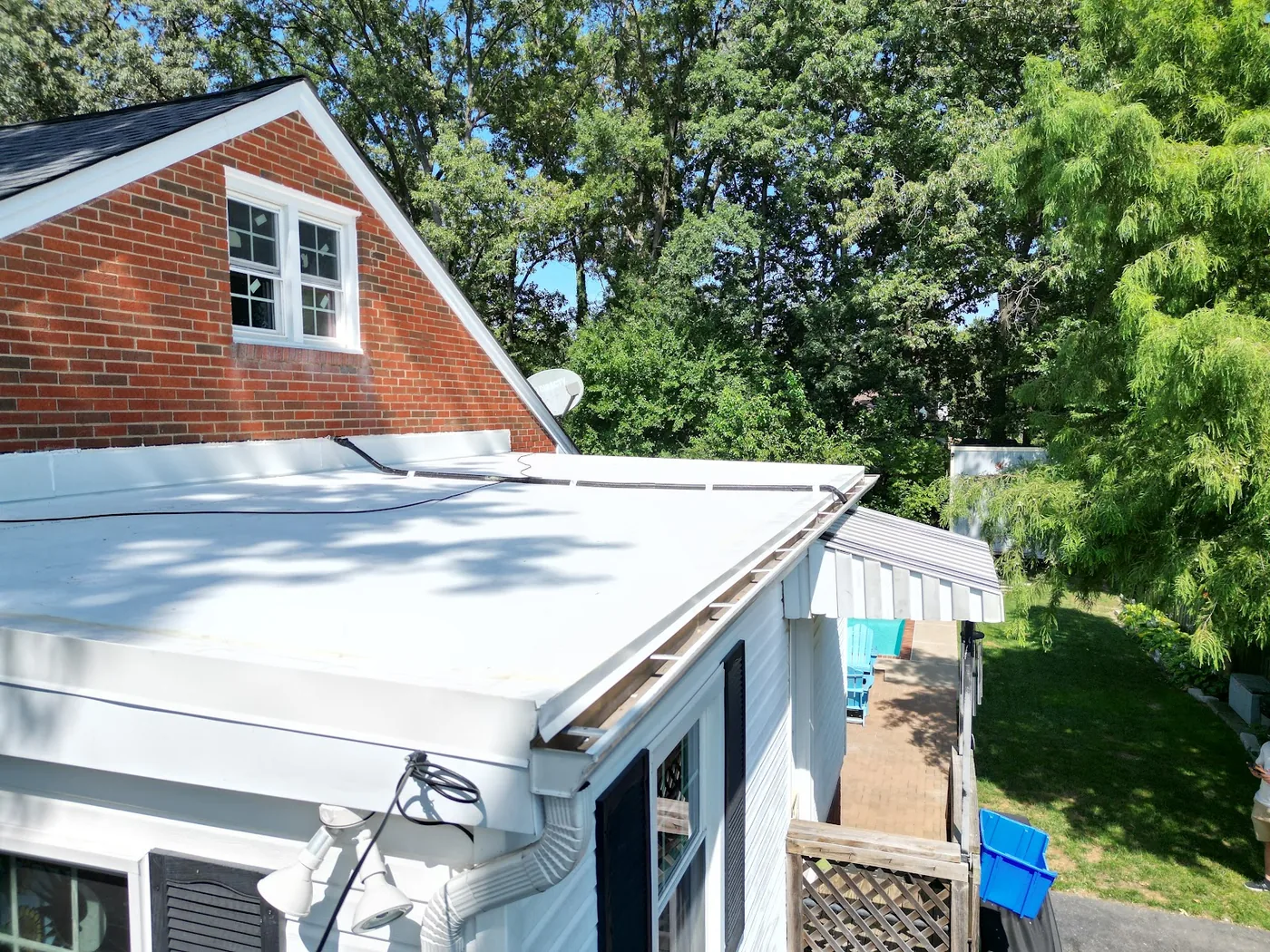
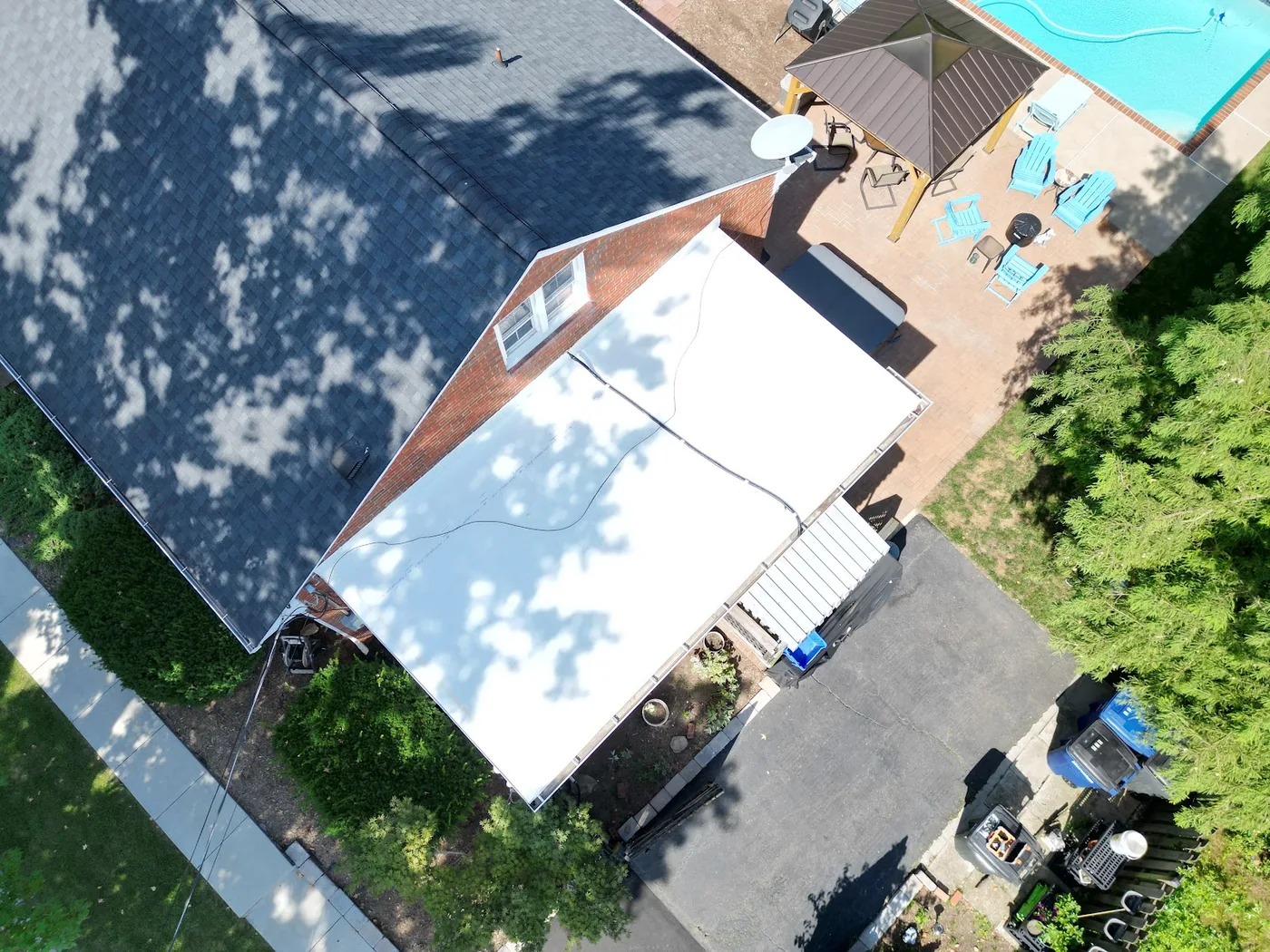
Picture a 1980s end-of-row townhouse with a flat roof of about 12 by 18 feet over the kitchen, and a ceiling stain that returns after each patch at the wall joint. We would open the old covering, test the insulation and decking for moisture, and check whether the plywood beside the shared wall is the fire-retardant-treated kind. If it is, the permit question goes to Loudoun before anything is replaced. If the community has an Architectural Review Committee, as Sugarland Run does, the application comes first. Then insulation, a welded sheet and new wall flashing.
A small one-story office with two rooftop units
The roof is about 2,800 square feet of old single-ply with split seams around two heat pumps. We would take moisture readings, replace wet insulation, weld a new sheet, rebuild the unit curbs and lay walk pads on the route from the hatch. Because it is a commercial roof, the state exemption covers only 100 square feet or less of covering, so we treat the replacement as permit work and confirm with Loudoun first. The owner gets photos of each curb and of the weld probing.
What Loudoun's pages say, and what they leave out
Sterling has no town government, so the Loudoun County Department of Building and Development is the only permit office. Confirm your scope with the county before work starts. Statewide, Virginia's building code exempts replacing roof covering on houses and similar R-3, R-4 and R-5 buildings, subject to a wind-speed condition, so confirm that point with the county too. It does not exempt decking beyond 256 square feet, or fire-rated decking of any amount.
Loudoun's monthly permit reports for early 2026 list several Sterling re-roofs, mostly with plywood replacement or on attached homes. A permit's existence does not prove one was required, because the state code lets an owner or agent request a permit even for exempt work. For commercial roofs the exemption is narrow, only 100 square feet or less. See our Loudoun roofing guide.
A TPO job from first look to last walk-through
- Before a quote: a level reading of the slope, photos, and moisture checks where a ceiling is stained.
- A written scope naming insulation, attachment method, flashings and walk pads. Any manufacturer guarantee terms for the system come to you in writing.
- Permit and association questions settled with Loudoun and your community before materials are ordered.
- Install: tear-off or recover, chosen from the moisture findings, then insulation and sheet, with the seams fused using a hot-air welder.
- Finishing: every seam edge probed, flashings last, then water run at the drain or scupper to confirm it leaves.
- A walk-through with photos of the details that will be hidden by morning.
Water that stays on a roof beyond roughly 48 hours after rain is treated by roofing trade guidance as harmful, and manufacturers differ on whether it affects a guarantee. So we check low spots before we choose a sheet. Our note on TPO versus EPDM covers the trade-offs.
Frequently Asked Questions
If the plywood under my flat roof is wet, does that change the permit answer?
It can. Virginia's code exempts replacing up to 256 square feet of roof decking on houses, but not decking that had to be fire-retardant-treated when the building was built, and townhouse roofs sometimes have it. Loudoun's own permit reports show Sterling re-roofs permitted where plywood was replaced. We count the wet sheets during the tear-off survey and raise the question with Loudoun before any decking comes off.
How thick should TPO be on a roof the size of a one-car garage?
Makers sell 45, 60 and 80 mil sheets. One maker measures the plastic over the fabric core at 0.018, 0.024 and 0.034 inch, and its lab puncture numbers rise with thickness. Those are laboratory figures, not promises about boots and ladders. A small roof that nobody walks on may not need the heaviest sheet. A roof with a path to a heat pump usually earns the thicker one plus walk pads.
What does probing the seams of a Sterling TPO roof actually check?
TPO laps are fused with hot air, and one maker describes a weld at least 1.5 inches wide. Weathered sheet has to be wiped with the maker's cleaner first, since dirt keeps the plastic from fusing. After welding, the installer runs a probe along the seam edge to find any open spot, and the maker may inspect for the guarantee. Ask to see photos of the probing.
My association approves roof colors. Can I still choose a light TPO?
Bring the approved palette. White, tan and gray are standard sheet colors at a major maker, and Sugarland Run publishes approved roofing colors on its association forms page. ENERGY STAR listing depends on the exact product and color, so ask for what the maker publishes for the sheet in your approved shade.
How many years will a TPO flat roof last in Sterling?
No single number applies. One maker lists guarantee terms of 5 to 20 years on its 60 mil sheet, and a professional institute reports TPO roofs now past 20 years in service while noting that early formulations failed young. A guarantee is not a lifespan. Drainage, welds, flashing details and cleared drains decide a lot, and any manufacturer terms come to you in writing.
Flat roof calls around Route 7 and Route 28
Reston Roof works from Reston and covers Sterling, including addresses off Route 7, Cascades Parkway and Algonkian Parkway, plus the Loudoun County Parkway side near Dulles Town Center. A Sterling mailing address can belong to a different census place, so confirm your parcel and county before planning. The full service area list has the rest.
A flat section leaking over a Sterling kitchen or garage?
Tell us the address, the size of the section and where the stain shows. We will say whether TPO deserves a quote. Call (571) 453-6515.
Book a Phone Consultation