PVC roofing in Chantilly: when the roof has more going on than a roof
Most Chantilly roofs do not need PVC. A few do: those with a fan venting onto them, a thicket of pipes, or a history of patches. This page is about telling the difference before anyone orders a sheet.
Three questions to settle before choosing PVC
- What lands on the roof? Kitchen exhaust, a dryer vent, a grill or a mechanical unit's condensate each ask something different of a membrane.
- What is already up there? Old rubberized flashing, tar and foam board all react differently with a plasticized sheet.
- How many holes does the roof have? Every pipe, curb and conduit is a place for a leak, and a roof with a dozen of them behaves very differently from one with none.
If the answers are nothing, nothing and almost none, we will probably point you to TPO or EPDM. That is not a sales dodge. PVC is a good material, and it is more material than a plain porch roof needs.
Which Chantilly buildings raise those questions
Townhouse rows and small condominium buildings
About 23 percent of the homes in the Chantilly area are attached townhouses, and another 9 percent, 679 homes, sit in buildings of five or more units. Those buildings can have flat or low sections with a cluster of vents and a shared wall. The roof may belong to an association, so the decision usually runs through its board.
Office roofs in Westfields
Westfields is a business park of mostly offices along Westfields Boulevard. One 166,380 square foot office on Park Meadow Drive dates from 1989, and a 69,679 square foot office on Newbrook Drive was built in 1999. Where an office roof does have a low slope, rooftop units and exhaust, PVC is one of the systems that gets a look.
Houses with a kitchen addition
A detached house is more likely to need TPO or EPDM on a small section. If the addition holds a range hood that vents through the roof, that exception is the one that sends us toward PVC.
The sheet, the weld and the old flashing
PVC is a plasticized thermoplastic, usually reinforced with polyester scrim. Makers list thicknesses from 40 up to 80 mil, with 50, 60 and 80 mil common. Laps are fused with hot air, and one maker makes the bottom ply gray so a good weld shows. Weathered or dirty sheet needs a cleaner before welding.
The plasticizer is also the weak point. Contact with rubberized asphalt can draw it out, leaving the sheet brittle, so we remove old flashing or separate it from the PVC with metal. Whether polystyrene insulation or bitumen needs a separator varies by maker, and we ask before we promise.
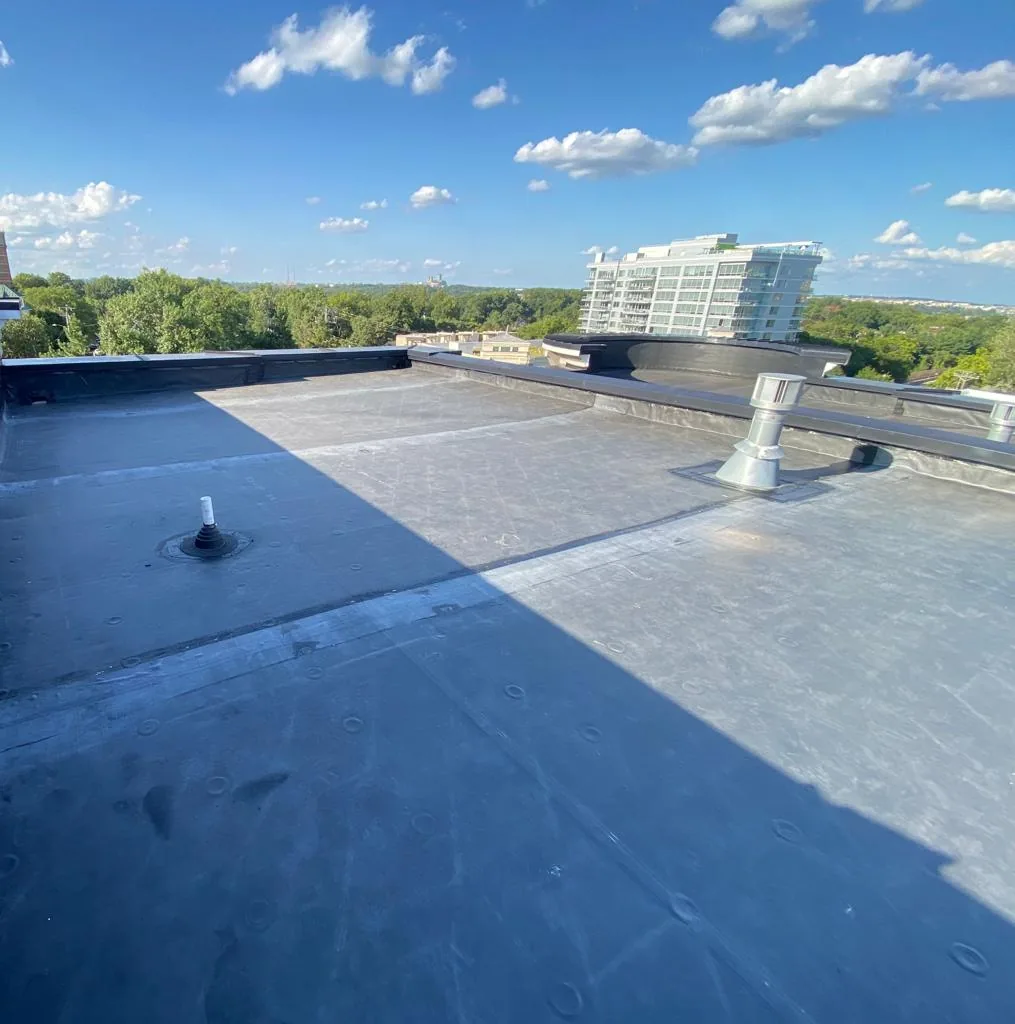
Two typical Chantilly PVC projects
A row of townhouses with rear flat sections
The roof section is about 300 square feet per unit, with two plumbing vents and an old black patch at each. The board has asked about leaks near the party walls. We would remove the patches, install prefabricated boots where the maker allows, weld a 60 mil sheet and photograph each lap. The manager gets one written scope for the row and a note on deck rating, which could bring in the county.
A low office roof near Westfields Boulevard
The roof is about 2,200 square feet with three rooftop units and a kitchen exhaust from a ground-floor tenant. After a moisture survey we would cut out wet insulation, rebuild the curb flashing and weld a PVC sheet with walk pads on the service route. Because it is a commercial roof, the permit question is a firm one, and the owner would see it in the scope.
Who decides, who reviews
For a townhouse association, the board usually hires the roofer. For an office, the property owner does, often with tenants whose equipment sits on the roof. Most of Chantilly is unincorporated Fairfax County, so Fairfax County Land Development Services is the building official. A Chantilly address in ZIP 20152 may be in Loudoun County, and we confirm the parcel before saying more.
Associations set their own roof rules. Ask for your governing documents and read them before work is scheduled. Our commercial roof maintenance checklist and roofing warranty guide explain what a maker's paperwork does and does not promise.
Frequently Asked Questions
Is PVC overkill for a townhouse roof section with one plumbing vent?
Often, yes. PVC fits when grease, many penetrations or chemical exposure are in play, and one vent pipe is none of those. For a quiet section TPO or EPDM may fit instead of the heavier-duty option.
If a Chantilly building vents a commercial kitchen, does the whole roof need PVC?
Not necessarily. We would read the maker's chemical guidance for the exact membrane, see where the exhaust lands and look at how much of the roof it touches. PVC is the material makers describe as resistant to oils and grease, but resistance depends on the product and exposure. A grease pan or a relocated fan may matter as much as the sheet.
Why do some PVC quotes show gray membrane and others white?
Color changes reflectance. One maker's data show white PVC near 0.87 initially, while its gray sheet is 0.59, below the 0.65 line ENERGY STAR sets for low-slope roofs. Virginia's energy code does not require a cool roof in Fairfax County, so color is a choice, not a mandate. Ask for the current listing of the exact product.
Does a commercial roof in Chantilly need a permit when a house reroof might not?
Probably, yes. Virginia's code exempts replacing roof covering on a house in many cases, but it exempts only 100 square feet or less on other building groups, and county guidance lists roof repairs as permit work. We confirm your exact scope with Fairfax County Land Development Services, or the county that holds the parcel, before we begin.
Can the old black flashing around my vents stay under a new PVC sheet?
Not touching it. A major maker warns that rubberized asphalt can pull plasticizers out of flexible PVC, leaving it brittle, and says to separate the two with metal or a compatible sealant. Old flashing should come off where possible. Other insulation or bitumen should not be assumed safe, so check with the maker before pairing them.
Getting to the roof
Office work in the Westfields area means thinking about Route 28 traffic and where materials can wait. We ask property managers what the site allows before planning a lift or a staging area. For nearby places, see the service areas page.
A crowded roof that keeps leaking?
Tell us what vents onto it, how many pipes come through it and what covers it today. Photos of the flashing help. Call (571) 453-6515.
Book a Phone Consultation