TPO roofing in Chantilly: the low corners of a 1980s suburb
Chantilly grew mostly in one decade. Census estimates count about 44 percent of its homes as built in the 1980s, and nearly all of those roofs are pitched. TPO is for the parts that are not: garage tops, rear additions and small flat sections.
Reading the Chantilly housing numbers for flat roofs
The Census Bureau's 2020 to 2024 estimates for the Chantilly area count 7,598 homes. The median was built in 1987, and 3,326 of them date from the 1980s. About 61 percent are detached houses and 23 percent are attached townhouses, so most of the roofs we see are on families' own houses. Roof material and age vary from house to house, so each roof is assessed on its own.
What the numbers do tell us is where low-slope sections hide. A 1980s colonial can have a side-entry garage or a rear bump-out whose roof is much flatter than the main roof, and a townhouse may have a small flat rear section. A real-estate listing site dates Poplar Tree Estates, off Poplar Tree Road, to roughly 1979 through 1993. We treat that as a loose guide, not a record, and we look at each roof.
What we look at before we put TPO in a quote
- The slope. Thermoplastic single-ply needs at least a quarter inch of rise per foot under the Virginia residential code, and we measure rather than eyeball.
- The deck. We press along the plywood for soft spots, especially at the low edge and around old flashing.
- The drains and scuppers. Water standing for two days after rain is a drainage problem to fix first, not something a new sheet cures.
- The layers. If the roof already has two coverings, or the lower one is wet, the old material comes off.
- The wall. Siding, brick or a party wall meets the roof here, and the flashing detail carries most of the leak risk.
- The traffic. If a person will walk the roof to reach a vent or a satellite dish, we plan walk pads.
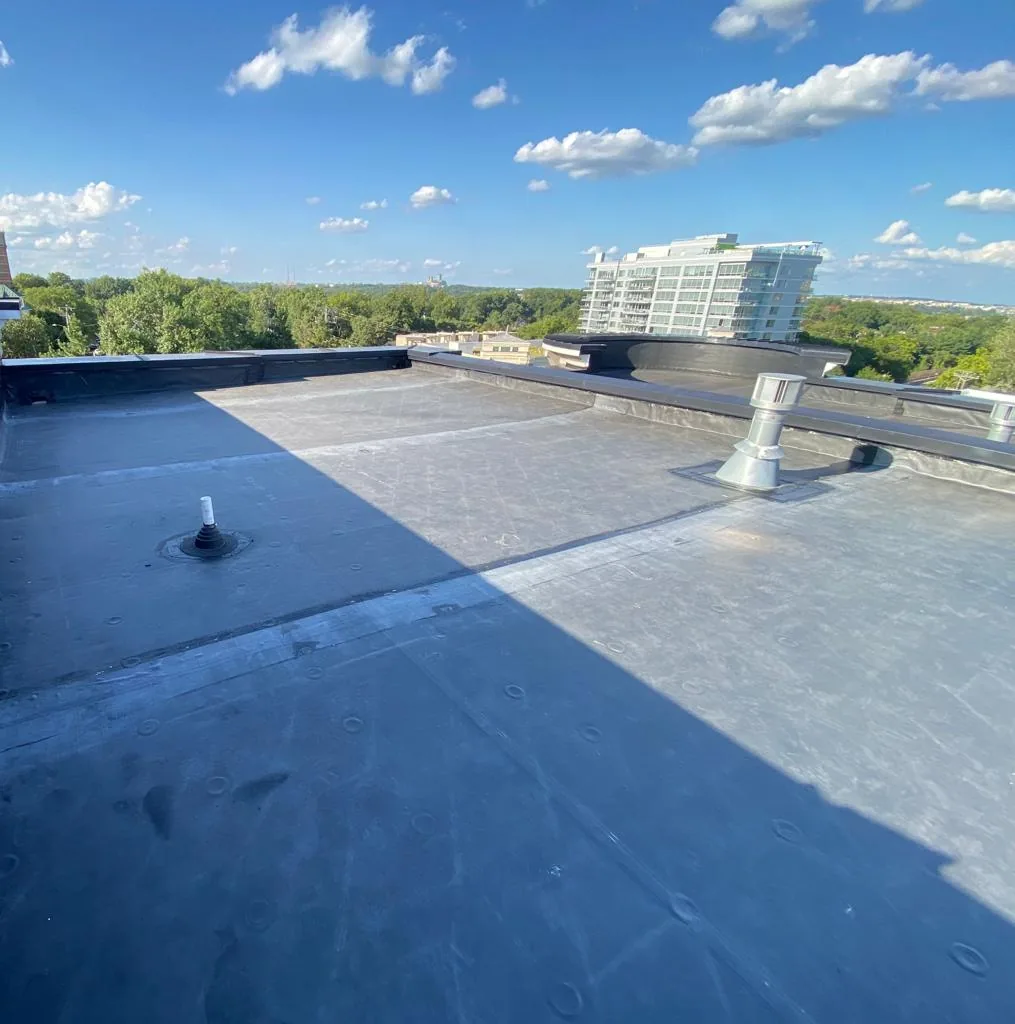
How the sheet itself is chosen and joined
TPO comes in nominal thicknesses of 45, 60 and 80 mil, and makers sell sheets up to 12 feet wide. A small Chantilly garage roof can therefore be covered with only a few laps. Those laps are welded with hot air, at least an inch and a half wide on one maker's system, after weathered membrane is cleaned. The finished edge is then probed with a tool, and the result is photographed.
Thicker sheet resists punctures better in laboratory tests, and some makers allow longer guarantee terms on it. A guarantee is paper, though, and it normally runs through an approved installer, using the maker's own flashings and parts. Any guarantee the maker offers should come in writing before you decide.
If your roof looks like this, then
- It slopes enough to see from the driveway. TPO is a low-slope product, and a steeper plane wants shingles or metal. A high-slope sheet exists, but it needs the maker's approval and rarely looks right on a front elevation.
- It is a tiny deck or shed top and black is acceptable. EPDM sheets are far wider and may leave you with almost no laps.
- A kitchen or bath fan vents onto it. Ask for the maker's chemical guidance, and compare PVC.
- It holds water or leaves ice patches. Slope and drains come first.
- It sits over a party wall. Deck rating and flashing along the wall come before color or thickness.
Westfields, and why we hedge
Westfields is a business park, not a neighborhood. The original 1985 plan zoned about 1,027 acres mostly for industrial use, and it was built up with offices, along streets like Westfields Boulevard, Newbrook Drive and Park Meadow Drive. Office and industrial buildings often have low-slope roofs, which is the real reason TPO belongs on this page. Most of our work is house and townhouse work, so an office roof starts with a walk of the deck and a talk through scope.
Two typical Chantilly TPO projects
A garage top on a 1980s colonial near Stringfellow Road
The roof is about 14 by 20 feet, with a low edge that stays damp and one corner of soft plywood. We would strip the old coating to the deck, replace the bad boards, add insulation sloped toward a scupper and weld a 60 mil white sheet with its own wall flashing. The owner sees photos of the soft corner before it is covered, a written scope, and the drain tested with a hose at the end of the day.
A rear flat section on an end-unit townhouse
The flat part is about 120 square feet, tied into shingles on the main roof, and the old membrane has lifted at the party wall. Before anything else we would find out whether the deck is fire rated, which can bring in the county. The new sheet is mechanically attached, the wall flashing is formed as a separate piece, and the owner gets word on whether the association needs a heads-up.
Which county holds your parcel
Most of Chantilly is unincorporated Fairfax County, so Fairfax County Land Development Services, in the Herrity Building on Government Center Parkway, is the building official. County guidance lists replacing roof shingles as work that needs no building permit, and lists roof repairs and chimney repairs as work that does. A membrane replacement falls between those two lists, so confirm your exact scope with the county before work starts.
A home with a Chantilly mailing name in ZIP 20152 may be in Loudoun County, which has its own building office and its own rules. The parcel decides, so confirm with the county that holds it. The Sully Historic Overlay District has its own Architectural Review Board, so ask whether a re-roof there needs its approval. Background is in our Fairfax County roofing permits guide, and the flat roof maintenance article covers upkeep.
Frequently Asked Questions
My address says Chantilly but the ZIP is 20152. Which office reviews a TPO re-roof?
Possibly Loudoun County rather than Fairfax. ZIP 20152 is generally tied to Loudoun even though the mailing name is Chantilly, so the parcel decides. Loudoun has its own building office, so for those homes confirm the rules with the county that holds the parcel before work starts.
Does the flat roof over my side-entry garage have to be dead flat for TPO?
No, but it needs a design slope of at least a quarter inch of rise per foot, which the Virginia residential code sets for thermoplastic single-ply. We measure the slope and look for low spots before quoting, because a roof that is flatter than it looks can hold water and may need tapered insulation.
Would an office roof in Westfields be a TPO job?
It could be, but the roof decides, not the street. The business park is mostly offices, and office roofs are often low-slope. Most of our work is residential, so an office roof starts with a walk of the deck, drains and equipment before any scope is written.
How do you know the insulation under an old Chantilly flat roof is dry enough to recover?
Not without testing. The residential code bars a recover over a water-soaked roof or one that already has two layers, so the deck is probed for soft spots and, on larger roofs, a moisture survey is used. A new TPO sheet also blocks vapor, so wet insulation trapped under it is the failure to avoid. Small sections are usually stripped to the deck anyway.
Does a TPO sheet over my 1980s townhouse roof deck change anything for the neighbors?
It can, through the shared wall and the roof deck. Fairfax County lists fire-rated roof decking, which townhouses often have, as a reason a small plywood repair may still need a permit. We check the deck type, keep flashing along the party wall intact and tell the association or the neighbor when a change might reach their side.
Where we get calls near Route 50 and Route 28
We take flat-roof questions from homeowners around the Route 50 and Route 28 interchange, along Walney Road and Centreville Road, and from neighbors in Centreville, Herndon and South Riding. When a delivery has to cross those corridors, we plan it around traffic. The service area page lists every town.
A flat section in Chantilly that leaks?
Tell us the street, your ZIP code, roughly how large the flat part is and whether it shares a wall. A photo of the low edge helps. Call (571) 453-6515.
Book a Phone Consultation