PVC roofing in Washington, DC: apartment roofs, kitchen exhaust and crowded rooftops
The census counts 58.5 percent of occupied District homes as rented, so many roofs belong to a landlord, a condominium board or a managing agent. PVC is the welded white sheet we point to when grease, exhaust or crowded equipment rules out the simpler options. Here is when it earns the extra look, and when it does not.
Three questions that decide whether PVC fits
Does anything greasy land on the roof?
Restaurant hoods, bakery vents and laboratory exhaust are the classic cases. M Street and Wisconsin Avenue in Georgetown, the blocks around Eastern Market and the Barracks Row stretch of 8th Street SE are commercial corridors, so wherever an apartment or office sits near a shop or eatery, we ask about kitchens. If the answer is yes, PVC moves up the list, though each maker's chart still has to match the exposure.
What is on the old roof?
The census says 41.1 percent of District homes were built before 1950, and old roofs collect repairs: coatings, mastic, rubberized flashing. PVC and rubberized asphalt do not get along, because the asphalt can draw the softening agent out of the sheet. If it is present, the old material is separated from the sheet or another system is chosen, and the quote should say which.
How many things stand on the roof?
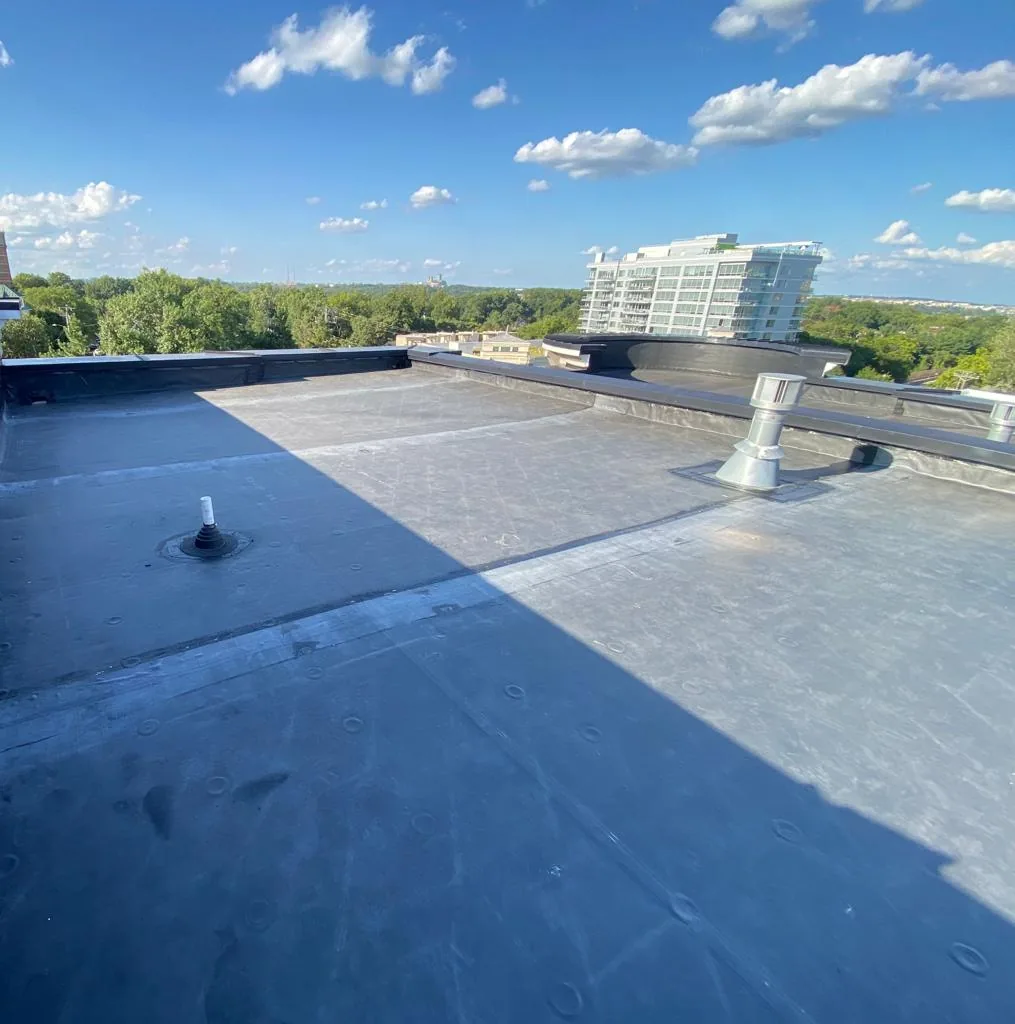
Vent stacks, pipe boots, curbs and hatches multiply the places a leak can start. Prefabricated sections and molded accessories can cut down the hand-flashing on a crowded deck.
What the sheet is made of
PVC roofing is a plasticized vinyl sheet reinforced with a polyester scrim or a fiberglass mat, sold at roughly 50, 60 and 80 mil depending on the maker. Laps are fused with hot air. One maker uses a gray underside so the installer can see that a weld has flowed, and another reports test seams that tore the sheet before the weld let go. As with every welded sheet, weathered or dirty laps get cleaned first.
The weak spot is chemistry, not strength. Keep it clear of anything that pulls out the plasticizer. Makers describe PVC as resistant to oils, coolants and fuels, which is not the same as immune, so the exposure still gets checked against the maker's chart.
When another sheet does the job for less fuss
- A rowhouse back roof with no kitchen below or beside it. Rubber or TPO usually does the same work.
- A roof that ponds beyond the trade's usual two-day yardstick. Fix the drainage first, whatever the sheet.
- A pitched visible slope on a house. That is metal or slate work, not a welded sheet.
- A small budget job with nothing chemical on the roof. A less specialized sheet makes more sense.
After install, plan upkeep. One maker advises two inspections a year and one after every storm, and a board that keeps dated photos has something to show a manufacturer or an owner.
Two typical PVC projects in the District
A mixed-use building on Connecticut Avenue with a restaurant below
The roof is about 3,000 square feet, with a hood fan near the back parapet and a film of grease on the nearby surface. Apartments above report ceiling stains. We would test for wet insulation, replace what is wet, and propose an 80 mil PVC sheet with a boot on the fan curb. The building's manager would see a written statement of what the maker says about the exposure.
A Capitol Hill rowhouse with years of black patching
The owner has been patching a leak near the chimney with black mastic. A sample would settle it, and PVC may be the wrong call if rubberized asphalt sits where the new sheet would go. If it is, we would suggest rubber or TPO instead, and we would explain why before anyone orders materials.
Who decides in the District
The Department of Buildings handles permits, and its Permit Center is at 1100 4th Street SW. Its Homeowner's Center serves owners of one- and two-family homes. A building of five or more units is a different kind of file, so ask DOB at the start how it classes the building. The 2017 Construction Codes are the code in force, with a newer edition planned for later.
A condominium or cooperative board usually has to agree to roof work on a common element, so check the building's documents. We ask the manager for the drawings, the repair history and any existing manufacturer paperwork before we write a scope.
PVC Questions for District Roofs
Our building has a restaurant on the ground floor, so does its exhaust matter for the roof?
Yes, it is the first thing to settle. Grease and oil that settle on a roof are hard on some membranes. One maker calls its PVC inherently resistant to oils and grease and another lists enhanced chemical resistance, but neither says immune. Match the exact sheet to the maker's chemical statement and to what the hood discharges.
Can PVC go over the black patching already on my rowhouse roof?
Not safely until we know what the patching is. One maker warns that rubberized asphalt can pull the softening agent out of flexible PVC, leaving it brittle, and the fix is a separation layer or a different detail. Housing here is old, with 41.1 percent of District homes built before 1950, so a roof may carry decades of repairs. We probe and sample first.
How often should a condominium board in DC have its welded roof looked at?
One PVC maker advises inspecting flashings, drains and termination sealants at least twice a year and after each storm. After the September 3, 2026 storm, with winds up to 70 mph in the District, that advice is easy to apply. Keep the photos each time, because a dated record helps when a warranty question or a unit-owner dispute comes up.
Is a factory-welded PVC roof a fit for a crowded roof with many vents?
Sometimes. One maker fabricates custom sections with factory-welded seams, which leaves fewer seams to weld on the roof, and that can help where vents, curbs and pipes crowd the surface. Whether a prefabricated section can reach your roof depends on the stair, hatch or hoist, and on measuring accurately. We look at access before we suggest it.
What should I ask before hiring any roofer for a DC condominium roof?
Check any contractor's license through the Department of Licensing and Consumer Protection, whose consumer alert says home improvement contractors must hold a Home Improvement Contractor license. Ask for a written scope, how DOB classes the building, and the manufacturer paperwork. Reston Roof is based in Reston, Virginia, so ask what Reston Roof takes on in DC.
Roofs we can look at in the District and beyond
We work across DC, Northern Virginia and the Maryland suburbs. Most of what we do is residential, so a large or specialized building may be outside what Reston Roof takes on. The service area list shows the wider map.
A manager's question about a leaking roof?
Send the address, what vents or hoods sit on the roof, and what you know about its past repairs. Those details show whether PVC fits. Call (571) 453-6515 or book a call.
Book a Phone Consultation