Rubber roofing for DC rowhouses: rear slopes, party walls and one-sheet coverage
A rowhouse roof is small and usually has a wall on each side. That is why one rubber sheet is often the tidy answer for the back of a DC rowhouse, and why the wall details matter more than the sheet. About 78,000 District homes are single-unit attached, the census group that holds most rowhouses.
What we look at on a rear rowhouse roof
- The fall. The Office of Planning says old flat roofs usually slope toward the back of the building, so we find the low edge and see whether water reaches it.
- The back edge. A drain, scupper or downspout that clogs turns a good roof into a shallow pond.
- The party walls. Both side walls need a flashing that rises above the sheet and a sealed top edge.
- The coping. The cap on the parapet sheds water away from the wall and is a frequent source of stains below.
- Penetrations. Vent stacks, a skylight curb, a chimney or a roof hatch each need their own boot or flashing.
- The deck. Soft spots near the drain tell us whether wood must be replaced before anything is laid.
- Old layers. We count them and probe for wet insulation before choosing a method.
Why rubber suits a roof this size
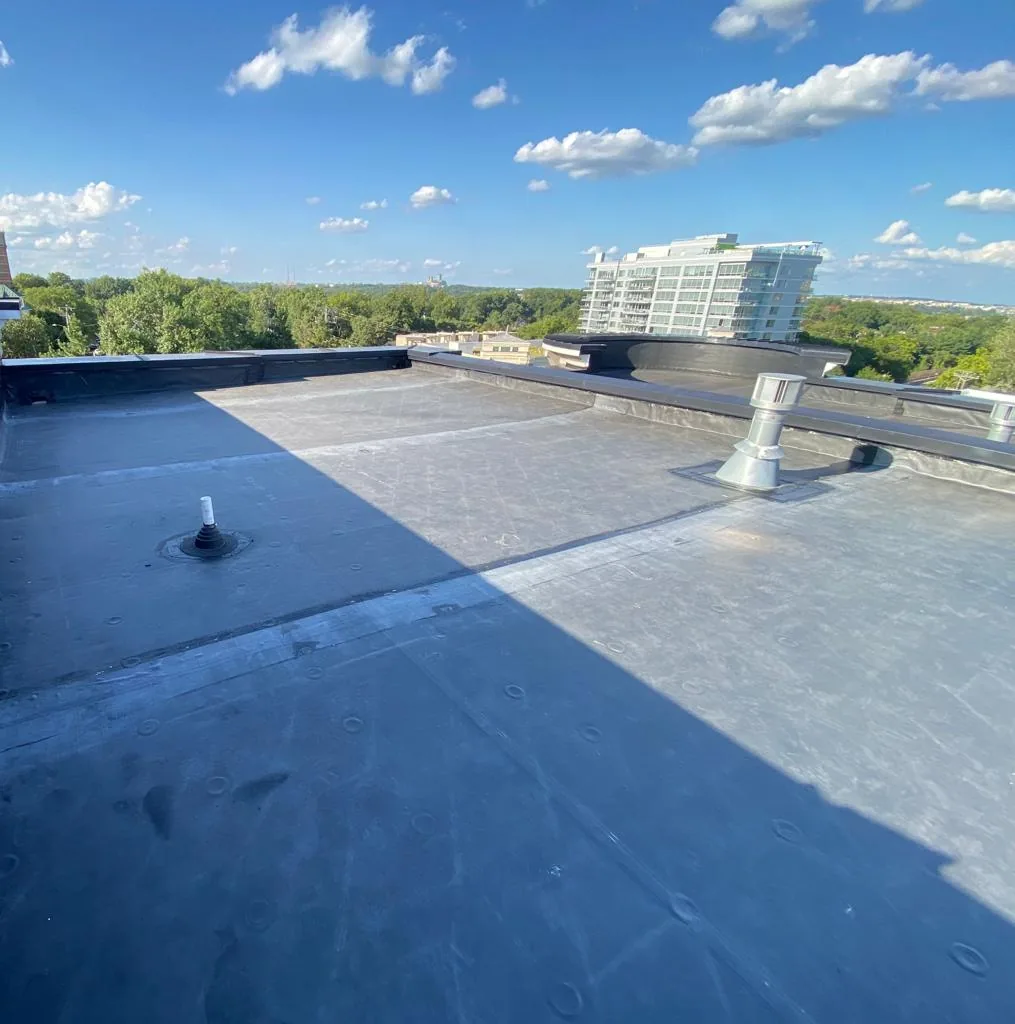
EPDM is cured synthetic rubber, black as standard. One maker rolls sheet 16.7, 20, 30, 40 and even 50 feet wide, so a back roof under 20 feet front to back can often be covered by a single piece with no seams in the field. The seams that remain sit at walls and penetrations, where tape and primer need a clean, dry surface.
Rubber shrinks a little as it ages, with typical figures under one percent in maker data, so terminations at the walls are fastened and sealed to take that pull. Patching is simple, using primer and tape on a clean sheet, which is helpful on a roof that will be visited again.
If this, then not rubber
- If grease, cooking oil or fuel will reach the roof, keep rubber away. The makers say to isolate oils and fats from the sheet, and PVC is the usual alternative.
- If you plan a roof deck, say so before we quote. DOB classes a deck differently from re-covering, and a deck visible from a street goes to the Historic Preservation Review Board.
- If people will walk the roof often, 45 mil is the thinnest option and scuffs first. Ask for 60 mil and walk pads.
- If the deck is sharp or pitted, it needs smoothing first, since the maker wants a clean, smooth, dry base.
- If the roof is a visible slope, a pent roof in slate or tile is not a membrane job. See our metal page for sloped coverings.
The historic district route for a rowhouse roof
Capitol Hill is on the National Register and described as one of the largest historic districts in the country, mostly rowhouses. LeDroit Park, founded in 1873 around Florida Avenue NW and Georgia Avenue NW, has Victorian rowhouses. In a district, a permit is needed for work that would otherwise be exempt, and DOB lists in-kind roofing under a Historic Property Special Permit.
The applicant confirms with the Office of Planning before filing with DOB. The Historic Preservation Office's expedited list includes roofing, coping, gutters and downspouts when the work is compatible with the property. If it is not, the application goes to the Historic Preservation Review Board. The roof guideline asks owners to maintain first, repair in kind second, and replace in kind third.
Two typical rubber projects in the District
A Victorian rowhouse in LeDroit Park with a rear flat roof
The rear roof is about 15 by 30 feet and drains to a single back downspout that backs up in autumn. Ceiling stains have appeared above the kitchen. We would clear and test the drain, replace damp deck boards, lay one 60 mil sheet fully adhered, and flash both party walls. The owner would see photos of the deck before it is covered, and a written note on which parts need the Historic Preservation Office.
A flat roof over a rear addition near Dupont Circle
The roof is about 250 square feet, with a skylight curb and a vent stack, and it leaks where the sheet meets the main house wall. We would replace the covering with one rubber sheet, reflash the wall in step with the curb, and fit a new boot at the vent. A skylight swap or a visible change would be discussed with the Historic Preservation Office first.
Rubber Roof Questions for District Rowhouses
My neighbor's roof meets mine at the party wall, so who flashes that joint?
Each roof meets the shared wall from its own side, so each is normally flashed up the wall from its own deck. We photograph the wall from your roof and describe what we see on the other side. If the neighbor's flashing is failing, we cannot repair it from your property, but we can describe the problem so you can raise it.
Does a rowhouse need a white rubber roof, or can I stay with black?
Black is the standard sheet and you can stay with it. White EPDM exists, and one maker lists an initial reflectance of 0.77, so a lighter roof is a choice rather than a rule. Ask DOB whether any reflectance requirement applies to a re-roof at your address. The Office of Planning says flat-roof coverings are usually not character defining, so color is mostly about heat.
Do I need a permit to re-cover my LeDroit Park rowhouse flat roof in rubber?
Plan on a permit application. DC's code text exempts like-for-like roof covering replacement, but not inside a historic district, where the Historic Preservation Office has to clear even an in-kind job. Whether your address falls in a district, and what the office and DOB need to see, should be settled before anything is scheduled.
What does a rubber roof do when a storm drops a limb on a rowhouse?
A limb can cut or crush the sheet, and a thin 45 mil sheet is the easier one to puncture. Winds reached up to 70 mph in DC on September 3, 2026, and a tree fell on a rowhouse on 8th Street SE, though the news report mentions no roof damage. After a strike we tarp the opening, photograph it for your claim, and patch or replace once we see the deck.
Why does a rowhouse roof quote list the coping and the rear drain separately?
Those two spots are where small roofs often start leaking, so a good scope describes and photographs each on its own. The coping caps the parapet, and the drain or scupper carries water off the low edge. The Office of Planning lists roofing, coping, gutters and downspouts together as in-kind work it can clear, so each one is worth naming in the scope.
Related Services
- Welded white sheet for larger flat roofs and walk-ups
- PVC when kitchen exhaust or oils reach the roof
- Metal for the sloped pent roof at the street
- Every roofing question in the District
- Rubber roofs on the Arlington side of the river
- Rubber roofs in Alexandria
- When a flat roof can be repaired instead of replaced
- How wall flashing is installed
Rowhouse roofs we can look at
We are a Reston, Virginia roofer and we cover DC, Northern Virginia and the Maryland suburbs. Before you book anyone for a District rowhouse, check their license with the Department of Licensing and Consumer Protection, and ask us what we can take on in the District. The service area list shows the wider map.
A stain on the back bedroom ceiling?
Tell us the block, how many floors the house has and where the stain shows. We will say whether a rubber sheet fits the roof or whether a repair is enough. Call (571) 453-6515 or book a call.
Book a Phone Consultation