TPO roofing for Washington, DC rowhouse flats, walk-ups and mid-rise roofs
The Office of Planning says most DC rowhouses have flat roofs, and the census puts 56.9 percent of the city's homes in buildings of five or more units. That makes low-slope sheet roofing a real topic here. This page covers when a welded TPO sheet fits a District roof, when it does not, and who must say yes first.
Which DC roofs are TPO candidates
The 2020 to 2024 census estimate counts 361,014 housing units in the District, a median build year of 1958, and about 31.5 percent built in 1939 or earlier. No census table records roof shape, so every roof is a question we answer by climbing up. TPO is usually worth discussing on:
- Rear flat roofs on Capitol Hill rowhouses near Eastern Market and Lincoln Park, where the old covering has worn out.
- Low roofs above the shops along Pennsylvania Avenue SE and the Barracks Row blocks of 8th Street SE.
- Apartment and condominium buildings where one roof covers dozens of units plus rooftop equipment. The census counts 124,410 DC homes in buildings of fifty or more units.
- Flat additions and porch tops behind larger houses in Georgetown and around Dupont Circle.
A pent roof facing the street is a different job. The Office of Planning says those are commonly slate, asphalt shingles or clay tile, which makes them sloped-roof work, and our metal page covers the sloped side.
Read the roof first, then choose
| What we find | What it means for TPO |
|---|---|
| Water still standing two days after rain | Fix the fall or add a drain point first. A new sheet over a pond only hides it. |
| Spongy board or wet insulation under the old roof | Cut out the wet sections. Welding over wet board traps the moisture. |
| Exhaust from a kitchen or lab lands on the roof | Check the maker's chemical statement for that exact sheet, and look at PVC. |
| Crews walk to rooftop equipment every season | Choose a thicker sheet and put walk pads along the route. |
| A roof deck or skylight is on your wish list | Settle that before the sheet goes down. A deck visible from a street goes to full historic board review. |
The sheet, and the fall it needs
TPO is a thermoplastic with a polyester scrim between two layers, offered at 45, 60 and 80 mil. Rolls 8, 10 and 12 feet wide cover a narrow rowhouse roof in a few runs. Laps are fused with a hot-air welder instead of glue, and a lap on weathered sheet is cleaned first, so repairing an old roof begins with scrubbing.
Drainage matters more than the brand. The model building code text DC builds on asks for a drop of at least a quarter inch per foot, about 1.2 degrees, on sheet roofs. We check the fall with a level and string line, then choose between a flat sheet over the old deck and tapered insulation that restores the slope.
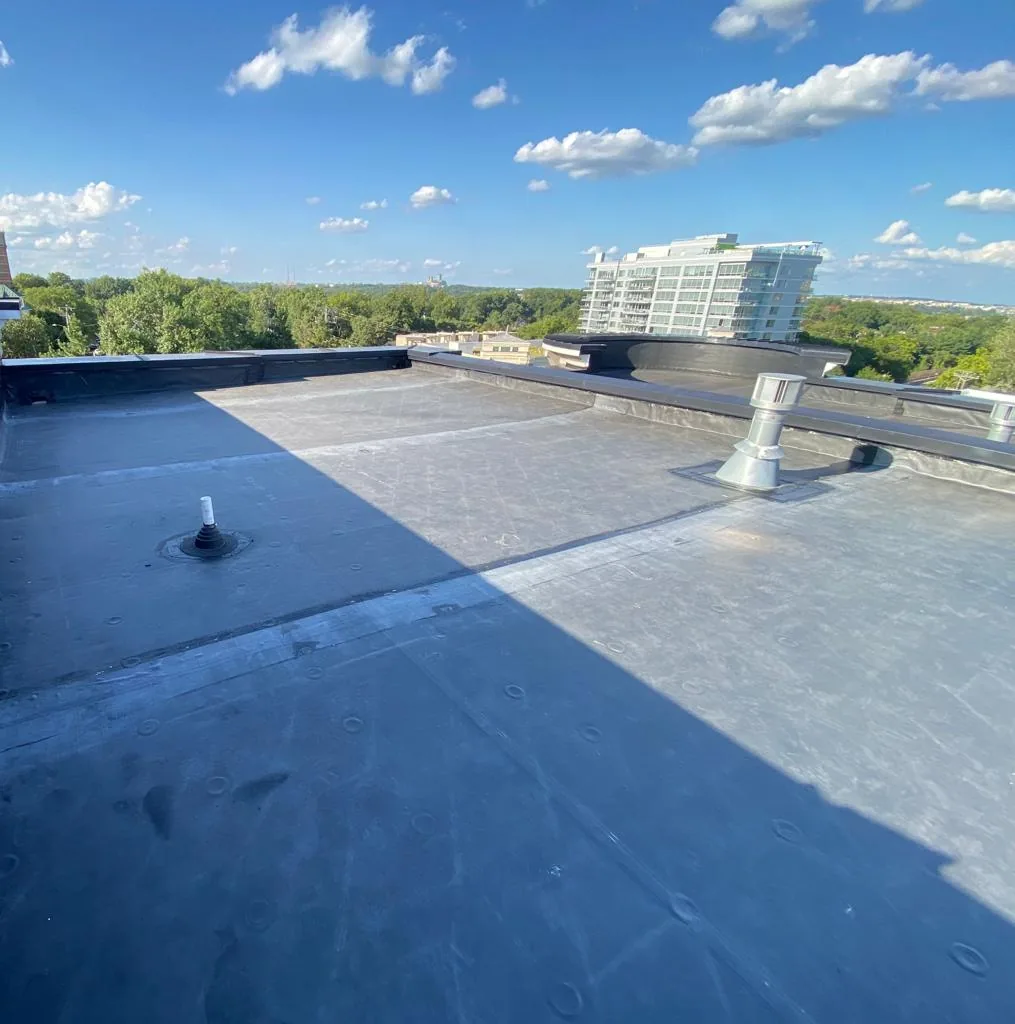
A rowhouse flat roof, in order
- Access first. We ask where a truck can stand, how materials reach the roof, and which neighbors share the party wall.
- District check. We ask whether the address sits in a historic district, since that changes the paperwork.
- Roof walk. Photos of the drain, the wall flashing and the coping, plus a level reading of the fall.
- Written scope, including what DOB or the Historic Preservation Office needs to see.
- Tear-off, deck repair and tapered board where the water needs help.
- Weld the sheet, flash it up the party walls and around the drain, then photograph every detail before leaving.
Two typical TPO projects in the District
A two-story rowhouse a few blocks off East Capitol Street
The rear roof is roughly 600 square feet. A stain shows on the back bedroom ceiling after long rains, and the old covering has pooled water near the back edge for years. We would check the deck near the drain, add tapered insulation to push water rearward, lay a 60 mil sheet and weld flashing up both party walls. Because Capitol Hill is a historic district, the owner would see a permit application cleared by the Historic Preservation Office before we start.
A four-story apartment building near Florida Avenue NW
The flat roof is about 5,000 square feet, with two drains, a stair bulkhead and a row of condensing units. The board reports leaks in top-floor ceilings. We would run a moisture survey, mark wet zones on a roof plan, and propose replacing only the wet insulation with an 80 mil sheet and walk pads between the units. We would ask DOB how it classifies the building before pricing the permit route.
Who has to say yes in the District
Permits come from the Department of Buildings, which took over from the old consumer and regulatory agency in October 2022. Its Permit Center and Homeowner's Center are at 1100 4th Street SW, and the Homeowner's Center handles roof repair and replacement with no structural change for one- and two-family homes. Virginia's building code and Virginia offices have no role here.
The District works under its 2017 Construction Codes. The code exempts replacing roof covering with like material that copies the old roof from a building permit, except in a historic district or flood hazard area. Confirm the scope with DOB before work starts. A structural change needs a permit, and so does a roof that is not a like-for-like swap.
Larger apartment and commercial roofs may follow a different route. Ask DOB how it classes a specific building before work is priced. Condominium and cooperative boards are a separate approval, so have the roof drawings and repair history ready.
TPO Questions for District Roofs
If my rowhouse has an old rubber roof, is putting TPO on it replacement in kind?
Not clearly. DC's code text exempts replacing roof covering with a like material that matches the old one in appearance, texture, design, detail and dimensions. A different sheet type is not obviously that. Whether a membrane-to-membrane change qualifies is a question for DOB before work starts. In a historic district a permit application with Historic Preservation Office sign-off is needed either way.
How much snow is a flat roof in the District designed to carry?
In a published copy of the 2017 DC building code, the design ground snow load is at least 25 pounds per square foot plus drifting, or a 30 pound equivalent uniform load, whichever is greater. Drifts build against taller walls and rooftop structures. Added insulation and sheet add some weight, so the framing of an old building is worth checking, with an engineer where there is doubt.
What fall does a flat rowhouse roof need before a sheet goes on?
The model building code text DC builds on asks for at least a quarter inch of drop per foot, about 1.2 degrees, for sheet roofs. The Office of Planning notes that old flat roofs usually slope toward the rear of the building. We check the fall with a level on the day we visit. If the roof has lost it, tapered insulation can restore it before TPO is laid.
Does DC make me use a white sheet when I choose TPO?
Ask DOB whether any reflectance level applies to a re-roof at your address before ordering. White and tan TPO reflect far more sunlight than gray, and listings for ENERGY STAR cover specific products and colors, not TPO as a whole. Pick the color by how hot the top floor gets and how visible the roof is.
Will the Historic Preservation Office object to a white flat roof on a Capitol Hill rowhouse?
The Office of Planning's roof guideline says the look of flat-roof coverings is usually not character defining, and its expedited list names roofing as in-kind work it can clear. It does ask that skylights, solar panels and roof decks stay out of view from the street. Review is still by permit application, so your address and scope should be confirmed with the office.
Related Services
- One-sheet rubber for small rear roofs behind rowhouses
- Welded PVC for apartment roofs with exhaust and crowded equipment
- Metal panels on pent roofs and what the historic review ladder says
- All roofing in the District
- TPO roofing across the Potomac in Arlington
- TPO roofing in the City of Alexandria
- TPO or EPDM, compared for flat roofs
- Keeping a flat roof healthy through the year
Where we work on District flat roofs
Reston Roof is based in Reston, Virginia, and takes calls across Northern Virginia, DC and the Maryland suburbs. Most of our work is on houses and townhouses, so a very large building may be outside what Reston Roof takes on. Whoever you hire for a District roof, check their license with the Department of Licensing and Consumer Protection before you sign. See the service area list for the wider map.
Is your flat roof ponding, leaking or due for a plan?
Send the address, the roof's rough size and where water shows inside. We will tell you whether TPO is worth a quote or whether another sheet fits better. Call (571) 453-6515 or book a call.
Book a Phone Consultation