TPO roofing in Springfield, VA: for the flat parts of mid-century houses and the low roofs of apartment buildings
Springfield is mostly houses, yet 27.2 percent of its homes sit in buildings of ten or more units, and 45.0 percent were built before 1970. That mix gives TPO two jobs here: the flat roof over a bump-out added to an older house, and the low roof of a garden-style apartment or condominium building. A steep main roof is neither.
When TPO is the answer, and when it is not
- If the roof is flat or nearly flat over a kitchen addition, family room or porch, TPO is usually the right fit. Field sheets are made 8 to 12 feet wide, so a small roof needs few seams.
- If you can see the pitch from the street, it is not a TPO roof. Single-ply is a low-slope system, and the code minimum is a quarter inch of rise per foot.
- If water still stands two days after rain, fix the drainage first. The trade's rule of thumb is no ponding after 48 hours, and manufacturers read standing water differently in their warranties.
- If cooking exhaust or grease reaches the roof, check the maker's chemical chart before choosing, and look at PVC as well.
- If the roof already carries two layers, or is wet, nothing goes over it. The residential code does not allow a recover in either case, so it comes off to the deck.
- If people cross the roof to reach equipment, the sheet needs walk pads, and thickness is worth a conversation.
Two kinds of low roof in one community
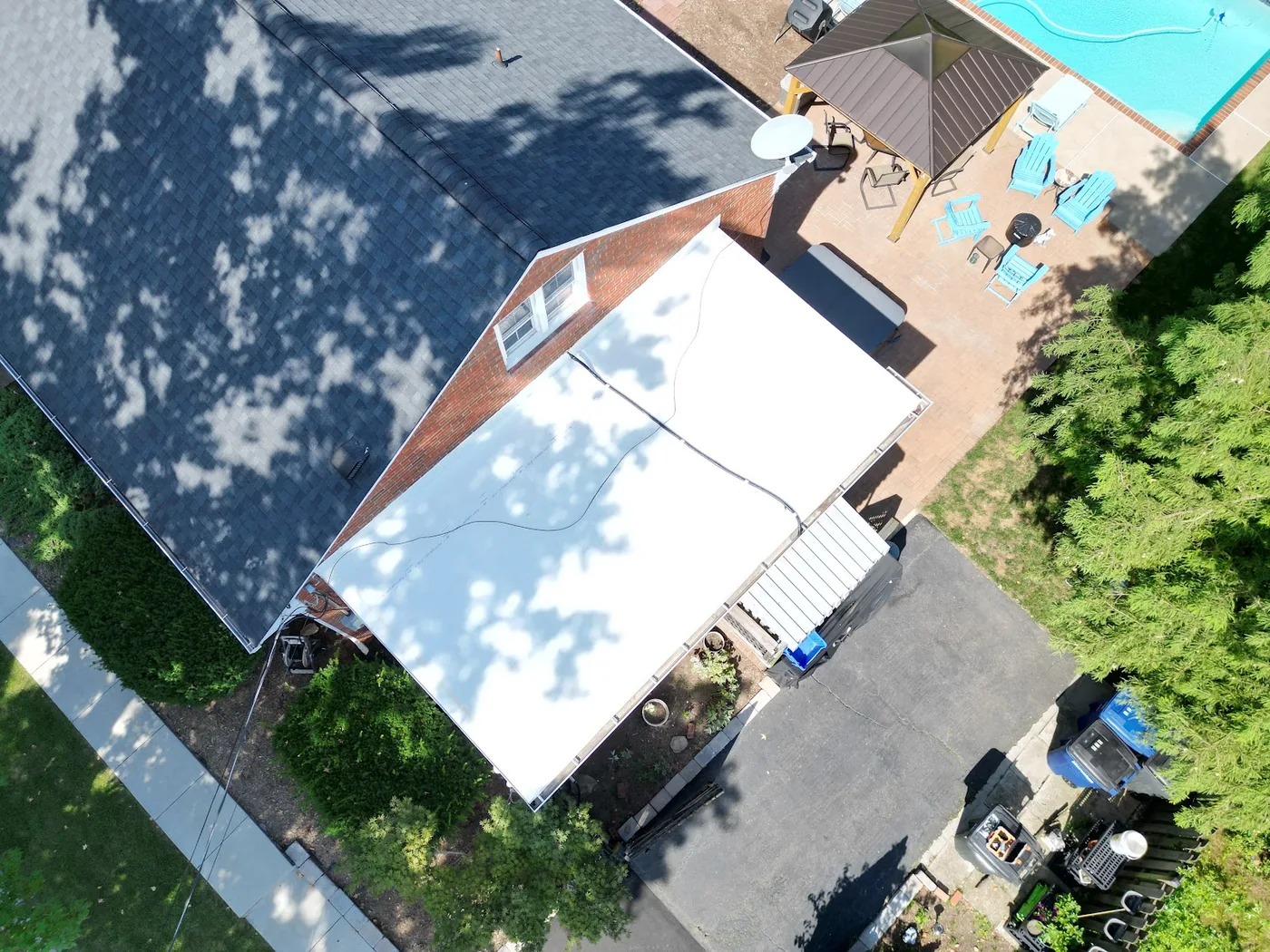
The Census place called Springfield counts about 10,801 homes, with a median build year of 1975. Of those, 57.0 percent are detached and 13.0 percent attached. The 1950s alone produced 26.8 percent of the stock, and houses of that age tend to gain rooms. A room added without a pitched roof is a low-slope roof, which is where TPO usually lives on a house.
The second kind is the apartment or condominium building. One county planning page covers parcels at Backlick Road, Amherst Avenue and Springfield Boulevard, about 5.7 acres, proposed for multifamily housing. And since 15.5 percent of Springfield homes date from 2000 or later, some roofs may still sit under a manufacturer guarantee. That paperwork is worth asking for before anything is cut.
Thickness, welds and drainage
TPO is a fabric-reinforced sheet sold at 45, 60 and 80 mil. Where a roof is visited only for repairs, a thinner sheet can be reasonable, and where people walk regularly we talk about thickness and walk pads. Seams are joined with hot air, a lap at least an inch and a half wide on one maker's system, and the edge of each weld is probed along its length. Weathered sheet needs cleaner before welding, and dirty laps are a common cause of weld trouble.
Manufacturers publish guarantee terms that run up to the 20 to 30 year range depending on thickness and system, but a guarantee is not a service life. A manufacturer warranty may be available depending on the system, with terms in writing.
What we look at on a Springfield flat roof
- Stains and soft spots on the ceilings below, photographed before we touch anything.
- How water leaves: drains, scuppers or an open edge, and where it collects instead.
- Whether old layers hide wet insulation. The sheet itself is a vapor retarder, so moisture under a recover cannot escape.
- The wall flashing where an addition meets the house, since trouble often starts at details rather than in the open field.
- Vent pipes, skylights and curbs, each of which needs flashing from the same maker as the sheet.
- The deck: soft or stained plywood decides how much of it is replaced.
Two typical TPO projects in Springfield
A kitchen addition on a 1950s house
The flat roof is about 280 square feet. It has two old layers, ponds by the back wall, and a stain has spread across the kitchen ceiling. Because two applications already exist, we would strip to the deck, replace the soft plywood, and rebuild the roof so water leaves in a day or two. Then we would weld a white 60 mil sheet and flash the wall, a vent pipe and the edge. The owner sees ceiling photos before and decking photos during, and a written note on how the drainage was fixed.
A twelve-unit garden-style building
The low roof is about 6,500 square feet, with a few rooftop vents and a stairwell hatch. The board reports leaks at two top-floor units. We would survey for wet insulation, ask the board for any paperwork from an earlier roof, and put the county question to Land Development Services before pricing. The work would be a fully adhered or mechanically attached 60 mil sheet, welded seams probed along their edges, and walk pads from the hatch to the vents. The board receives a photo record and the manufacturer terms in writing.
Permits, and which Springfield you mean
Springfield is unincorporated Fairfax County, so Fairfax County Land Development Services is the building official, and no Springfield permit office exists. County guidance lists replacing roof shingles as work that does not need a building permit, but it lists roof repairs and chimney repairs as permit work. Fire-rated townhouse roof decking can also trigger one. So we check your exact scope with the county before we start.
The word Springfield covers more ground than the Census place, which holds about 31,154 people. The four ZIP codes 22150 to 22153 hold about 108,600, and many of those addresses belong to West Springfield, Kings Park, Newington, Franconia, Kingstowne or Lorton, which are separate Census places. The parcel decides, but the county is the same permit office. Our Fairfax County permits guide explains the process.
Frequently Asked Questions
Is the flat roof over my 1950s Springfield addition a TPO job?
Often, yes, provided the roof meets the quarter-inch-per-foot minimum slope and water can leave it. A small addition roof can be covered with a few wide sheets, which keeps welded seams few. Soft decking and wet insulation need checking first, because a membrane traps moisture. A roof that is nearly pitched, or cannot drain, is not a TPO candidate.
Our Springfield building has twelve units. Who has to approve a TPO re-roof?
Two parties. The owner or association must sign off on the work, and Fairfax County Land Development Services is the building official. State code exempts only 100 square feet or less of roof covering outside the house exemption, so a roof this size is a question for the county before work starts. Have the scope and any findings in writing before you call.
Would a white TPO roof cut the cooling bill in a Springfield apartment building?
Savings are not guaranteed. White and tan sheets reflect more sunlight, but listing as ENERGY STAR is product by product, and a gray TPO tested at 0.46 initial reflectance falls short of the 0.65 bar. The Virginia energy code does not require a cool roof in Fairfax County. Treat reflectance as a comfort question, not a rebate question.
How is one open seam fixed on a TPO roof later on?
The area is cleaned, because weathered or dirty sheet will not weld, and then a compatible TPO patch is heat-welded over the defect. That is a repair, not a replacement. If several seams are opening, or insulation under the sheet is wet, patching only chases the problem, and we would recommend a moisture check before anyone commits to more welds.
Does replacing decking under a Springfield townhouse flat section bring in a county permit?
It can. County guidance says replacing less than 256 square feet (about nine boards) of roof plywood needs no permit unless the decking must be fire rated, as on townhomes. A rotted townhouse deck is therefore worth a call to Land Development Services. Decking above 256 square feet needs a permit in any case, so the extent of rot affects the paperwork.
Related Services
- Rubber roofing for small porch and garage roofs
- PVC where exhaust reaches the roof
- Metal panels for pitched Springfield houses
- Roofing in Springfield, the full picture
- TPO roofing in neighboring Burke
- TPO roofing in Annandale
- Flat roof maintenance, season by season
- How flashing is installed at walls and vents
Beyond the Springfield line
Reston is our base. On a Springfield apartment building we ask early where a dumpster and a delivery truck can stand, since crews and material arrive along roads such as Backlick Road, Franconia Road or Old Keene Mill Road. Most of our work is on houses and townhouses, with some larger roofs. The service area page lists the rest of the places we cover.
Describe the flat roof you are worried about
Tell us the street, how many layers you think are there, and where the stain shows. We will say whether TPO fits before we talk about anything else. Call (571) 453-6515 or book a call.
Book a Phone Consultation