TPO roofing in Burke: flat sections on 1970s and 1980s houses and townhouses
Burke is almost all houses and townhouses, so TPO here is a small-roof question. This page covers where a welded sheet fits and which Fairfax County office you answer to.
Start with the housing, not the membrane
The Census Bureau's 2020 to 2024 survey counts 13,878 homes in the Burke place, which sits in unincorporated Fairfax County. Of those, 64.7 percent are detached houses and 33.5 percent are townhouses and other attached homes. Only 1.0 percent are in buildings of five or more units, and 89.5 percent are owner-occupied. Burke is a house and townhouse market, so a warehouse-size TPO job is unlikely here.
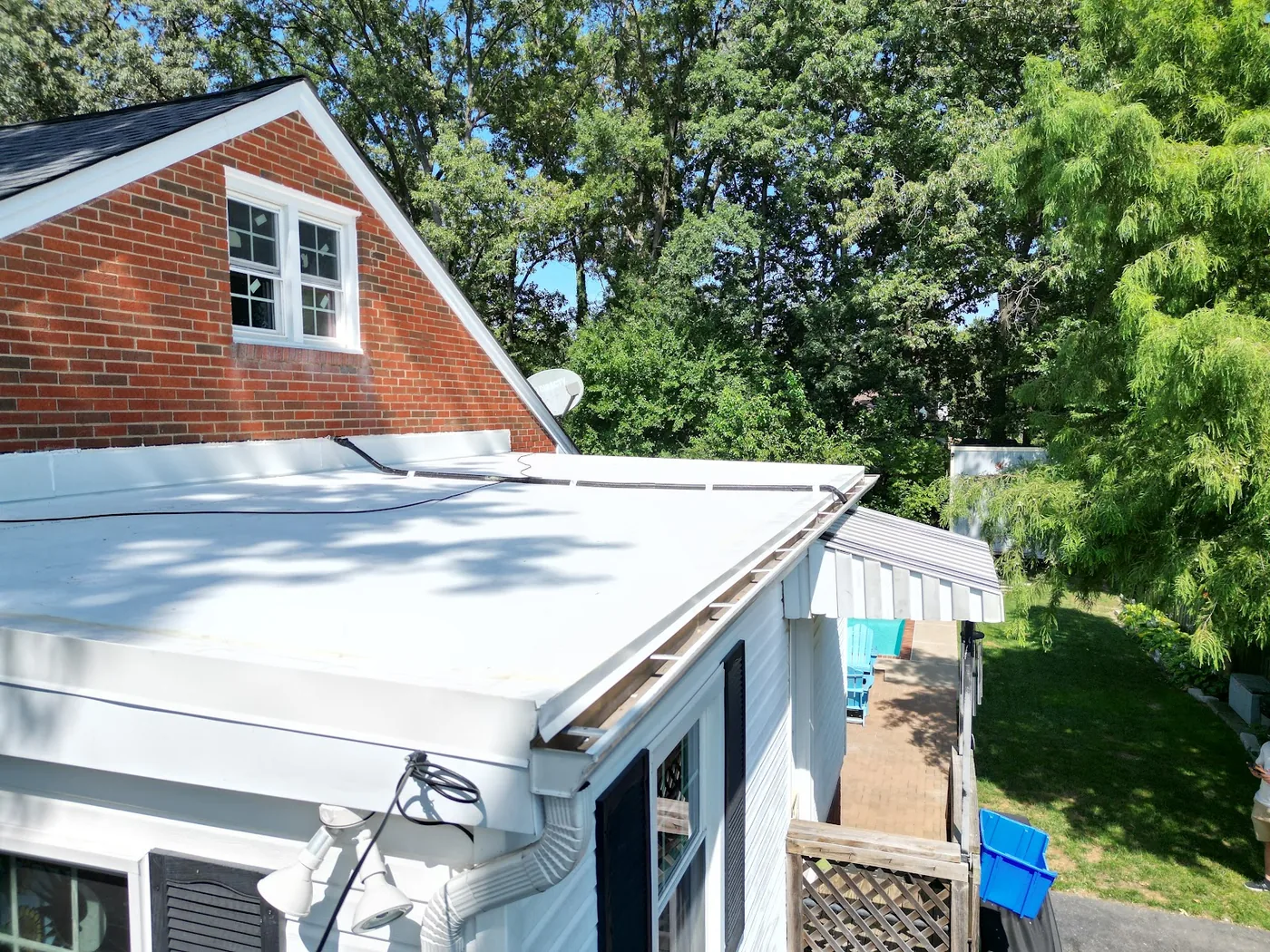
Most of the stock is from the 1970s and 1980s: 81.8 percent of homes were built in those two decades and the median year is 1979. A house of that age often picked up a sunroom, a rear family room or a garage later, and the flat roof over that piece is the usual place a welded sheet makes sense.
Where TPO fits in Burke, case by case
| What you have | Is TPO a good answer? | Why |
|---|---|---|
| A flat rear section over a family room or kitchen addition | Usually yes | Wide sheets keep seams few, and the welds are fused rather than glued. |
| The flat back of a townhouse | Yes, after the decking question | Fire-rated plywood changes the permit answer, so we check before tear-off. |
| A garage or carport top that drains to one edge | Yes, if water leaves | Roofs that hold water for days need drainage fixed before any sheet goes on. |
| A steep, visible roof plane at the front of a house | No | Single-ply is a low-slope system. Shingles or metal suit it better. |
| A leak at a chimney or wall junction on a pitched roof | Not a membrane problem | That is a flashing repair. Our chimney flashing note explains why. |
| A porch roof under heavy branches | Maybe | Where punctures are the worry, EPDM is worth comparing. |
Two typical Burke TPO projects
A flat rear section on an end townhouse near Burke Centre Parkway
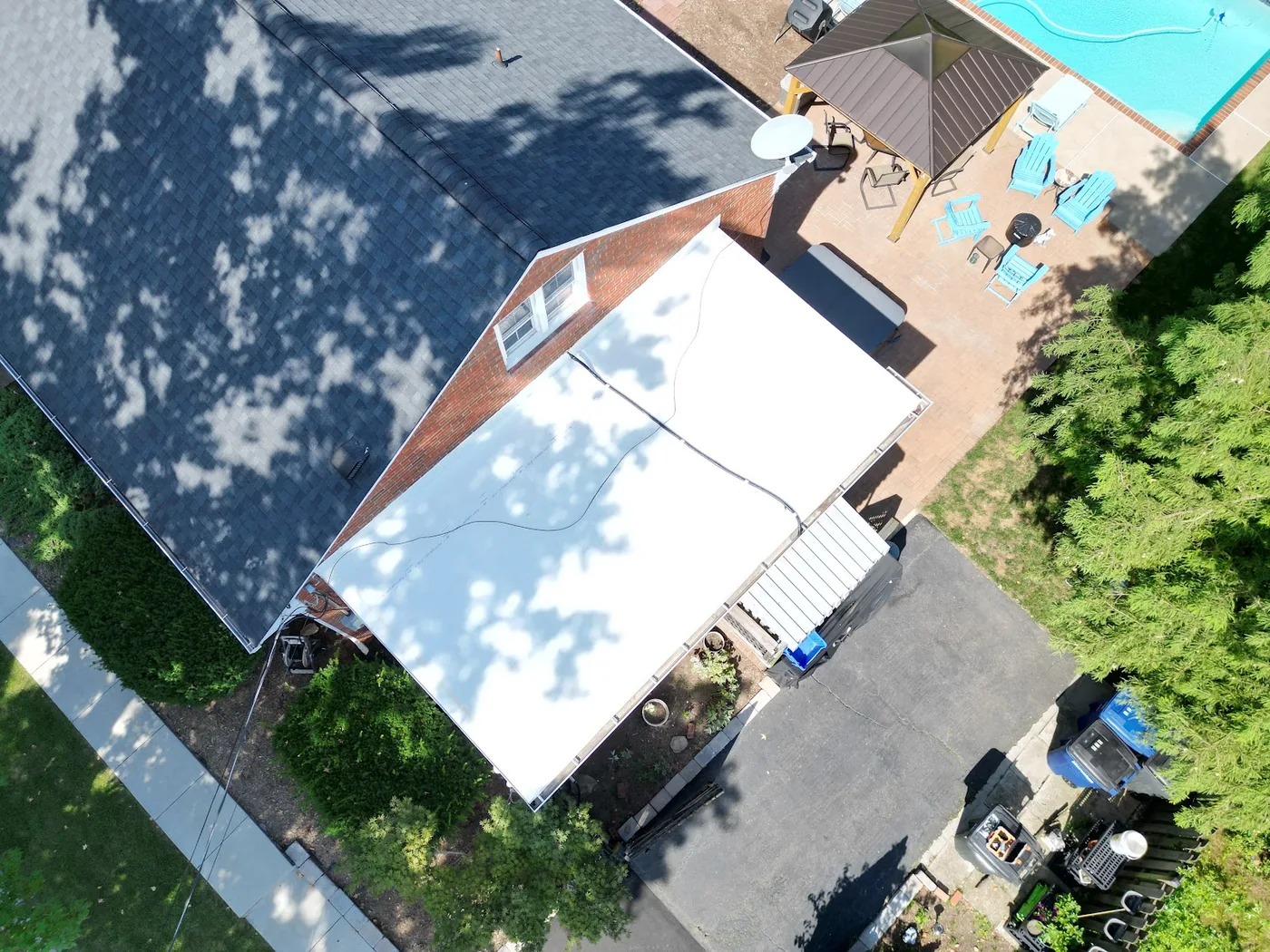
Picture a townhouse from the 1980s with a flat roof of about 10 by 16 feet over a rear sunroom, and a ceiling stain that comes back every spring along the party wall. We would open a test square, check the insulation for moisture and look at the plywood. If it is fire rated, we confirm the permit question with the county before replacing any. If the home is inside the Burke Centre planned community, we would also ask you to check with the Conservancy or your own association before exterior work. Then new insulation, a welded sheet and taller wall flashing.
A family room addition behind a detached house off Burke Lake Road
This one is a 1970s house with a roughly 20 by 14 foot flat roof over a later addition, two plumbing vents and a brick chimney chase beside it. The old covering has split at the wall. We would measure the fall, probe for wet insulation, replace what is damp, weld a new sheet and rebuild the chase and vent flashings. The owner sees photos of the details that get buried, including the weld probing, before the crew leaves.
What to check on the roof before choosing TPO
- The slope, measured with a level, because the code floor for thermoplastic sheet is a quarter inch of fall per foot.
- Where the water goes: a drain, a scupper or an edge gutter, and whether it is clear.
- How high the wall flashing can run, since a low brick ledge limits the detail.
- Whether the insulation is wet, using a small test cut and a moisture meter.
- The deck: plywood or something else, and whether it is the fire-rated kind in a townhouse.
- What else lives on the roof: vents, a flue, solar racks, a satellite mount, an attic hatch path.
- The route people take across it, because that decides walk pads and sheet thickness.
Any manufacturer guarantee depends on the system and the maker's rules, and its terms come to you in writing. Our TPO versus EPDM note and the flat roof maintenance guide cover upkeep after the job.
Fairfax County, not a town hall
Burke has no town government. Fairfax County Land Development Services is the building official, and county zoning applies. The county's permit guidance lists replacing roof shingles as work that does not need a building permit, but it lists roof repairs, chimney repairs and solar panels as permit work, and fire-rated townhouse roof decking can also trigger one. We check your exact scope with the county before we start.
None of the county's historic overlay districts carries a Burke name, so the historic-district exception to Virginia's re-roofing exemption is not a usual issue here. A commercial roof is different: the state exemption covers only 100 square feet or less of covering, so a small shop roof is treated as permit work. Our Fairfax County permits guide goes through the rest.
Frequently Asked Questions
My Burke townhouse shares walls with the neighbors. Does that change who I call before a flat roof is replaced?
There is no Burke town office, so the building official is Fairfax County Land Development Services either way. What changes is the decking. The county's own list says replacing less than 256 square feet of roof plywood needs no permit unless the plywood must be fire rated, and it names townhomes as the example. About one Burke home in three is attached, so we check the deck type first and then confirm the scope with the county.
If most Burke homes were built in the 1970s and 1980s, is my flat porch roof probably original?
Not necessarily. The census gives a median build year of 1979 for the Burke place, but it records neither roof age nor roof shape. A porch or family room roof may have been added years after the house, or redone since. We date a flat section by cutting a small test square and reading the layers, not by the year on the deed, and we report what the layers show.
Do solar panels on a flat roof change the TPO plan?
Yes, in two ways. Fairfax County lists solar panels among the work that does need a permit, so that is a separate conversation with the county. And panels sit on the membrane for many years, so the sheet, the walk paths and any curb flashings should be right before the racks go on. Tell us early if panels are planned, because it can change the thickness we suggest and where we put walk pads.
Why would you steer my sloped dormer top away from TPO?
TPO is a low-slope system. One maker publishes a separate high-slope sheet with extra flame retardant for steeper planes, which tells you the standard sheet is not meant for them, and a visible pitched plane on a house usually looks better in shingles or metal anyway. If your dormer top is nearly flat we will say so and measure the fall. If it is steep, we will point you to a different covering rather than force a membrane onto it.
Can new TPO simply be laid over my old flat roof to save a day?
Sometimes, but only when the old roof is dry and sound and carries fewer than two layers already. TPO is itself a vapor retarder, so any water trapped beneath a recover has nowhere to go. We test for wet insulation first. If the readings are bad or the deck is soft, the old covering comes off to the deck, which also lets us see the plywood the county's fire-rating question depends on.
Calls from the Rolling Road and Old Keene Mill Road side
Reston Roof works from Reston and takes calls across Burke, from the Rolling Road end to the streets off Burke Lake Road and Old Keene Mill Road, including addresses that carry a Springfield or Fairfax Station mailing line. We confirm the parcel and the county before planning anything. The full service area list has the rest.
A flat section leaking over a Burke sunroom or garage?
Give us the street, the rough size of the section and where the stain shows. We will tell you whether TPO deserves a quote or whether something else fits better. Call (571) 453-6515.
Book a Phone Consultation