TPO Membrane Roofs for City of Fairfax Flat Sections and Small Buildings
Welded white membrane for the flat and nearly flat parts of Fairfax roofs: rear additions, porches, garage tops, townhouse sections and small commercial buildings. We also tell you when TPO is the wrong pick.
Which Fairfax permit office applies to your roof
Two governments use the name. The City of Fairfax is an independent city of about six square miles, with City Hall at 10455 Armstrong Street, and its building office is Code Administration at 703-385-7830. Mantua, Fair Oaks Mall, Fairfax Station and almost all of George Mason University carry Fairfax mailing addresses but sit in unincorporated Fairfax County, where Land Development Services handles permits.
This page is written for City parcels. A county-addressed flat roof gets the same advice with a different office, and our county permit guide covers that side. The parcel decides, not the mailing address, so send us the street address and we will check.
Talk to a roofer by phone
Phone ConsultationWhere low-slope roofs hide in a mid-century city
Census figures from the 2020 to 2024 American Community Survey put the median City home at the year 1967, with roughly 57 percent of the 9,313 housing units built before 1970. About 54 percent are detached houses, 17 percent are townhouse-type attached homes and 26 percent are in buildings of five or more units. Roof age and material vary from house to house, so each roof is assessed on its own.
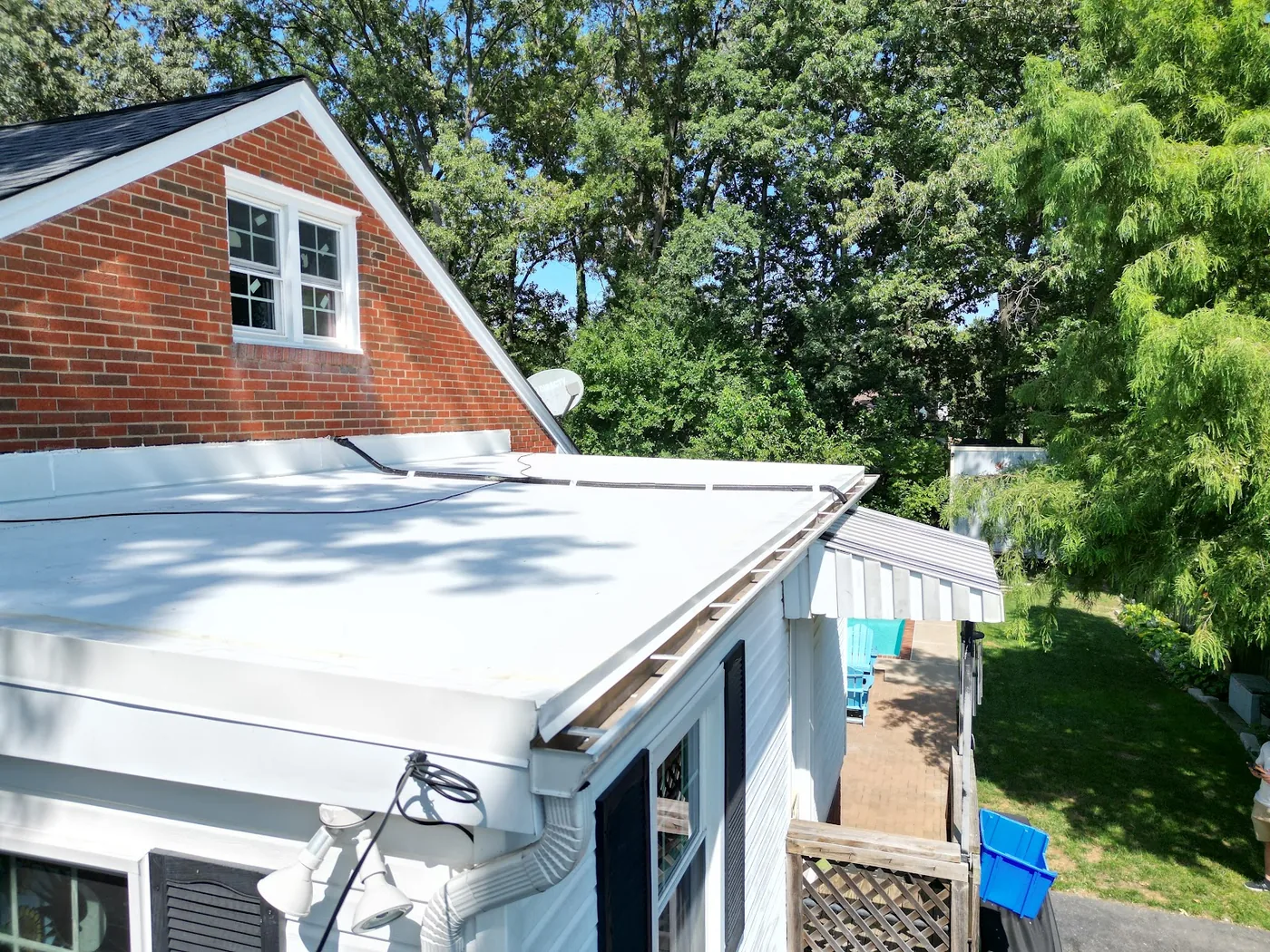
Three kinds of Fairfax roof where TPO usually gets the call
- Single-family houses of the Mosby Woods type, where the first section was dedicated in 1961 and later sections followed through 1983. A rear room, sunroom or carport roof added later can be nearly flat while the main roof is pitched.
- Townhouse-type attached homes, where a bump-out over a kitchen or an entry porch can leak long before the main roof does. Some townhouse decking has to be fire-rated, and how the City treats that is a question for its building office.
- Apartment buildings and small commercial buildings. Fairfax Boulevard, Lee Highway and Main Street carry steady traffic, so on these jobs delivery timing and the spot where a lift or hoist stands are worth settling before the first morning.
A quick fit check before anyone orders a roll of membrane
Find your roof in the first column.
| What the roof is like | Is TPO a fit? | What we look at first |
|---|---|---|
| Flat addition or porch roof with at least a quarter inch of fall per foot | Usually yes | Deck condition, where the water leaves, height of wall flashing |
| Roof that still holds water two days after rain | Not until drainage is corrected | A new drain, tapered insulation or a scupper before any membrane goes down |
| Steep visible front slope | No, wrong system | Shingle or standing seam metal, see our metal roofing page |
| Rooftop kitchen exhaust or regular grease | Only if that exact membrane's chemical statement covers it | The maker's data sheet, or PVC if the exposure is heavy |
Our rule of thumb for the second row is the roofing trade's habit of expecting water to be gone within 48 hours of rain in drying weather.
How a TPO section goes in, step by step
- We photograph the roof and the ceiling below, check the slope with a level and probe the deck for soft spots.
- The old covering comes off. Wet insulation and soft decking leave with it. Where a house roof is wet or already has two layers, the residential code does not allow covering over it.
- New insulation goes down, with a cover board only where the maker's system calls for one, and then the membrane is fastened or adhered.
- Laps are welded with hot air. Sheet that has weathered or got dirty is cleaned first, and the welded edge is probed by hand.
- Walls, drains and pipes get flashing made from the same maker's parts.
- We photograph the finished roof and hand you the set. A manufacturer guarantee may be available depending on the system, and the terms come in writing.
Two typical TPO projects in the City
Your roof will differ, and the inspection decides.
A flat rear room on a 1960s brick house
The house has a pitched main roof, but the family room added at the back has a flat roof of about 250 square feet. The old covering is cracked, a ceiling stain shows near the back wall and the drain at one corner never fully empties. We would check the deck, replace saturated insulation and add taper so water travels to the drain.
TPO would be welded across the new surface, with the brick wall flashing rebuilt and a new drain bowl. The owner sees a ladder, a tear-off, a tarp over open sections at day's end and a photo set afterward. Weather sets the schedule.
A one-story commercial building with rooftop units
A low-slope roof of roughly 4,000 square feet carries three rooftop units and a few pipe penetrations. Seams at the curbs have opened and water shows in a storeroom. Because replacement above 100 square feet of covering on a commercial roof is not permit-exempt, we would call Code Administration about the scope first.
The work would be a moisture survey, tear-off, new insulation, welded TPO with curb flashing and walk pads on the service route. Deliveries would be timed around traffic, and the open area would be closed in each evening.
Storms, trees and the approval trail
On the night of September 3 to 4, 2026, gusts topped 60 mph and 607 City customers lost power, according to FFXnow. The June 2012 derecho put a 71 mph gust on record at Dulles, and the National Weather Service report notes trees falling through roofs. After nights like those, we check membrane edges, drain baskets and branch scrapes first.
On approvals, the statewide code treats houses and commercial roofs differently, so confirm the scope with Code Administration before work begins. Roofs visible from public places inside the Old Town Fairfax historic overlay may also need review through Community Development and Planning at 703-385-7930. We document storm damage with photos for your claim.
Fairfax TPO questions, answered plainly
Does a white TPO roof on a City of Fairfax townhouse or small commercial building need a permit?
It depends on the building and the scope. Virginia's statewide code exempts many residential re-roofs, but replacing more than 100 square feet of roof covering on a commercial roof is not exempt, and decking repairs above 256 square feet are not exempt either. No City page spells out its own re-roof position, so we confirm the scope with Code Administration at 703-385-7830 before we start, and we tell you what they say.
Will the tree canopy over my Fairfax flat roof shorten the life of a TPO membrane?
Trees do not harm the sheet by themselves, but they feed the usual problems: leaves in drains, branches scraping the surface and standing water. The City reports about 40 percent canopy cover as of 2021. A drain you can reach, walk pads where you will step and regular debris clearing all help. Nobody can promise a number of years, because drainage and upkeep decide it.
Is white TPO required in the City, and does it count as ENERGY STAR?
Required, no, as far as we can tell. Virginia's 2021 energy code applies its cool-roof reflectance rule only to Climate Zones 0 through 3, and Virginia's table lists Fairfax County in Zone 4, so white looks like a choice rather than a mandate. ENERGY STAR status belongs to specific products and colors, not to TPO as a class; gray sheets reflect noticeably less than white or tan. Check the exact product, and ask Code Administration how the City reads it.
What do manufacturers really publish about TPO life, and what will you tell me?
Manufacturers publish guarantee terms, not service lives. One major maker lists terms of 5, 10, 15 or 20 years for its 60 mil sheet. An engineering institute notes that early TPO formulations failed prematurely and that TPO roofs in this country now have more than 20 years in service. So we describe a range with its source and never promise a lifespan.
Can TPO cover the steeper front slope of my 1960s house in Fairfax?
Not as a normal choice. TPO is a low-slope system, and steeper planes need a special high-slope sheet plus the maker's approval, and the roof still looks like a flat membrane from the street. If your house is inside Old Town Fairfax or another historic overlay, a change of material visible from public places generally goes through the Board of Architectural Review. Shingles or standing seam metal are the usual answer for a pitched front.
Related Services
Comparing materials or neighboring towns? Start here.
Describe your flat roof to a roofer
Call (571) 453-6515 or book a phone consultation, and give us the street address so we can tell you which permit office applies and what a TPO section would involve.
Book a Phone Consultation