TPO Roofing in Annandale, VA: Where a Welded White Sheet Fits, and Where It Does Not
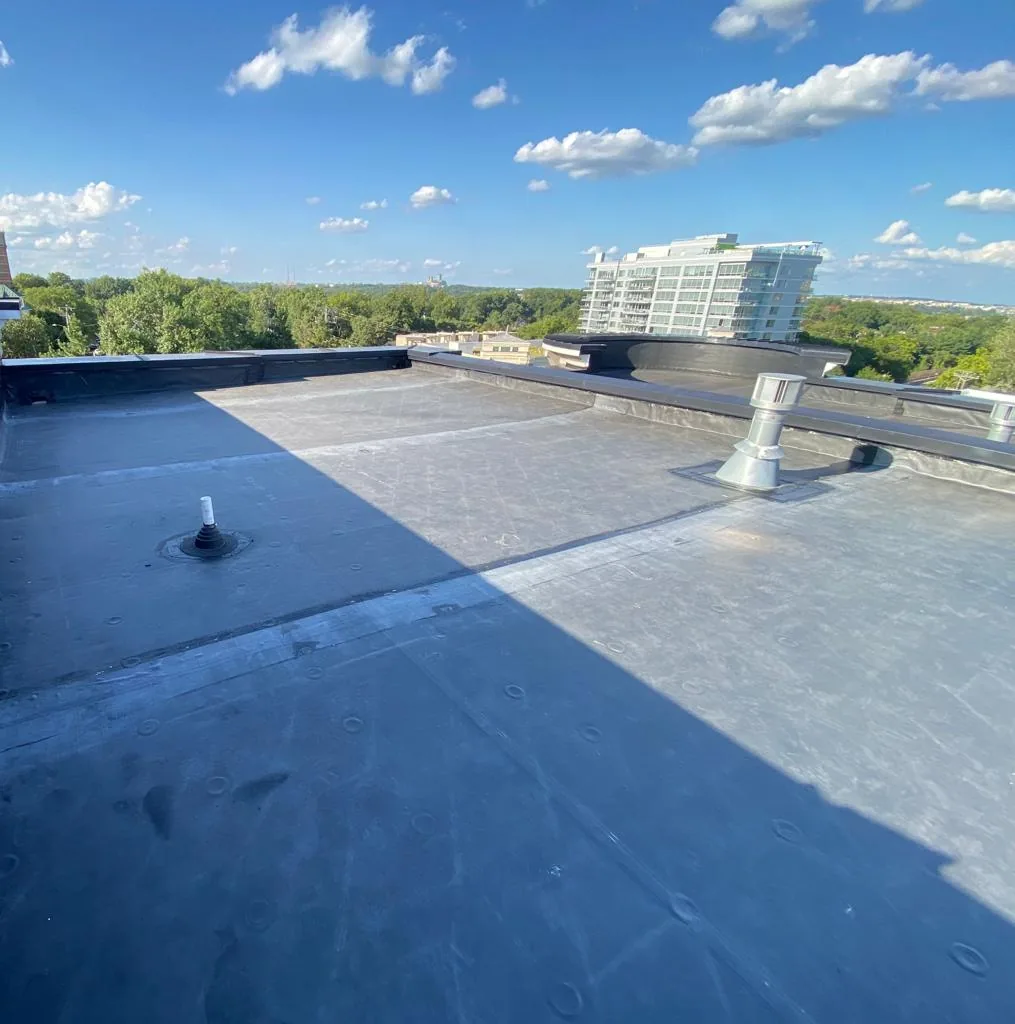
Most roofs in Annandale are pitched, and TPO is not a pitched-roof material. It is a flat-roof sheet. This page covers the few places in town where it earns its keep: townhouse rears, flat roofs over additions, and the low roofs of buildings with several units.
Fit Check: Five Roofs, Five Answers
| Flat rear section of a townhouse | Often a good fit. Fire-rated decking and the county permit question come first. |
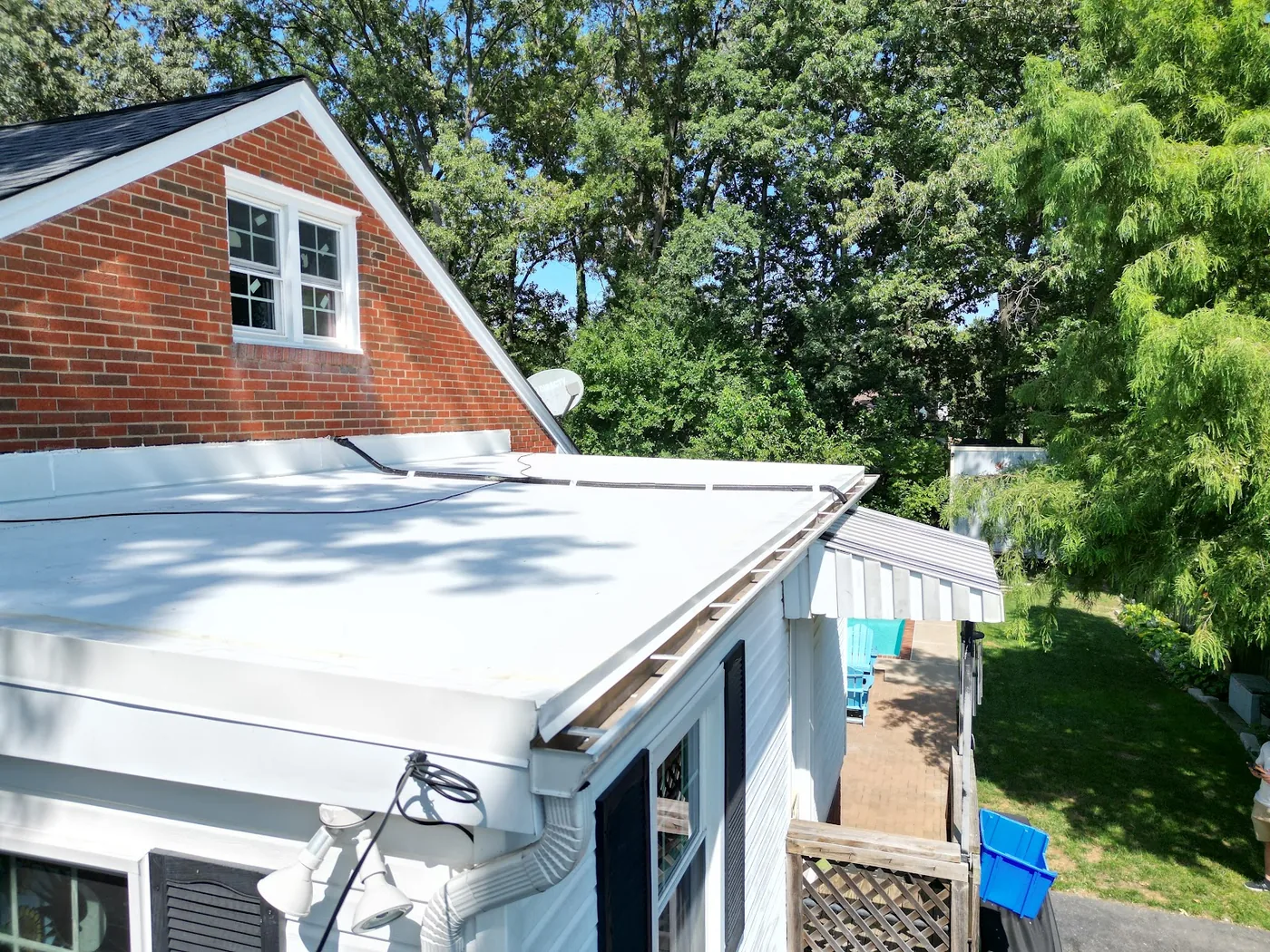
| Flat roof over a family room or garage addition | A good fit when rain can leave the roof within about two days. |
| Low roof on a building with five or more units | Possible. The number of old layers and the board's wishes decide. |
| Steep front slope seen from the street | Wrong tool. Choose shingles or metal. |
| A roof that holds puddles for days | Fix the fall first, then pick the sheet. |
Talk to Reston Roof
Phone ConsultationWhere Flat Roofs Are Likely to Turn Up in Annandale
The census survey for the Annandale community counts 14,474 homes. About 47 percent are detached houses, 17 percent are attached townhouses, and 31 percent sit in buildings of five or more units. The median home dates to 1968, and 56.9 percent were built before 1970. Whether a given house has a flat roof only shows from the roof itself. Nearly half the homes are attached or in larger buildings, which is where low-slope roofs are most likely.
Little River Turnpike carries most of the through traffic, Columbia Pike turns into a divided highway at Gallows Road, and Braddock Road marks the southern edge of the community. On narrow side streets near those corridors, a delivery has to be planned around parked cars and neighbors' driveways, so we ask where a truck can stand before we schedule a tear-off.
The Order of Work on a TPO Re-roof
- Look. We climb up, photograph the surface, drains and wall flashings, and count how many layers are already there.
- Test. A moisture check shows whether the insulation below is wet. Wet insulation comes out rather than being covered.
- Open. The old covering comes off to the deck. Soft boards are replaced, and on a townhouse we ask whether the new boards must be fire rated.
- Shape the water path. Where water has stood, tapered insulation or a new drain goes in. The roofing trade's guideline is no ponding 48 hours after rain.
- Lay and weld. One maker sells sheets 8 to 12 feet wide, so small roofs need few seams. Seams are joined with hot air, and that maker's minimum weld is 1.5 inches wide. A sheet that has weathered is cleaned before it is welded.
- Probe. We run a probe along the welded edges, because a seam that looks closed can still be open.
- Close out. You get photos of the finished roof and flashings, and any manufacturer guarantee terms in writing.
What Makers Publish About Thickness and Life
TPO is sold at nominal thicknesses of 45, 60 and 80 mil. Thicker sheets show better puncture and impact numbers in lab tests, and a lab number is not a promise about your roof. One maker's data sheet lists guarantee terms of 5, 10, 15 or 20 years for its 60 mil sheet, depending on the system. A guarantee term is not a service life.
A building-science institute has noted that TPO roofs in the United States now have more than 20 years in service, while early formulations failed prematurely. So we focus on drainage, welds and flashings, where leaks start.
Two TPO Roofs, Described as Typical Jobs
An end-unit townhouse with a flat roof over a rear kitchen bump-out. The roof is about 9 by 14 feet, with a vent pipe and a brick party wall on one side. The ceiling stains at the wall after hard rain. We would test for wet insulation, open the roof, and ask the county whether the deck boards must be fire rated before anything is ordered. Then we would lay one 60 mil sheet and flash up the brick. The owner sees photos of the bare deck and the finished seams.
A 1960s split-level with a flat roof over a rear family room. The room is about 15 by 20 feet, a scupper is clogged with leaf debris, and the back corner holds a puddle. Two old layers sit on the deck. We would remove both, add tapered insulation to move water to the scupper, and weld a 60 or 80 mil sheet. The owner sees moisture readings, the old layers in the bin and a written scope.
When We Would Talk You Out of TPO
- Water that will not leave. If the roof cannot be made to drain, no sheet fixes that, and maker positions on ponding differ.
- Steeper visible planes. Single-ply is a low-slope system, and houses are better served by shingles or metal.
- Constant foot traffic. Without walk pads, scuffs and punctures follow. A thicker sheet helps but does not cure it.
- Heavy exhaust from a kitchen vent. One maker states its own TPO resists restaurant exhaust, yet resistance varies by product, so for greasy discharge we would compare PVC and read the chemical data first.
- A small porch where rubber is simpler. EPDM may suit a very small roof better.
Which Office Decides What
Annandale has no town hall of its own. It is unincorporated Fairfax County, and Land Development Services is the building official. County guidance lists replacing roof shingles as work without a building permit, and lists roof repairs, chimney repairs and solar panels as work with one. Fire-rated townhouse decking can also bring a permit into play. A membrane job on a townhouse rear is the case where we phone the county before day one.
The Northern Virginia Community College campus carries an Annandale mailing address but belongs to the separate Wakefield community, and Lake Barcroft and Lincolnia are their own places too. If your street has an association, ask it as well, since an association can set its own rules. Our Fairfax County roofing permits guide and the flat roof maintenance notes are good next reads.
TPO Questions From Annandale Owners
Does the deck under my townhouse's flat section have to be fire rated if only the rear is redone?
County guidance exempts replacing less than 256 square feet of roof plywood from a permit, but not where the plywood must be fire rated, and it names townhomes as the example. Whether your rear section falls under that depends on the building and on how much deck we replace. We check the exact scope with Fairfax County Land Development Services before work starts, and we never assume the answer from a neighbor's job.
Can TPO also go on the sloped front of my split-level?
Usually not. TPO is a low-slope system with a code minimum of one quarter inch of fall per foot. Steeper planes need a sheet made for them, and one maker publishes a separate high-slope formulation that needs its own approval. On a front roof people see from the street, shingles or metal normally look better and are the safer match, so that is where we would point you.
My flat roof already has two layers. Can you simply cover it with TPO?
The residential code does not allow a recover when the existing roof is water-soaked or already has two or more applications. A moisture survey tells us whether the old layers are dry. With two layers or wet insulation, the old material comes off down to the deck. Any recover must also follow the maker's rules for that system.
Does TPO color change anything besides looks?
Yes, it changes how much sunlight the sheet reflects. One maker's 2014 data sheet lists an initial reflectance of 0.79 for white and 0.46 for gray, and the federal ENERGY STAR bar for low-slope roofs is 0.65 at the start, so only certain white and tan products qualify. Virginia's 2021 energy code does not require a cool roof in Fairfax County's climate zone, so color is a choice, not a mandate.
Is a thicker TPO sheet worth it on a small roof over a rear addition?
Sometimes. TPO comes in 45, 60 and 80 mil. Thicker sheets post higher puncture figures in maker lab tests, and some makers allow longer guarantee terms on them, though a lab number is not protection in the field. Where ladders, branches or a dish installer will reach the roof, we lean toward a thicker sheet and walk pads. For a roof nobody visits, 60 mil is often reasonable, and the inspection settles it.
Related Services
If TPO is not the right sheet, try:
TPO nearby, in other communities:
Flat roof over a rear room, or a townhouse that leaks at the back wall?
Tell us the street, the type of building and where the stain shows up. We will say whether the roof reads as a TPO candidate, and what we would need to inspect before saying so. Call (571) 453-6515.
Book a Phone Consultation