PVC Membrane Roofing in the City of Fairfax: When Grease and Crowded Roofs Call for It
Welded PVC suits roofs that carry exhaust, many vents or an older flashing detail. This page lays out when it fits and when a simpler membrane is the better choice.
Start with what is already on the roof
A PVC quote begins with questions rather than square footage. What covers the roof today? What leaves the building through it: exhaust, condensate, steam? Where does water go when it stops raining? The answers decide whether PVC, TPO or EPDM fits, and sometimes the answer is not PVC.
This page covers the City of Fairfax, where the building office is Code Administration. A Fairfax-addressed building near George Mason University, Fair Oaks Mall or Mantua is in unincorporated Fairfax County instead and goes to Land Development Services, so we confirm the parcel before we talk permits.
Talk to a roofer by phone
Phone ConsultationThree Fairfax buildings, three PVC conversations
The City's housing mix is 54 percent detached homes, 17 percent attached and 26 percent in buildings of five or more units, per the 2020 to 2024 census survey. Here is where PVC tends to enter the discussion.
Food service and shop buildings
A restaurant roof with hood fans is the classic PVC candidate because of grease. Main Street, Fairfax Boulevard and Lee Highway carry steady traffic, so deliveries and any lift position need planning so the business can stay open and the road stays clear.
Apartment and condominium buildings
Buildings of five or more units hold a quarter of the City's homes, and their roofs combine vents, curbs and drains in a small space. A prefabricated or welded PVC sheet with molded accessories can suit that crowding, though TPO may suit it just as well.
Townhouse-type rows and house additions
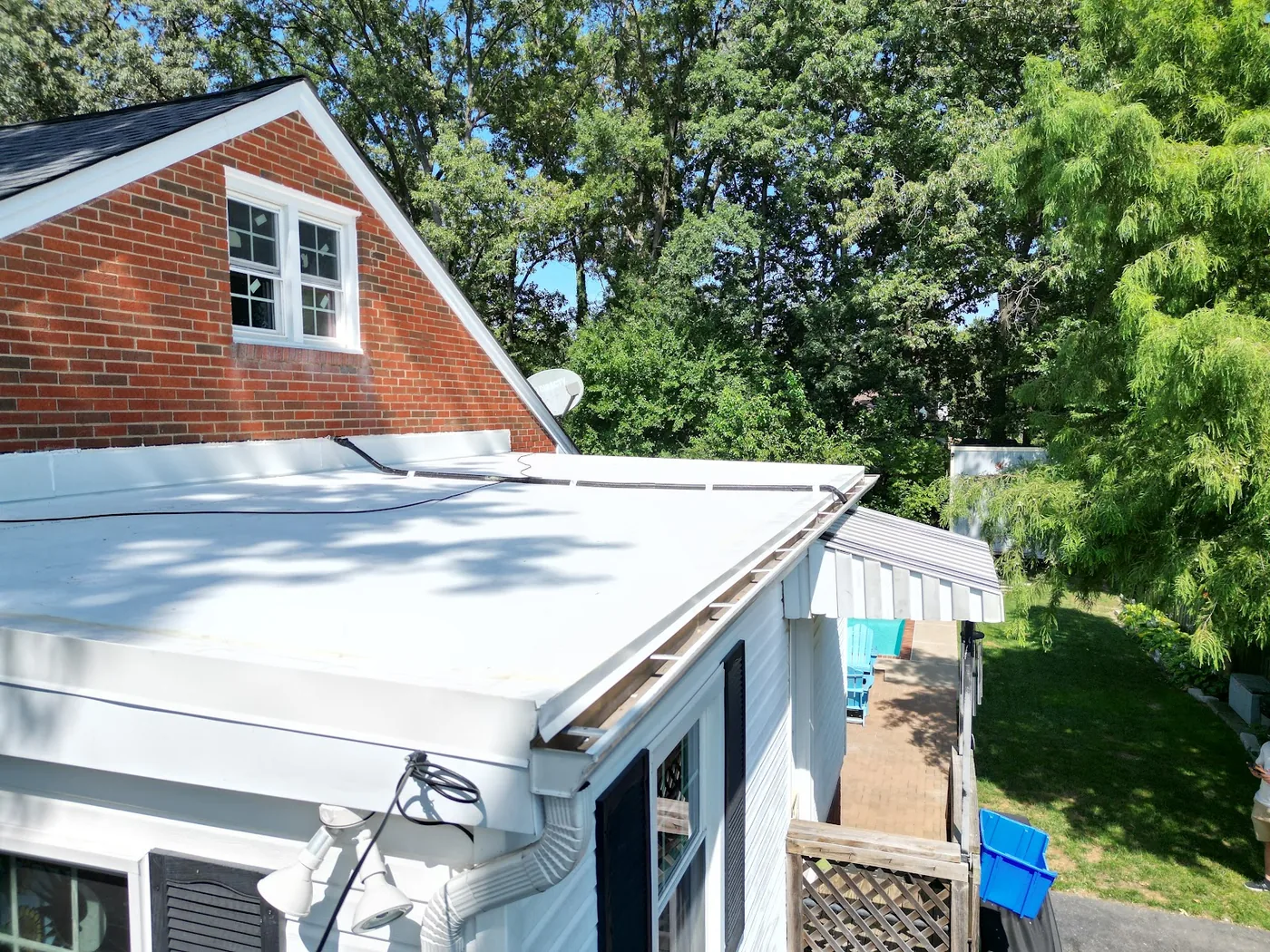
A flat roof on a house rarely sees grease. PVC is worth considering only when the roof has many penetrations or an old rubberized-asphalt detail. For a plain porch roof, EPDM or TPO may meet the need.
Welded sheet: what the makers publish
PVC is plasticized polyvinyl chloride reinforced with a polyester scrim or a fiberglass mat. Laps are joined with hot air, and weathered or dirty sheet needs a membrane cleaner first. Thickness runs from 40 to 80 mil, depending on the maker.
White PVC reports initial solar reflectance of about 0.86 to 0.87 in two makers' sheets, while a gray sheet at 0.59 sits below the 0.65 initial level that ENERGY STAR sets for low slopes. Guarantee terms are published by the makers, up to 25 years at one and 15 to 30 at another, and a guarantee is not a promised service life. A manufacturer warranty may be available depending on the system, and the terms come in writing.
The compatibility checklist we run before ordering
- Old flashing or sealant: is any of it rubberized asphalt that touches the new sheet?
- Exhaust: what leaves the building, how often and where does it land?
- Drains: does water leave within roughly two days of rain, or do we fix the fall first?
- Traffic: where do service staff walk, and does that route need pads?
- Penetrations: how many pipes, curbs and fans, and could prefabricated parts cut seams?
- Insulation below: confirm with the maker what the sheet may touch, because not every insulation pairing has been confirmed for every maker.
- Permits: is the replacement area over 100 square feet on a commercial roof, so Code Administration needs to hear about it?
Two typical PVC projects in the City
These describe how we would scope common jobs, and your building will differ.
A one-story restaurant of about 3,200 square feet
The old membrane is swollen and stained around two kitchen exhaust fans and has split at a curb. We would test for wet insulation, remove the damaged covering, replace saturated board and check every flashing for rubberized asphalt. We would weld PVC, use the maker's chemical chart for the exhaust, and talk with the owner about a grease catch on each fan.
The owner sees a phased tear-off planned so the roof can be sealed each night, a call to Code Administration beforehand and a photo record at the end.
Two attached homes with flat roofs and many vents
A pair of townhouse-type homes shares a flat roof of about 900 square feet with six plumbing vents, a skylight curb and an old rubberized-asphalt wall flashing. We would remove the asphalt flashing and weld PVC with molded pipe boots and a metal wall termination.
The owners see a few days of work depending on weather, a neighbor note about timing and a finished roof photographed in detail.
Inspections, storms and the approval trail
Gusts topped 60 mph on the night of September 3 to 4, 2026, and 607 City customers lost power, according to FFXnow. A welded roof still needs eyes on it: drain baskets, curb flashings and sealants twice a year and after big storms is the maker guidance worth following.
In the Old Town Fairfax historic overlay, a change in appearance visible from public places may need a Certificate of Appropriateness, and Community Development and Planning at 703-385-7930 handles it. Traffic around Kamp Washington and Fairfax Circle, the City's busy gateway intersections, is one more factor when we plan deliveries.
PVC questions from Fairfax roof owners
The kitchen hood on our Fairfax restaurant sends grease onto the roof. Is PVC the safe answer?
PVC is often the first membrane to consider there. One maker states that its PVC is inherently resistant to oils and grease, and another lists enhanced chemical resistance. Resistance depends on the product and the exposure, though, so we match the maker's chemical chart to what your hood discharges. A grease catch on the exhaust fan and regular cleaning still matter. PVC resists the problem; it does not erase it.
Why will you ask about old flashing materials before quoting a PVC roof?
One manufacturer warns that rubberized asphalt can pull plasticizers out of flexible PVC, which can leave the sheet brittle or cracked. If your old roof has rubberized asphalt flashing or sealant, the new membrane must be separated from it with metal or a compatible sealant, or the old material must go. We check that on the first visit, since it changes the scope.
Is a prefabricated PVC roof sensible for a small Fairfax building?
It can be. One maker builds custom sheets with factory-welded seams, so fewer seams are welded up on the roof. That helps on a small roof with many vents and curbs, and it needs accurate measuring before ordering. The trade-off can be less room to change dimensions on site. On a plain rectangle with few penetrations, field-welded sheet may do the same job.
Who reviews a PVC re-roof on a commercial building in the City of Fairfax?
Code Administration, the City's building office at 703-385-7830, reviews building plans and inspects renovations and major repairs. Statewide, replacing more than 100 square feet of roof covering on a commercial roof is not permit-exempt. Confirm the scope with the City before work starts, including any fee and timeline the office gives.
How often should a PVC roof in Fairfax be checked after thunderstorms?
One maker's data sheet recommends inspecting flashings, drains and termination sealants at least twice a year and after each storm, and that is a fair guide for any welded roof. After a night like September 3 to 4, 2026, with gusts above 60 mph, we would look at drain baskets, curb flashings and any spot where a branch could have scraped. Catching a small split early keeps it small.
Related Services
Know what is venting onto your roof?
Call (571) 453-6515 or book a phone consultation. Tell us what is on the roof and what comes out of it, and we will say whether PVC makes sense.
Book a Phone Consultation