EPDM Rubber Roofs for Fairfax Garages, Porches and Townhouse Flats
Cured rubber sheet for small flat roofs on City of Fairfax houses: what it does well, what ruins it, and which building office signs off.
Rubber roofing for Fairfax houses, in short answers
What is it? EPDM is cured synthetic rubber sold in wide sheets. It is black unless you specify a white product, and it is joined with primer and tape or adhesive rather than heat.
Where does it fit? Small flat roofs on houses: rear rooms, porches, deck covers, garage and carport tops, dormer flats and the flat sections on townhouse-type homes. It also covers some commercial roofs.
Where does it not? Anywhere grease, oils or animal fats will reach the surface, on steep visible planes, and on roofs that cannot drain. That comes up at the first visit, before anything is signed.
Talk to a roofer by phone
Phone ConsultationWhat gets checked on the roof before a quote
The census counts 5,061 detached homes among the City's 9,313 housing units, and the median home dates to 1967, so we expect aging flat sections beside newer additions. This is the checklist we walk with each owner.
- Slope and fall: water has to leave within a couple of days, so we look for sag, birdbaths and clogged drains.
- Deck condition from above and from the attic, including stains on the ceiling below.
- What the old covering is made of, because a recover is not allowed over a wet roof or one that already has two layers.
- Wall and chimney edges, since rubber moves with temperature and terminations are where that movement shows up.
- Anything greasy near the roof, such as a kitchen vent that sprays the surface.
- Overhanging limbs and how many leaves the drain sees each fall.
- Where a sheet can be unrolled and where a ladder, a lift or a tarp can stand without blocking a driveway. Deliveries are best timed around traffic on Old Lee Highway and Pickett Road.
Why sheet width and seam count matter on a house
A small roof wants as few joints as possible. Rolls of EPDM are available in very wide widths, so many porch and garage roofs need one sheet and a handful of flashing joints. Trade press says seam trouble is where EPDM problems cluster, usually from dirt, talc left on the sheet, damp surfaces or short curing, so the cleaning and priming before tape goes on is the skilled part.
Rubber also shrinks a little after it is laid. One maker's data lists typical change of about half a percent for 45 mil sheet, which is why edges and wall flashings are detailed to take movement instead of being pulled tight. Sheets come in 45 and 60 mil, and one maker adds a 90 mil option; thicker sheet resists punctures better, and we match it to how much foot traffic the roof sees.
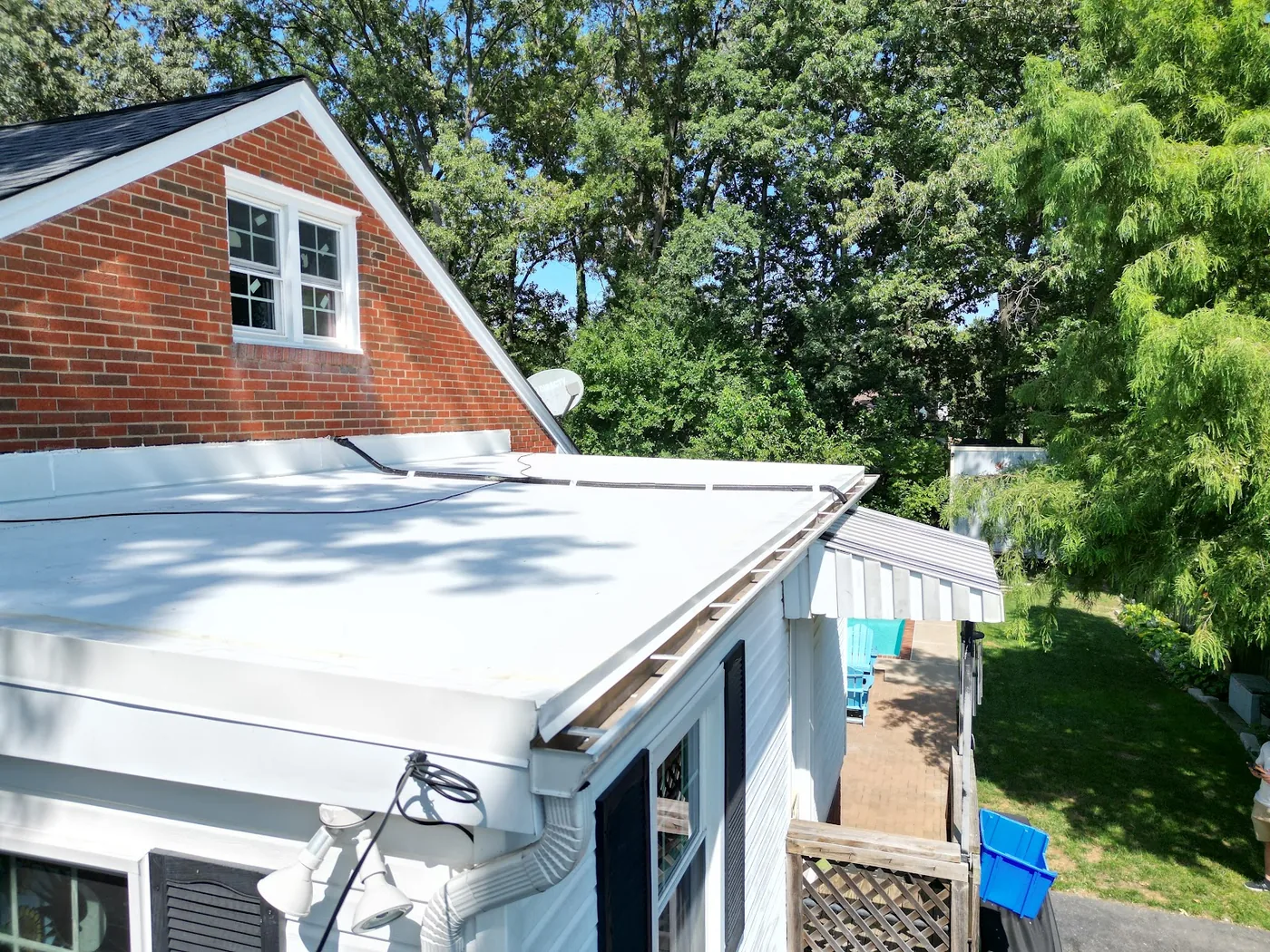
If your roof looks like this, here is what we would do
- Small flat roof under oaks, with a drain: EPDM in 60 mil is a sensible starting point, plus a leaf guard and a clearing habit.
- Flat roof that holds water for days: fix the fall first; TPO or EPDM both fail early on a pond.
- Roof with a grease-spraying vent: not EPDM; look at PVC and the maker's chemical chart.
- Pitched front slope with worn shingles: shingles or metal, not rubber.
- Large commercial roof with many units: a welded sheet may be the better fit.
- Roof you want white: ask for a white EPDM product, or compare a white welded sheet.
Who approves a house roof here
The mailing address does not settle it. Inside the City of Fairfax the building office is Code Administration at 10455 Armstrong Street, Suite 208. The Historic Fairfax County Courthouse on Chain Bridge Road and Old Town Hall on University Drive sit in the City's historic district. Mantua and the Fairfax County Government Center area are not in the City.
For a house, statewide code exempts many re-roofs from a permit, but decking repairs and structural work are not exempt, and we confirm the scope with the City before work starts. In the historic overlay districts, a material change visible from public places goes to the Board of Architectural Review, and like-for-like repair may qualify as ordinary maintenance. Community Development and Planning at 703-385-7930 can say which applies.
Two typical EPDM projects in the City
Each is how we would scope a common roof after a visit.
A detached garage under oak limbs
A one-story house from the 1960s has a detached garage with a nearly flat roof of about 350 square feet. Leaves fill the one scupper each autumn, water stands beside it and the plywood under the old roll roofing has gone dark in one corner. We would replace the damaged plywood (a patch under 256 square feet), form a slight taper toward the scupper and lay a single 60 mil sheet with a rebuilt scupper flashing.
The owner sees a tear-off on day one, a sheet unrolled and taped by the end, and a photo set to keep. We also mark where limbs should be trimmed.
A townhouse bump-out with a fire-rated wall
The attached home has a flat roof of about 120 square feet over a kitchen addition, butted against a shared wall. Water tracks down the wall after heavy rain. We would remove the old covering, check the decking and the wall termination, ask Code Administration how fire-rated decking is treated, and then lay one sheet up the wall with a metal termination bar.
The owner sees a short job with careful work at the party wall, and a clear note about what the City said.
After the June 2025 storm and the September 2026 one
A June 19, 2025 thunderstorm brought winds reported up to 66 mph at Dulles and cut power to more than 70,000 county customers at its peak. On the night of September 3 to 4, 2026 gusts topped 60 mph and 607 City customers lost power. Canopy covers about 40 percent of the City, so roofs with a single scupper or drain, like those on any wooded street, get checked first for blocked outlets and punctures.
What Fairfax owners ask about EPDM
My flat rear-room roof is about the size of a one-car garage, so how many seams would EPDM need?
Possibly one or none in the field. Rolls come wide: one maker lists widths up to 50 feet, and another offers sheets up to 10 feet with factory-applied seam tape. A roof that size can often be covered by a single sheet or one lap. The joints that remain are at walls, corners and pipes, and those flashing details matter more than the field. We measure first and then tell you the real seam count.
Black rubber on a Fairfax porch roof: will it make the room below hotter?
Standard EPDM is black, and black absorbs heat. White EPDM exists, and one maker's white sheet lists an initial solar reflectance of 0.77. Virginia's energy code does not require a cool roof in this climate zone, so color is your call. One manufacturer argues dark roofs help in colder regions, but Northern Virginia is a mixed climate and we would not rely on that. For a conditioned room we would discuss white EPDM or another membrane.
A limb came down on my EPDM roof in a thunderstorm. What should I do first?
Stay off the roof, photograph the damage from the ground and inside, and move belongings away from any drip. Call us and we can tarp the area and document the damage with photos for your claim. Rubber punctures are patched with primer and tape on a clean, dry surface. Rules on removing large trees can apply inside the City, so check with the City before cutting anything big.
Should the flat section over my Fairfax townhouse bump-out be EPDM or TPO?
Both are single-ply sheets for low slopes. EPDM is cured rubber joined with tape or adhesive, and it suits a small, simple section with few penetrations. TPO is welded and comes in white, which can win when the section has many pipes or when you want a lighter color. Neither is automatically better. We pick after looking at drainage, the number of penetrations and how the fire-rated wall detail was built.
Does an EPDM re-roof on my house in the City of Fairfax need a permit?
Virginia's statewide code exempts many residential re-roofs, but decking repairs over 256 square feet and non-exempt repairs need one, and the City's building office is Code Administration. Call 703-385-7830 to confirm the scope before work starts. If your home is in the county instead, Land Development Services lists shingle replacement as no permit and roof repairs as permit work.
Got a flat roof near the oaks?
Call (571) 453-6515 or book a phone consultation. We will ask for the street, because a City parcel and a county parcel go to different offices.
Book a Phone Consultation