TPO membrane on the flat parts of a Fairfax Station house
The Census Bureau counts 4,165 housing units in the Fairfax Station community, and 85.1 percent are detached houses. A TPO job here is rarely a whole building. It is a flat section on a house: an addition, a rear porch, a garage or a bay. This page says when a welded white sheet suits that section and when it does not.
Find your roof in this list
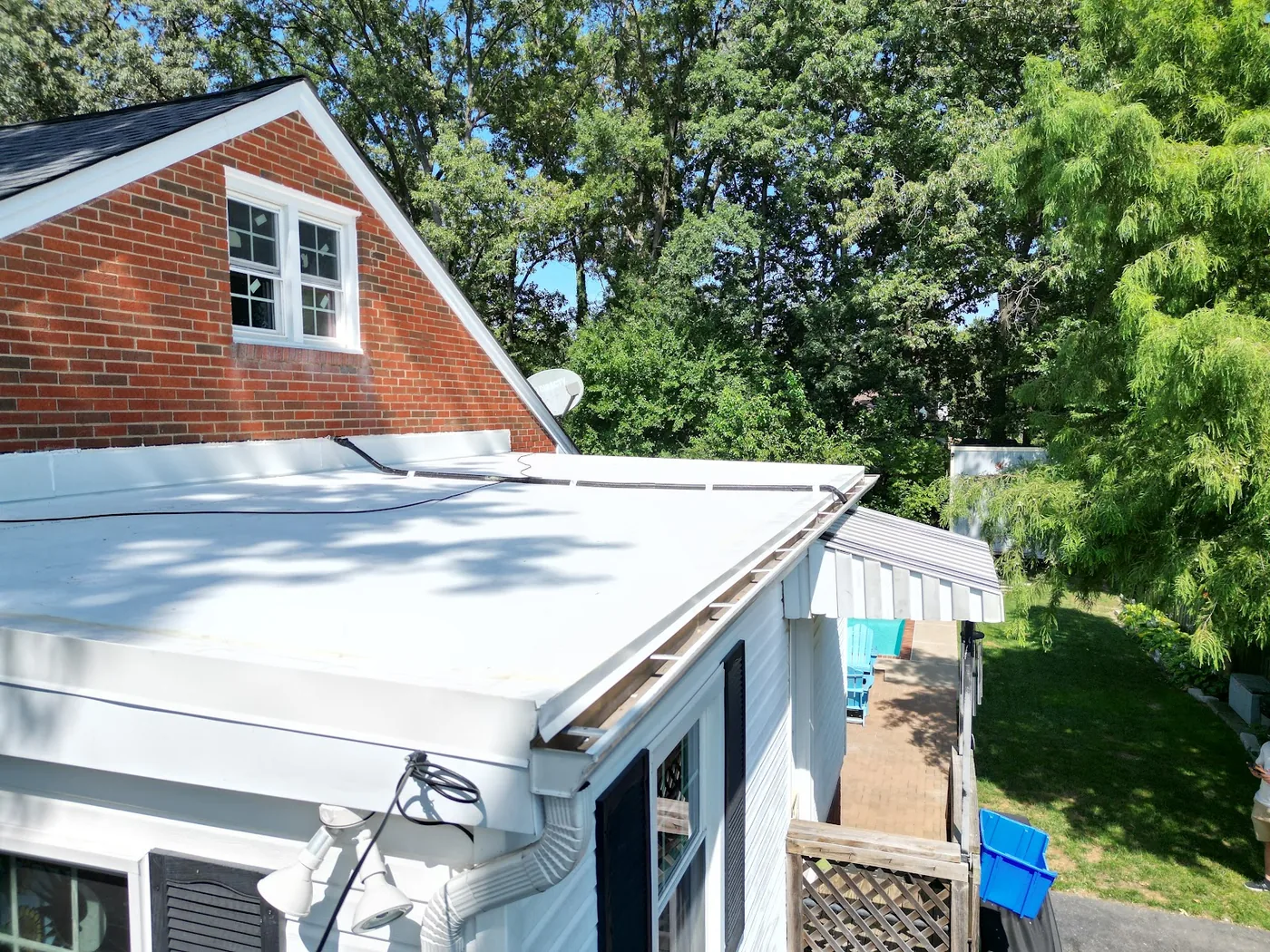
- If it is the flat roof over an addition or a rear room, then TPO is usually a strong fit. The code allows thermoplastic single-ply down to a quarter inch of fall per foot, and one maker sells field sheets up to 12 feet wide, so a roof this size can end up with only a seam or two.
- If water stays on it more than about two days after rain, then the fall gets fixed first. The National Roofing Contractors Association treats ponding beyond 48 hours in drying weather as harmful, and makers differ on how they treat ponding in a guarantee. We would add tapered insulation or a scupper before any sheet goes down.
- If it is a dormer top or any visible roof with real pitch, then TPO is the wrong tool. It is a low-slope system, and one maker sells a separate high-slope formulation that needs its own approval. Shingles or metal suit those roofs better.
- If a kitchen vent or a grill discharges grease onto it, then check the maker's chemical statement for that exact sheet. One maker states resistance to restaurant exhaust for its own product, but products differ, and PVC may be the safer match.
- If it is a townhouse section, then the deck may need to be fire rated. Fairfax County says replacing less than 256 square feet of roof plywood needs no permit unless it must be fire rated, and it names townhomes as the example. Any association approval is a separate step we raise early.
What the building years tell us
The Census Bureau's 2024 estimates give Fairfax Station a median build year of 1982. About 80 percent of homes went up between 1970 and 1989, and only 5.1 percent predate 1970. This is not a market of 1950s ranchers, and it is not mostly new construction. A flat section original to a 1982 house is now more than four decades old. What matters is the condition of the membrane, the deck and the drain, not the build year.
Thickness at a glance
| Nominal sheet | Over the scrim (one maker) | Lab puncture minimum | Where we would consider it |
|---|---|---|---|
| 45 mil | 0.018 inch | 250 lbf | A quiet roof with a sound deck |
| 60 mil | 0.024 inch | 300 lbf | The middle choice for most house sections |
| 80 mil | 0.034 inch | 400 lbf | A roof that gets walked on or sits under falling debris |
These are one manufacturer's published figures and lab tests. They describe the sheet, not what a falling limb will do.
How a TPO job runs, in order
- We measure the fall, probe for wet insulation or a soft deck, and count how many layers the old roof has.
- The old covering comes off to the deck. A recover is possible only over a dry, sound roof with fewer than two applications, and a TPO sheet blocks vapor, so any trapped moisture stays trapped.
- Insulation is fastened at the density the maker's specification asks for, with tapered pieces where water needs a path.
- The sheet is mechanically fastened or adhered, as the deck and the maker allow.
- Seams are hot-air welded. One maker's welds are at least an inch and a half wide, and weathered sheet is cleaned before it is welded.
- We probe the weld edges along every seam, then flash the walls, pipes and edge metal.
- You get photos of the deck, the seams and the flashings before we leave.
Two typical Fairfax Station TPO projects
A family room addition on a two-story house from the 1980s
The flat roof is about 14 by 20 feet, a little under 300 square feet, and water stands beside the downspout where the old covering has worn thin. We would tear off to the deck, replace any damp insulation, set tapered pieces toward the drain and lay one white 60 mil sheet in two widths with a single welded seam. Fairfax County's plywood line is 256 square feet, so if the whole deck proves soft, we call Fairfax County Land Development Services before we start. The owner sees weld probing on site and a note on keeping the drain clear.
A rear flat section on a townhouse
Attached homes are 14.9 percent of units here, so some roofs share a wall with a neighbor. The section is roughly 9 by 12 feet over a rear bump-out, with a wall of siding on one side and a shared wall on the other. The deck may need to be fire rated, which the county names as a permit trigger for townhomes, so we confirm scope with the county first. The sheet is 60 mil, the flashing climbs the party wall as the maker details it, and access should be agreed with the neighbor before the ladder goes up.
Permits: the county, and one exception
Fairfax Station is unincorporated Fairfax County, so Fairfax County Land Development Services is the building official. County guidance lists replacing roof shingles as work that does not need a building permit, but it lists roof repairs and chimney repairs as permit work, and fire-rated townhouse decking can also trigger one. We check your exact scope with the county before we start. The Town of Clifton, just west, is separate and has its own review, so tell us if your address is inside it. Our Fairfax County roofing permits guide goes deeper, and the flat roof maintenance article covers upkeep after the job.
Frequently Asked Questions
Can the flat roof over my family room addition be TPO when the rest of the house has shingles?
Yes, that is the most common pairing. Shingles cover the pitched roof and a welded single-ply sheet covers the flat part, with metal and flashing where the two meet. The code asks for at least a quarter inch of fall per foot on thermoplastic single-ply. We check the slope, the deck and the wall junction first, and we tell you if the flat roof needs a different fix.
Does replacing a flat section need a county permit, or is it treated like shingles?
County guidance lists replacing roof shingles as work without a building permit, but it lists roof repairs as permit work, and state code adds limits for decking over 256 square feet and for fire-rated decking. A flat section is not a shingle job, so we do not assume. We describe your exact scope to Fairfax County Land Development Services before we start.
Is 60 mil enough for a small roof, or should I ask about 80 mil?
One maker lists 0.024 inch over the scrim for 60 mil and 0.034 inch for 80 mil, with lab puncture figures of 300 and 400 pounds-force. Those are lab numbers, not a promise about branches or foot traffic. If the roof is walked on or sits under limbs, 80 mil or walk pads are worth a conversation. For a quiet roof, 60 mil is often reasonable.
How do I know whether my old flat roof can be covered over instead of torn off?
The residential code does not allow a recover over wet roofing or where two or more applications already exist. Because a TPO sheet blocks vapor, wet insulation trapped under it is a real concern. We probe the roof, count the layers and check the maker's rules. On many older flat roofs a tear-off to the deck is the likelier outcome, and the reasons should be shown to the owner.
Is white TPO a county requirement or only an option here?
It is an option. Virginia's 2021 energy code applies its cool roof table only to Climate Zones 0 through 3, and Fairfax County is in Zone 4A. ENERGY STAR listing is also product specific: one maker's gray TPO measures well below the 0.65 initial reflectance threshold, while its white and tan sheets are listed. Color is a choice, so pick by cooling needs and association rules.
Reaching a flat roof from Ox Road to Burke Lake Park
Reston Roof, based in Reston, expects to reach most Fairfax Station addresses by Ox Road, which is Route 123, or by the Fairfax County Parkway, Route 286, which curves through the middle of the community. Burke Lake Park, at 7315 Ox Road, carries a Fairfax Station address even though Burke is a separate place, so we look up the parcel before we quote. See the service area page for the wider list.
A flat roof that holds water?
Send a photo of the roof after rain, the drain and the wall it meets. The reply covers whether TPO fits or whether the fall needs fixing first. Call (571) 453-6515.
Book a Phone Consultation