Rubber roofing for the small flat roofs on older Silver Spring houses
Silver Spring's median year built is 1964, and about 10,600 of its homes are detached houses. Houses of that age may have gained sunrooms, kitchen bump-outs, porches or garages over the years, and those little flat roofs are where a single sheet of EPDM earns its keep.
Three older neighborhoods, and what is known about them
Woodside Park was platted in 1923 between Georgia Avenue, Colesville Road, Dale Drive and Spring Street. The state's inventory form describes bungalows, Colonial Revival houses, Tudor and Cotswold cottages and Cape Cods, then postwar ranches and split-levels, and counts 293 of about 415 houses in the original portion as built before 1941. No record tells us which of those houses gained flat-roofed additions, so we learn that on the roof.
Indian Spring grew around the Silver Spring Golf Club, founded in 1921, with most of its homebuilding in the 1940s and 1950s, and it borders the Capital Beltway and Franklin Avenue. Lyttonsville was settled in the 1850s and is described as mostly single-family. Roof material and age vary from house to house, so each roof is judged on the roof itself.
If this is your roof, then this is the plan
- If it is flat and about the size of a room, one sheet of rubber can often cover it without a field seam.
- If water stands on it for days, we correct the fall first. A new sheet does not cure a dip.
- If large trees overhang it, consider thicker rubber and keep the drain clear.
- If a grill, kitchen fan or cooking vent is nearby, read the PVC page instead.
- If the roof is pitched and visible from the street, rubber is the wrong tool. Look at metal or shingles.
- If you own a large flat roof over several units, start with the TPO page.
What rubber does well, and where it fusses
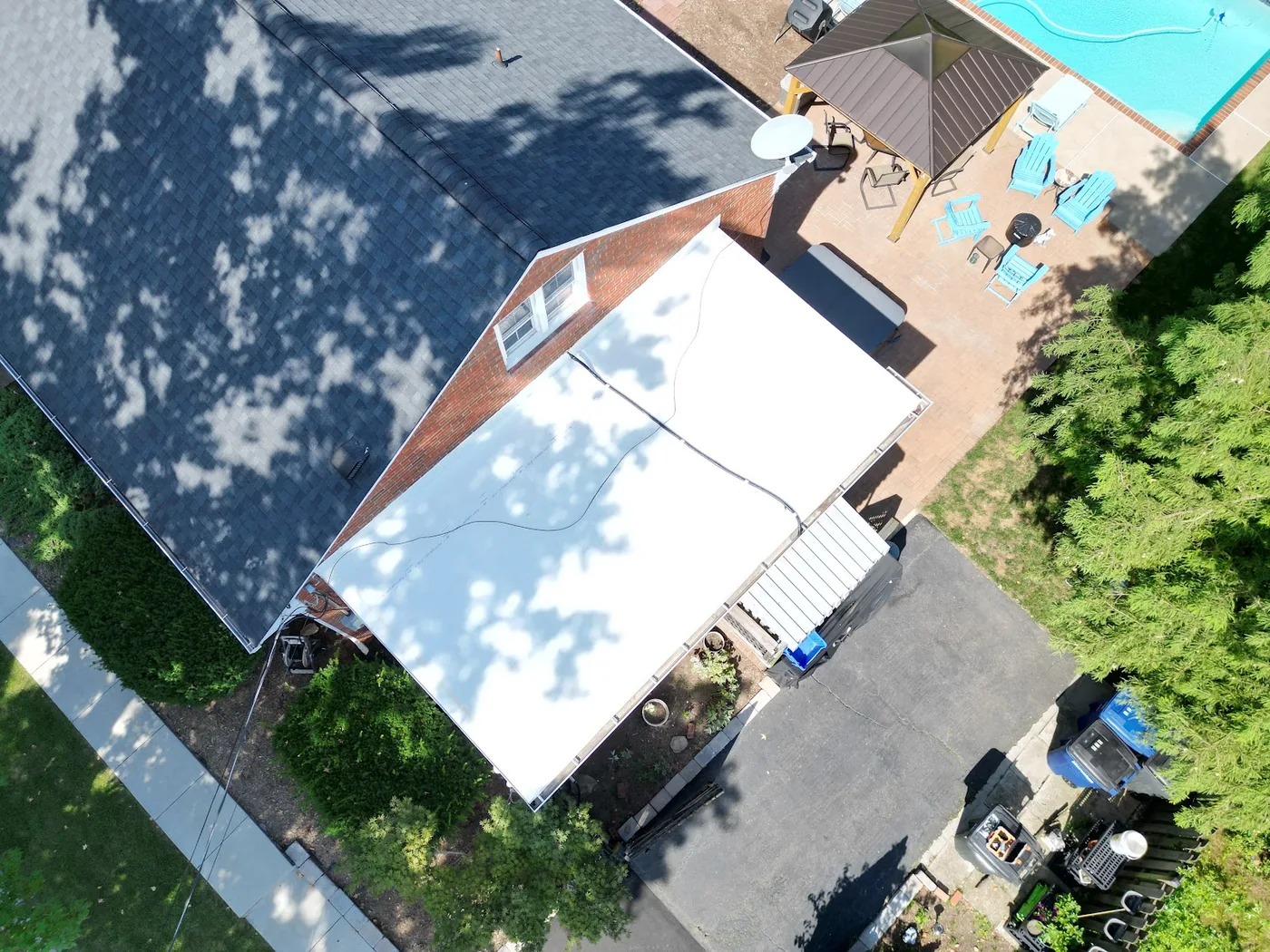
EPDM is a cured synthetic rubber, black as sold unless you ask for a white product. One maker rolls it up to 10 feet wide with seam tape already applied, and another sells widths up to 50 feet, so a small roof may have no field seam at all. Where a seam is needed, it is made with primer and tape or splice adhesive, and trade writers trace many failures to dirt, talc or dampness on the lap. A clean, dry lap matters most.
Rubber also shrinks slightly. One data sheet gives a typical figure near half a percent for the thinnest sheet, with a limit of one percent. That small pull explains why corners and wall terminations get extra care. Grease is the other enemy: that maker says to keep fats and oils away from the sheet. A white rubber product with a published 0.77 starting reflectance exists if you want a lighter roof over a sunroom, and thickness runs 45, 60 and, at one maker, 90 mil.
The Takoma Park line
Takoma Park is a separate city on the edge of downtown Silver Spring, and its own page for construction lists what can be needed. Roads such as Sligo Creek Parkway and New Hampshire Avenue begin in Takoma Park, so the parcel decides whose rules apply.
| Item | What the City says |
|---|---|
| Municipality letter | Required before work that needs a county permit; no fee, and the City says it is not a permit. The page does not say whether a re-roof needs one, so check with the City. |
| City permits | Tree protection, stormwater, and right-of-way items such as a driveway apron, a street dumpster or a fence. A Stop Work Order can follow if skipped. |
| Historic district | A county Historic Area Work Permit applies to property in the Takoma Park historic district, which sits in Takoma Park, not Silver Spring. |
Two typical EPDM jobs in Silver Spring
A sunroom roof behind a 1930s Colonial in Woodside Park
The sunroom roof measures about 11 by 13 feet and drains to one gutter. A large oak overhangs it, and a brown stain has appeared where the roof meets the house. We would remove the tired covering, look at the wall flashing and the deck edge, and lay a 60 mil sheet in one piece with fresh termination at the wall. The owner sees photos of the bare deck and a written scope, and decides between black and white rubber.
A detached garage behind a 1950s ranch in Indian Spring
The garage is about 20 by 20 feet with a nearly flat roof, and the old covering has split where a branch fell. We would check for soft deck near the low corner, adjust the fall with tapered insulation if water has been pooling, and cover the roof with a single sheet. If more than a patch of deck needs replacing, the county should be asked what applies before work starts, since it publishes no threshold. The owner receives photos of every stage.
Rubber Roof Questions From Silver Spring Owners
Does a dumpster in front of my Takoma Park porch need a City permit?
If it sits in the street, the City of Takoma Park lists dumpsters among right-of-way items that need a City permit. A dumpster on your own driveway does not. Tree protection and stormwater work have City permits too. The City Engineer's office at 301-891-7620 answers right-of-way questions, and it is worth asking before a container is ordered, not after it arrives.
A limb came through a roof on Woodside Parkway in January 2024. Can rubber take that kind of hit?
No membrane is built to stop a falling limb, and a branch heavy enough to break a deck is a structural and claims matter before it is a roofing one. Thicker rubber does resist twigs, acorns and scuffs better. After a hit we tarp the roof, photograph the damage for your claim, and put the permanent repair in writing.
Do I need a county permit to replace the rubber on a rear porch roof?
Montgomery County lists replacing the roof covering only among work that most likely needs no permit, but it also says its list leaves out municipality and association rules, and structural work is different. The county posts no threshold for replacing deck boards. Your exact scope should be confirmed with the Department of Permitting Services before work starts.
What keeps rain from running behind the rubber where it climbs the house wall?
The sheet turns up the wall and is finished at the top with the maker's termination pieces and sealant, set into sound siding or masonry. Rubber shrinks a little as it ages, so the top edge and the corners get the most attention. We look at the wall first, because a crumbling brick joint or loose siding board can defeat a perfect sheet.
Is a lifting seam on my rubber roof a quick patch, or is the sheet finished?
One lifted seam on an otherwise flat, supple sheet can be cleaned, primed and re-taped. Several lifted seams, a hard or cracked surface, or wet insulation below point to a larger job. We press the seams, check the sheet for brittleness and take a moisture reading, then give you both paths with photos so the choice is yours.
Reaching Silver Spring from Reston
Reston Roof is based in Reston, Virginia, and travels into Silver Spring for porches, sunrooms and garage roofs. We mostly do residential work and tell you when a roof is beyond what we should take on. Our service area page lists the other places we visit.
Tell us about the flat roof at the back of your house
Share its size, what it drains to and where the ceiling is marked. We will say whether rubber suits it and which offices to ask first. Phone (571) 453-6515, or book a time.
Book a Phone Consultation