TPO roofing in Silver Spring, MD: the flat roof usually belongs to a building, not a household
Census estimates for 2020 to 2024 count 35,774 homes in the Silver Spring census-designated place, and 21,613 of them sit in buildings of five or more units. Detached houses are 29.6 percent. A white membrane here is more often a shared decision than one family's.
Five flat roofs, five people to call first
| The roof | Who decides | Where TPO stands |
|---|---|---|
| A mid-rise apartment or condominium building in Downtown Silver Spring, where the Metro station opened in 1978 | The owner, or the board through a property manager | A normal candidate if the roof is low-slope and drains; we check fall, drains and layers first |
| A low-rise building from the 1960s, the decade that built the most homes here (7,511) | Owner or association board | Common fit, done in sections so the top floor stays dry |
| A townhouse with a flat rear section | The owner, plus any association | Good fit once we know what the decking is |
| A flat addition or porch on a detached house | The owner | Works, though a tiny roof may suit rubber better |
| Any roof that catches kitchen exhaust | Owner and the restaurant's landlord | Read the PVC page before choosing |
What the building's age tells us, and what it cannot
The same Census table puts the median year built at 1964 and counts 14,577 homes, 40.7 percent, built before 1960. That suggests many buildings are old enough to have been re-roofed at least once. How many layers sit on a deck is settled with a small test cut, not by the age of the building.
Getting to a building matters too. Georgia Avenue and Colesville Road run through the center of town, and East-West Highway is a main east-west link. For a staged job we ask the manager where the roll trucks may stop and where material can wait, because a loading plan that ignores the street holds up everyone.
Welds, thickness and standing water
TPO is a thermoplastic sheet with a polyester fabric layer inside, so overlaps can be fused with hot air rather than glued. One maker asks for a weld at least an inch and a half wide, and sheet that has weathered or collected dirt is cleaned first, since fusion will not take on a dirty surface. Each welded edge is then probed with a tool to find any spot that did not bond.
Sheets come in 45, 60 and 80 mil. Heavier sheet posts better laboratory puncture numbers, and we pick by traffic and penetrations, not by habit. Water is the other test: the trade expects a flat roof to be dry within 48 hours of rain. A roof that holds water longer gets its fall corrected before any membrane goes on.
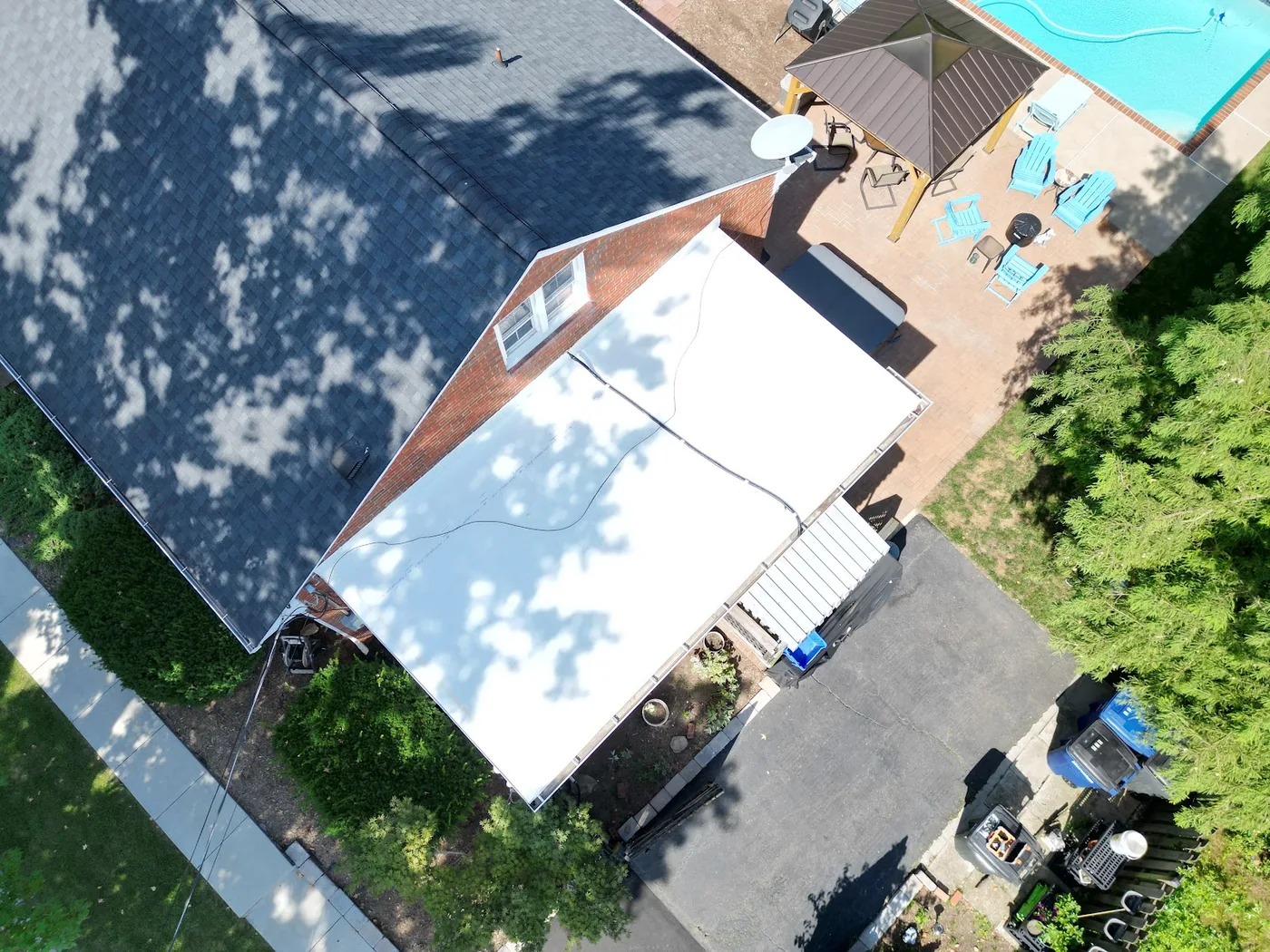
How one section goes down on an occupied building
- Walk the roof with the manager and mark every drain, pipe, hatch and curb.
- Cut a small test opening to count layers and look for wet insulation.
- Draw a section map so only part of the roof is open at a time.
- Replace soaked or crushed insulation, and add tapered pieces where water gathers.
- Lay the sheet, weld the laps, probe them, then flash walls, curbs and pipes.
- Photograph the closed section and send the pictures to the manager before the next section opens.
White sheet reflects most sunlight. One 2014 data sheet lists 0.79 for new white TPO, while its gray sheet lists 0.46, so the color you choose changes the number. Reflectance listings belong to specific products, which is why we quote the product, not the material class.
Where the county's published list stops
Montgomery County's Department of Permitting Services, based at 2425 Reedie Drive in Wheaton, publishes a short home improvement list that names replacing the roof covering only among work that most likely needs no permit. That list is written for homeowners and says it leaves out municipality and homeowner association rules. Structural work is not an ordinary repair under county code, and apartment, condominium or commercial buildings are a separate question. For those roofs, DPS (240-777-0311) should be asked before work is scheduled.
One border matters: if the building is inside the City of Takoma Park, the City asks about its own items, including a dumpster in the street. The Silver Spring overview explains how to tell which side of the line you are on.
Two typical TPO jobs in Silver Spring
A three-story building near Georgia Avenue with a leak over two top-floor units
The roof is roughly 60 by 90 feet, with two interior drains, four vent pipes and a stair bulkhead. Stains return at the same two ceilings after heavy rain. The board has asked for a full replacement, and the manager wants the building kept dry throughout. We would take moisture readings, open test cuts, and divide the roof into sections. Wet insulation comes out, tapered pieces go in near the drains, and a 60 mil white sheet is welded down with walk pads where residents reach the hatch. The board receives the section map and photos of each closed section.
A rear kitchen roof on a 1950s house in Woodside Park
The flat roof over the kitchen is about 14 by 16 feet and meets a brick wall, where the old flashing has pulled loose. Water has marked one ceiling corner. We would strip the old covering and check the deck for soft spots. The county publishes no plywood threshold, so DPS should be asked whether any deck repair changes the answer. A single welded sheet turns up the wall under new flashing. The owner sees the open deck in photos and decides on the final scope in writing.
TPO Questions From Silver Spring Owners
Who has to approve a new membrane on the roof of a Silver Spring condominium?
Usually the board or the property manager who signs contracts for the association, and sometimes a vote of owners first. The county says it does not enforce covenants and deed restrictions, so the governing documents are yours to read. We ask for written authorization from whoever signs, and Montgomery County permitting is the place to ask what applies to a multi-unit building before any date is set.
How wide are TPO sheets, and does that matter on a small stair-tower roof?
One maker lists field sheets 8, 10 and 12 feet wide, with narrower perimeter sheets of 4 and 6 feet. On a small roof that means few welded laps, and fewer laps means fewer places to check. Wide sheets are harder to carry up a narrow hatch, though, so access is part of the plan. We measure the roof and the way up before we choose roll widths.
Top-floor residents see a stain at the same corner after hard rain. Is the membrane to blame?
Often the open field of the roof is fine and the water enters at a detail: a wall flashing, a drain bowl, a pipe boot or a curb. We trace the stain upward, test the suspect detail and report what we find before recommending a full replacement. If the insulation under the area is wet, a spot repair will not hold.
TPO is a newer material than rubber. Is it old enough to trust on a building I manage?
A professional institute for building envelope specialists notes that early TPO formulations failed prematurely, and also that TPO roofs in this country now have more than 20 years in service. Current sheets are tested against tougher weathering requirements. The manufacturer's guarantee terms are separate from service life, and they come to you in writing from the maker.
Can new TPO simply go over our old roof to avoid a tear-off?
Sometimes the membrane maker allows a recover, but only over a dry, sound roof, and the sheet itself blocks moisture from escaping upward, so wet insulation trapped below is the danger. We take moisture readings before suggesting it. The county permitting office and the maker should both be asked before anyone agrees.
Related Services
- EPDM rubber for small porch and garage roofs
- PVC where grease and clutter reach the roof
- Metal panels for pitched house roofs
- Roofing in Silver Spring
- TPO roofing in Bethesda, down East-West Highway
- TPO roofing in Washington, DC
- TPO and EPDM compared for larger roofs
- A maintenance checklist for commercial roofs
Where we travel from
Reston Roof is based in Reston, Virginia, and takes calls for Silver Spring buildings and houses. Four Corners and Forest Glen often carry a Silver Spring address too, so give us the street and we sort out the rest. The service area page shows where else we go.
Send us the roof and the building's name
Tell us whether it is a condominium, an apartment building or a house, what the ceiling below shows, and who signs for repairs. We will say whether TPO fits. Call (571) 453-6515 or book a time.
Book a Phone Consultation