TPO Roofing in Bethesda, MD: Flat Sections on Houses, Attached Homes and Small Buildings
A pitched roof wants a different covering. TPO is for the flat part: the back addition, the porch top, the garage, the attached-home roof with a drain. Here is where it fits and what the county says first.
Where the Flat Roofs Are
The Census Bureau's 2020 to 2024 estimates count 30,095 homes in the Bethesda area. About 52.9 percent are detached houses, 3.9 percent are attached homes of the townhouse type, and 34.6 percent sit in buildings of 50 or more units. The median home dates from 1970, and 50.6 percent were built before that year. These numbers only hint at who is likely to own a flat section.
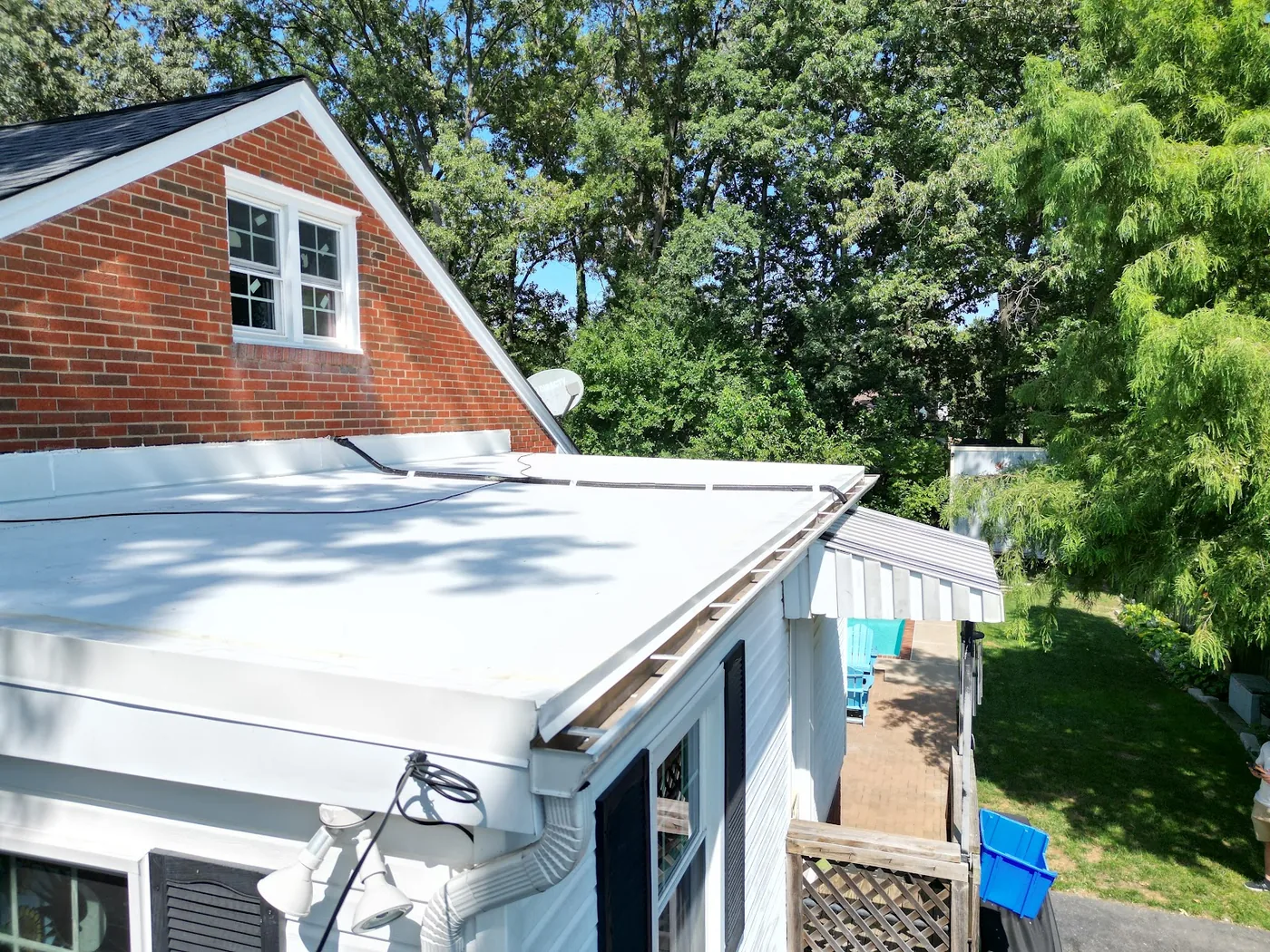
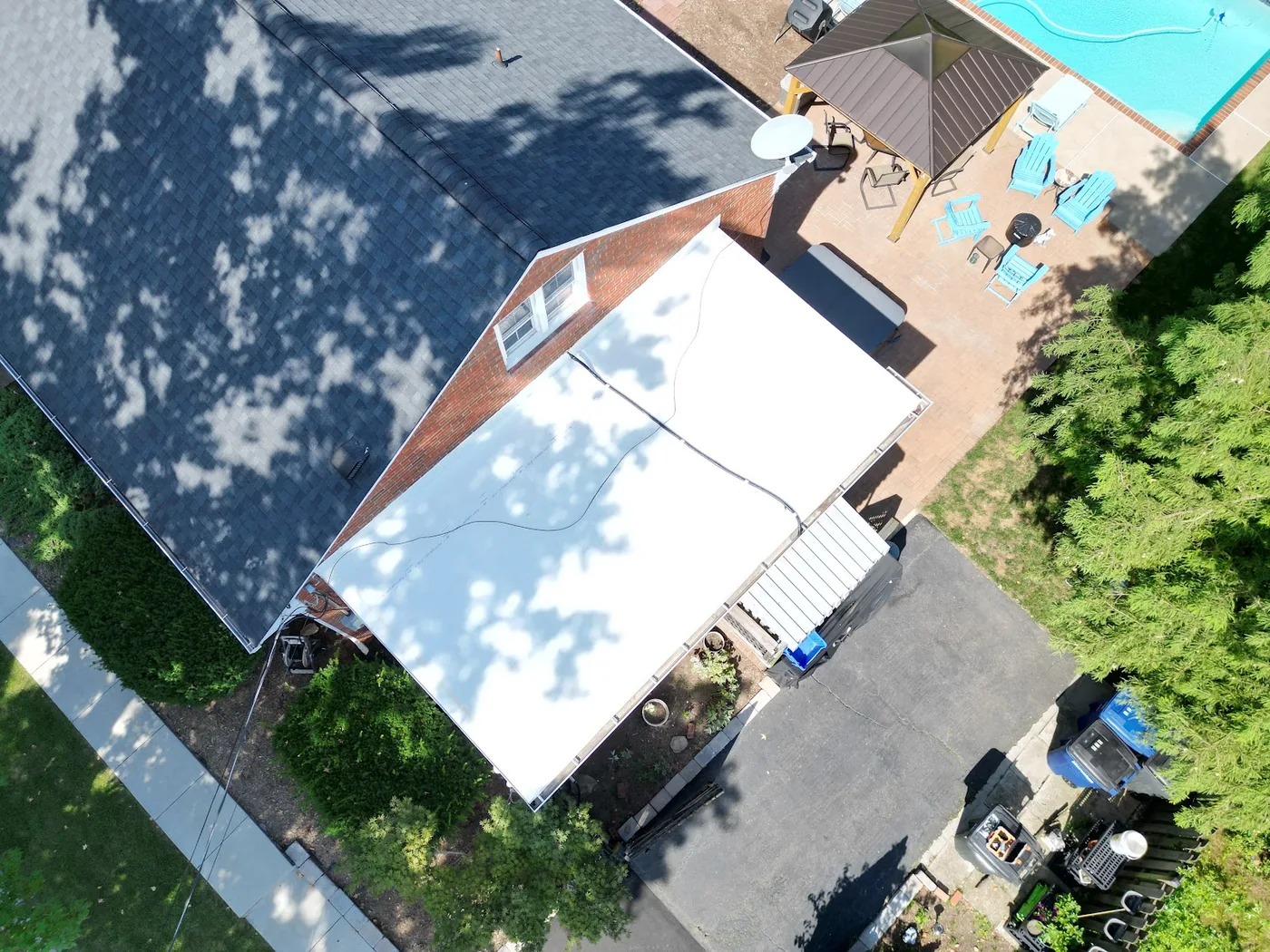
On a house, that is usually an addition. Neighborhoods such as Edgemoor, Battery Park and Kenwood were laid out between 1912 and 1926, so their houses have had many decades for rooms to be added. A kitchen or sunroom added behind a 1950s house near Old Georgetown Road may have a roof with little fall, which makes its covering and its drain the two things to check. On an attached home the flat roof can be the whole roof. Downtown, around Wisconsin Avenue, East-West Highway, the Bethesda Metro station and Bethesda Row, the buildings are mostly multi-unit, and their roofs answer to an owner or a board.
Talk to Reston Roof
Phone ConsultationWhich Roofs Get TPO, and Which Do Not
| The roof | Our first look | What decides it |
|---|---|---|
| Flat roof over a back addition | TPO is a natural candidate | Fall toward a drain, and the condition of the deck |
| Porch or sunroom top | TPO if it drains; look at EPDM if the roof is small | Wall flashing and how people reach the roof |
| Attached home with a flat main roof | A common TPO fit | Party wall flashing, scupper size, neighbor access |
| Condominium or apartment roof | Possible, after the owner or board agrees | Ask Montgomery County about large buildings |
| Visible pitched roof on a house | Wrong choice | Single-ply is a low-slope system |
| Roof under kitchen exhaust | Look at PVC first | The maker's chemical chart for that discharge |
What We Walk and Probe Before Quoting TPO
- The deck. Soft or stained boards turn a new covering into a decking job, and that changes the permit question below.
- Standing water. We note where it sits after rain, because a sheet laid over a low spot only hides it.
- Wall edges. Where a flat roof meets brick or siding, the flashing takes more of our time than the open field does.
- Pipes and vents. Each one needs a boot or a welded patch that is fitted by hand.
- Foot traffic. If someone steps out a window to service a unit, we plan walk pads.
The sheet is either fastened through plates or adhered, and we choose after we see the deck. A manufacturer warranty may be available depending on the system, and the terms come to you in writing before work starts.
What Montgomery County's List Covers
The Department of Permitting Services (DPS) issues building permits for the Bethesda area from its office at 2425 Reedie Drive in Wheaton. Its Home Improvements page lists replacing the roof covering only among work that most likely needs no permit, and it warns that the list leaves out municipality and homeowner association rules. "Most likely" is the county's own hedge, and we keep it. Structural roof work is a different matter, because the county code does not count framing changes as ordinary repair.
The county publishes no figure for how much decking can be replaced before a job stops being covering only. When a deck turns out rotten, the scope should be confirmed with DPS before work starts, and you can ask the county yourself through MC 311 at 240-777-0311. If the property is a Master Plan historic site, or sits in a municipality such as Chevy Chase Village, extra steps come first. For what condition a flat roof should be in between replacements, our flat roof maintenance guide is a good companion.
Two TPO Roofs We Would Scope
A 1950s brick house with a back addition
The addition is about 14 by 18 feet, with one drain at a corner and a brown stain on the ceiling below. We would open a test area to see the deck and the insulation, mark where water stands, and replace anything wet. If the deck has no fall, we would add tapered insulation to steer water to the drain, then lay a 60 mil sheet and weld flashing up the brick. The owner sees photos of the bare deck before it is covered, a written scope and whatever warranty terms apply.
An attached home with a flat main roof
The roof is roughly 16 by 32 feet between two party walls, with a scupper at the rear that drains onto a neighbor's side. The seams and wall flashings are the likely trouble, so we would map them before quoting. A replacement would carry the sheet up both walls and tuck it under the coping, with a larger scupper if the old one is undersized. The owner sees a drawing of the drain path and a note on where the truck and dumpster will sit.
Large Buildings and Big Roofs
Dense construction followed the opening of the Bethesda Red Line station in 1984, and much of downtown is apartments, condominiums and offices. Those roofs are real work for single-ply membranes, but this page is about houses and small buildings first. If you manage a large building, send the roof size, the deck type and who signs for it, and the fit can be judged from those.
Other pages cover the neighbors: TPO in Silver Spring and TPO in Washington DC. For a broader comparison of membranes, read TPO versus EPDM.
Where TPO Is the Wrong Answer
Skip it on a visible pitched roof, where a single-ply sheet is the wrong kind of covering and a shingle or metal panel belongs. Skip it, or at least check the maker's chemical chart first, where grease or solvent reaches the roof. Be careful on a roof that cannot drain at all, since any membrane suffers there. A very small porch top is often a better fit for EPDM, which comes in wide sheets with few seams. See the Bethesda overview and our service areas.
TPO Questions From Bethesda Owners
Can a Bethesda addition roof with hardly any slope take a TPO sheet?
Often it can, but we measure before we promise. Each maker publishes a minimum slope for its sheet, and a nearly level roof has to shed water somewhere. The trade's rule of thumb is that no water should still be standing 48 hours after rain, so a roof that holds a puddle longer needs drainage work whichever covering goes on. Sometimes that means tapered insulation or a new drain location, and the written scope should say so.
How thick should the TPO sheet be on a small porch or sunroom roof?
Makers sell 45, 60 and 80 mil sheets. Thicker sheets score higher on lab puncture tests, and some makers tie the length of a guarantee to thickness, so the choice also depends on the system. A roof that people cross to reach a deck or equipment gets walk pads and a closer look at thickness.
Why do some TPO sheets come in gray or tan instead of white?
Makers sell white, tan and gray, and reflectance differs by color. One maker's published sheet lists white at 0.79 initial reflectance and gray at 0.46. ENERGY STAR listing is specific to a product and color, so a label on one white sheet says nothing about a gray one. For a small flat roof on a house, color is mostly about appearance from upper windows and how hot the surface gets, and the maker's color chart shows the options.
My Bethesda condominium has a flat roof. Who decides what goes on it?
The owner or the association board decides, and the county does not enforce covenants or deed restrictions. Montgomery County is the place to ask what applies to a condominium, apartment or commercial roof, and the board's written approval is what the work should follow.
How do you check a TPO seam after it is welded?
Welding is done with hot air, and the membrane has to be clean first, because weathered or dirty laps do not fuse well. One maker calls for a weld at least 1.5 inches wide. Afterward the welded edge is probed along its length to find any spot that did not close, and the maker may send an inspector if a guarantee is part of the job.
Related Services
- Roofing in Bethesda, from county permits to storm tarping
- EPDM rubber roofs in Bethesda, for porches and small garages
- Metal roofs in Bethesda, for pitched houses
- PVC roofs in Bethesda, for exhaust and crowded roofs
Flat Roof Trouble in Bethesda?
Tell us what the roof sits on, where the ceiling stain shows and roughly how big it is. We will say whether TPO is worth a visit. Phone (571) 453-6515.
Book a Phone Consultation