PVC Roofing in Bethesda, MD: When Exhaust, Vents or Old Flashing Call for a Welded Plastic Sheet
PVC fits a narrow set of roofs. This page covers when kitchen exhaust, a crowd of vents or old flashing compounds make it the right sheet, what permits those vents can raise, and when a plainer membrane is the better choice.
A Narrow Fit
PVC is a heat-welded plastic sheet with a polyester or fiberglass layer inside it. Compared with other flat-roof sheets, it suits a few roofs and not most. This page explains which ones, and when a plainer membrane is the better choice.
Bethesda has the building mix for it. Dense downtown buildings near the Bethesda Metro station sit beside Bethesda Row, a retail and dining district, and neighborhoods such as Edgemoor, Battery Park and Kenwood have older houses that may have gained kitchen additions. A good rule is to ask what reaches the roof, what touches the sheet and how many things stick up through it.
Talk to Reston Roof
Phone ConsultationThree Questions We Ask First
1. What lands on the roof?
Kitchen exhaust drops grease on a roof. So can a lab or workshop exhaust. If the discharge is a fan from a restaurant, a medical office or a home range hood, the maker's chemical chart decides whether PVC is warranted. If nothing but rain and leaves reaches the roof, a plainer sheet may do the job for less trouble.
2. What touches the sheet?
Old flashing compounds, asphalt-based cement and some insulation boards can react with plasticized PVC. Old roofs in Bethesda have had decades to collect patches in odd materials, so we look under and around before we order anything.
3. How many penetrations are there?
A roof with a dozen pipes, conduits and curbs needs a dozen boots and flashings. Prefabricated boots and, in some systems, factory-welded sections reduce the hand work. A clear roof with one vent does not need that.
Where It Shows Up on a House
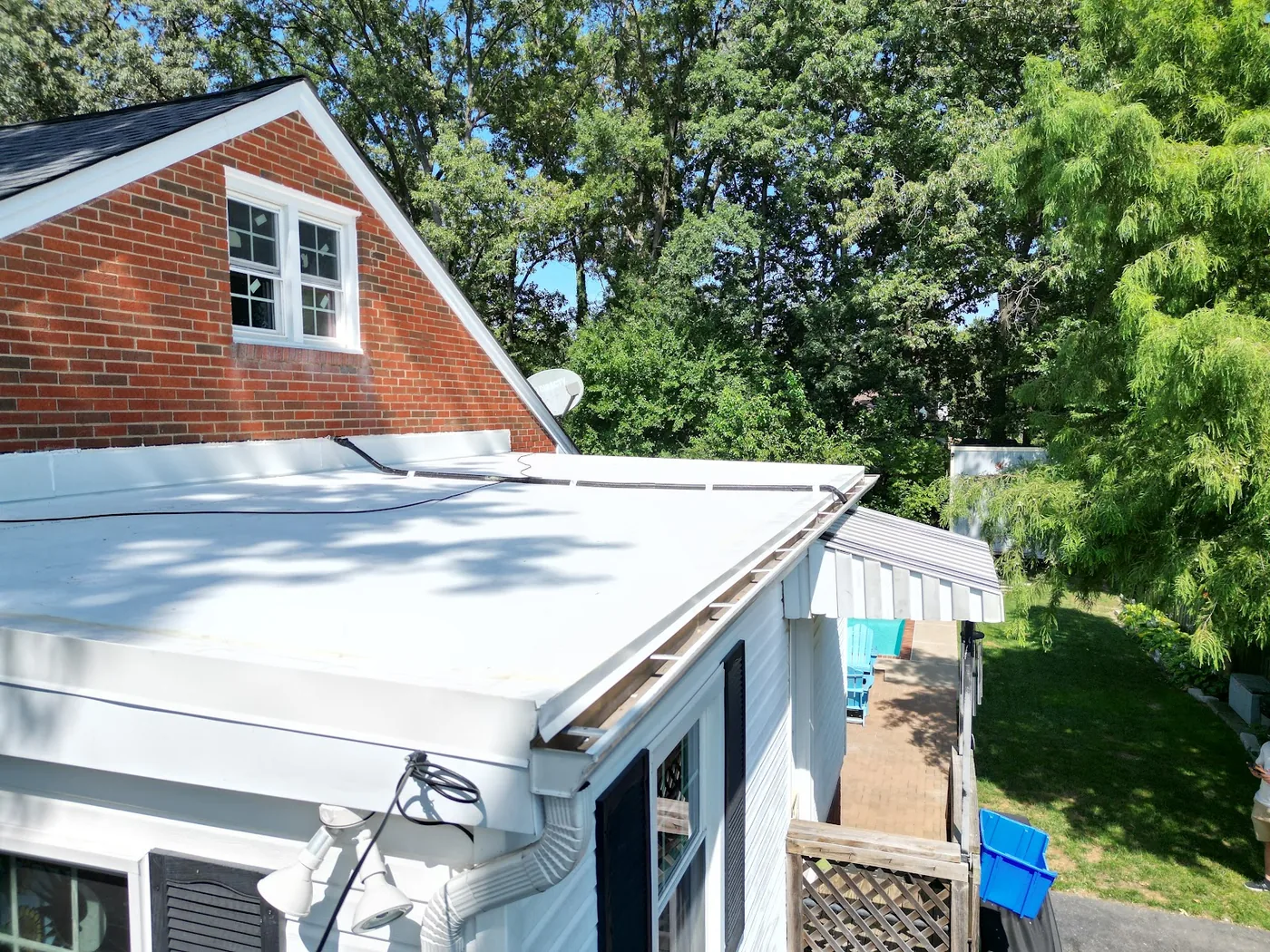
The usual house-sized case is a back addition, often a kitchen, whose flat roof carries a range hood duct, a plumbing vent and an old patch where it meets the main house. The 1950s and 1960s homes in the area, 10,258 by the Census count, have had decades for such additions to be built, and their roofs are not all in the same shape. A roof inspection is the only way to see what a given roof carries.
The other case is a small commercial building along Wisconsin Avenue, Old Georgetown Road or East-West Highway where a fan or two sits on a flat roof. A job much larger than a fan or two may be outside what Reston Roof takes on.
What Goes Through the Roof Can Raise More Permits
Montgomery County lists replacing the roof covering only among work that most likely needs no permit. The same list names electrical work and plumbing, with plumbing going through WSSC, as work that needs one, and the county code says ordinary repairs do not include changes to piping or wiring. A re-roof that disconnects or relocates a vent stack, a gas flue or an electrical mast may therefore touch another permit. This is our reading and not a county statement about roofs, so the Department of Permitting Services should be asked before work starts.
The county also says it does not enforce covenants and deed restrictions, and that many subdivisions have private ones governing construction. If your deed or association has a say about how a roof looks, send it to us. For help picking a company for a low roof, choosing a flat roofing company lists what to ask, and the commercial maintenance checklist suits a building with a fan on top.
Two PVC Roofs We Would Scope
A 1960s house with a kitchen addition
The flat roof is about 16 by 20 feet and carries a range hood duct, a plumbing vent and a skylight curb, with black cement smeared around two of them. We would find out what the hood discharges and read the maker's chart. We would strip the cement or isolate it with metal, fit prefabricated boots and weld a 60 mil sheet to them. The owner sees a note on the compound we found, a photo of every penetration and a written statement about any warranty.
A small two-story building with two exhaust fans
The roof is about 30 by 60 feet, and grease has stained the area around the fans. We would check the old membrane, ask the owner about the fan discharge and propose a PVC sheet with extra sheet around the fans, plus walk pads. The owner receives a roof plan marking each fan and curb, and a plain list of what to clean and how often.
When Another Sheet Is the Better Buy
If the roof is a plain porch top with no exposure, ask whether TPO or EPDM would meet the need. PVC may be more than that roof requires. It is the wrong choice where it must touch rubberized asphalt and cannot be separated from it, and wherever water stands longer than about two days, since makers differ on what ponding does to a guarantee. On a pitched house roof it is the wrong kind of covering, and metal or shingles make more sense. See also PVC in Silver Spring and PVC in Washington DC, or return to Roofing in Bethesda.
PVC Questions From Bethesda Owners
Why would a kitchen vent on a Bethesda roof point toward PVC instead of TPO?
Because of what lands on the sheet. One maker states that its PVC is inherently resistant to oils, fuels and grease, and another lists enhanced chemical resistance. One TPO maker also states resistance to restaurant exhaust for its own sheet, so it is not a rule that TPO fails. The right move is to read the maker's chemical chart against what your fan actually discharges, and we do that before we recommend either one.
Can new PVC go over the old rubberized flashing compound around my roof?
Not in contact. A major maker warns that rubberized asphalt can pull plasticizers out of flexible PVC, which can leave it brittle and cracked. The usual fix is to separate the two with metal or a compatible sealant, or to remove the old compound. Whether polystyrene insulation or bitumen can touch the sheet is a question for the maker's own document, and we check it before we order.
How often should a PVC roof be looked at once it is finished?
A maker of PVC roofing recommends inspecting flashings, drains and termination sealants at least twice a year and after every storm. Clear the drains and scuppers, watch for punctures near equipment and keep anything that contains plasticizer-absorbing material off the surface. A weld that was cleaned and made properly should not need attention, but the details at the edges do. A short written list of what to look at is worth asking for.
If a roof job moves a plumbing vent or a gas flue, does the permit answer change?
It can. The county's own list of permit items includes electrical work and plumbing, with plumbing going through WSSC, and county code says ordinary repairs do not include work on gas or vent piping or on wiring. A roof job that only recovers a vent stack is different from one that relocates it. The Department of Permitting Services in Wheaton is the place to ask before work starts, and that kind of work should wait for an answer.
How many seams does a prefabricated PVC roof have on the roof itself?
Fewer than a roll-by-roll roof, because the maker welds sections together in the factory to your measurements. One maker builds custom prefabricated sections with factory-welded seams, which cuts the number of field welds. The sections still have to be joined on the roof and flashed at every wall, curb and pipe, so the count never reaches zero. Whether that approach fits a small roof depends on its shape.
More Roofing Pages for Bethesda
- Roofing in Bethesda: county rules, towns and storm calls
- TPO in Bethesda: for plain flat roofs with little exposure
- EPDM in Bethesda: rubber for small porch and garage tops
- Metal in Bethesda: panels for pitched houses
Vents and Exhaust on a Flat Roof?
Tell us what comes out of the roof, what the old flashing is made of and how big the roof is. We will say whether PVC fits or something plainer will do. Phone (571) 453-6515.
Book a Phone Consultation