EPDM Rubber Roofing in Bethesda, MD: One Wide Sheet for Small, Low Roofs
Rubber roofing is cured synthetic sheet, laid wide so a small roof needs few seams. This page covers the porches, garages and dormer tops of older Bethesda houses, who has to approve the work, and when rubber is the wrong choice.
Why Small Roofs Suit One Wide Sheet
EPDM is cured synthetic rubber. It is black unless a white version is specified, it is sold in sheets far wider than a porch, and its seams are made with primer and tape rather than heat. On a small roof that last point matters, because every field seam is a place for dirt, damp or a skipped step to cause trouble later.
That is the case for rubber on the flat tops of dormers, side porches, back additions and detached garages, This page also covers where rubber is the wrong call.
Talk to Reston Roof
Phone ConsultationOlder Houses and Their Small Low Roofs
Bethesda's older neighborhoods were laid out in pieces. Banker Walter Tuckerman had a subdivision of large lots laid out in 1912 on 183.5 acres, and it became Edgemoor. Battery Park was divided into 200 lots on oddly shaped streets by its founders, Maj. Henry Maddux and Gen. Richard Marshall. Edgar Kennedy bought more than 200 acres in 1926 for Kenwood, which has about 300 homes off River Road and Little Falls Parkway.
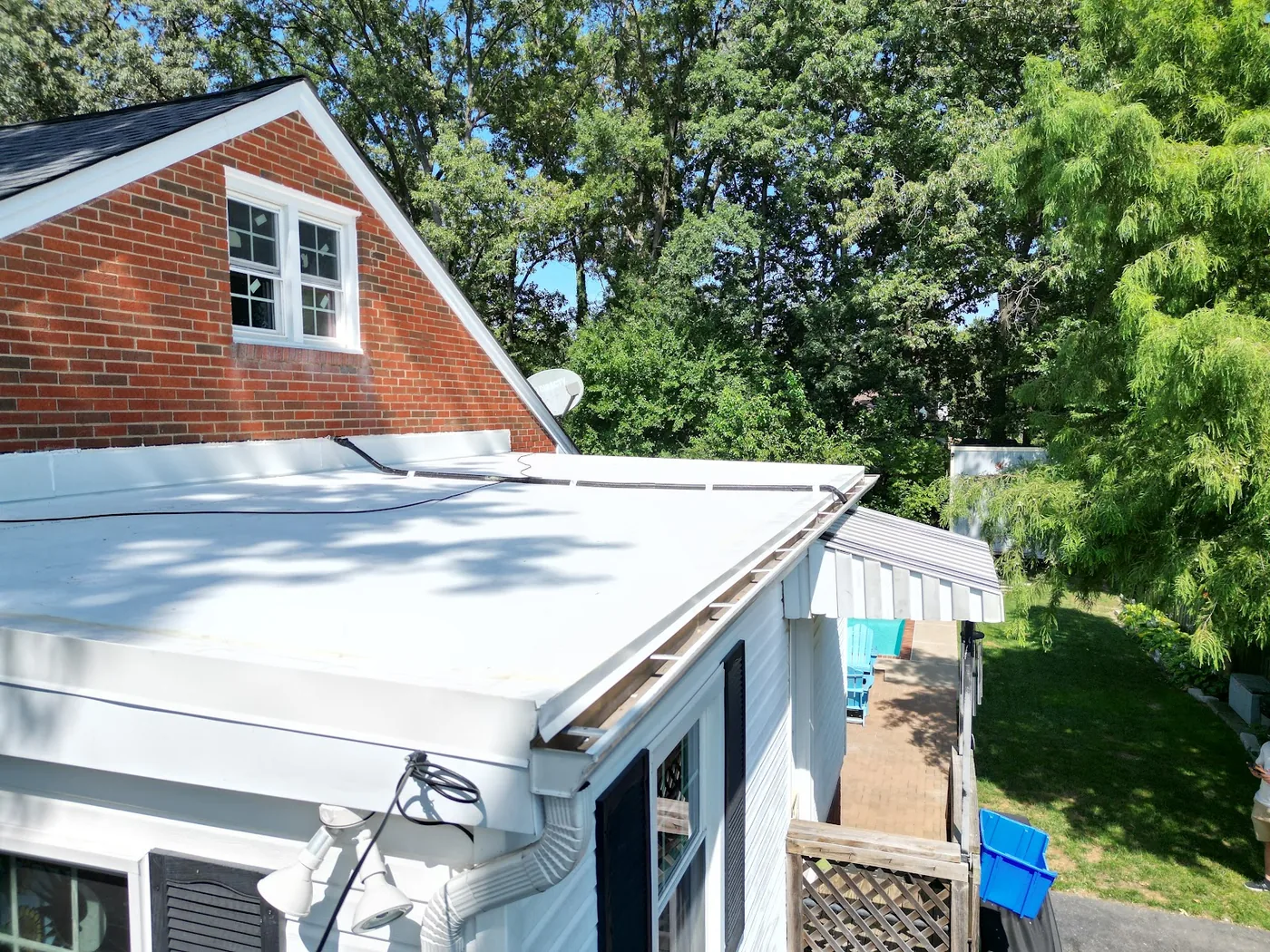
The Census counts 2,488 homes in the area date from the 1940s, 6,033 from the 1950s and 4,225 from the 1960s. Houses that old may have had a porch closed in, a garage attached or a room added, and each of those can leave a small flat roof. That is where a rubber sheet fits.
A Rubber Roof Job, in Order
- Look and photograph. We check the old covering, the ceiling below and every wall the roof touches.
- Open and dry. The old roof comes off, and wet insulation or soft boards come out.
- Make the surface smooth. One maker requires a clean, dry, smooth substrate with voids over a quarter inch filled, so we spend time here.
- Set the sheet. It is adhered, fastened or, where the structure can carry the weight, ballasted with stone, and the maker's instructions pick the method.
- Seam and flash. Primer and tape go on a clean surface, and the sealant at the edges goes on last.
- Finish the edges. Drains, scuppers and terminations get checked, then photographed for you.
Three Layers of Approval, Sorted
Montgomery County's Department of Permitting Services covers the unincorporated Bethesda area, and its list of work that most likely needs no permit includes replacing a roof covering only. The list does not cover municipal or homeowner association rules. Chevy Chase Village, the Town of Chevy Chase, Chevy Chase Sections 3 and 5, Martin's Additions, Somerset and the Village of Drummond all use Chevy Chase 20815 addresses and have approvals of their own.
What a re-roof needs from each of them varies. The Chevy Chase Village permit guide says a county permit does not guarantee a Village permit, and it requires a permit for a dumpster, which a re-roof normally uses. Section 5's code exempts ordinary exterior repairs using the same materials, and Martin's Additions exempts ordinary repairs or maintenance. So the village or town office should be called before materials are ordered.
Two Rubber Roofs We Would Scope
A side porch on a 1940s house
The roof is about 12 by 14 feet, and the old roll roofing has split at its seams. We would strip it, check the boards and lay one 60 mil EPDM sheet with no field seam in the middle. Flashing goes up the siding and under the window sill. The owner sees a sample of the rubber, a note about the drip edge and a short list of what to check after the first heavy rain.
A detached garage with a slight slope
The garage is about 20 by 22 feet and has had two patches. Before we recommend anything, we would take a moisture reading, since a wet board under a patch means a replacement. If the deck is sound and the seams are lifting only at one edge, we might patch again and say how long we think it will hold. If it is wet, we would replace it and leave the owner a spring checklist.
Storms, Trees and the Rubber
In May 2018 a large tree came down on a house on South Chelsea Lane in Bethesda. The report said the structure had significant structural damage and was judged unsafe to live in. A rubber sheet cannot do much against that. A lighter hit is the sheet's problem: a 45 mil membrane can be punctured by a limb or by a dropped tool. Montgomery Planning's tree canopy study, based on imagery from 2009 to 2011, put downtown Bethesda at 24 percent canopy, just under the 25 percent minimum it recommends for urban areas. Canopy and roof wear are separate questions, but limbs are a fact of life here.
For standing-water and leak checks on small roofs, our flat roof repairs guide has a plain-language checklist, and roofing flashing installation covers the wall details.
When Rubber Is the Wrong Choice
Rubber is the wrong choice anywhere grease, animal fat or oil will reach the roof, because one maker tells installers to isolate those from the sheet. It is also a poor choice for a roof that will take heavy foot traffic with no walk pads, and for a roof where a white surface is a design goal and nobody has specified white EPDM. A pitched, visible roof on a house is for other materials, such as metal. Welded options for flat roofs are on the TPO and PVC pages. Nearby EPDM pages cover Silver Spring and Washington DC.
Rubber Roof Questions From Bethesda Owners
Can my back porch roof be covered with one sheet of rubber and no seams?
Sometimes. One maker sells EPDM in widths up to 50 feet, and another makes sheets up to 10 feet wide with factory seam tape, so a small porch or dormer top can be covered with few seams or none. We measure the roof and the walls first, because flashing at the walls is made separately and has its own seams. When one sheet can cover the roof, the written scope should say so.
Should I patch the rubber on my garage roof or replace it?
That depends on the age of the sheet, the state of its seams and whether the insulation underneath is wet. Patches with primer and tape are a standard repair, and a moisture survey is the usual way to learn whether water has spread under the sheet. If the rubber is cracked in many places or the seams are lifting along their length, patching only buys time, and we will tell you which case we see.
What happens at the edges of a rubber roof as it ages?
EPDM shrinks a little. One maker lists typical shrinkage of about half a percent for 45 mil sheet, with a limit of 1.0 percent, and that pull lands on the edges and flashings. A well-made termination allows for it. When we inspect an older rubber roof, we look first at the edges, the wall flashing and the corners, since movement shows up there before it shows up in the middle.
My address says Chevy Chase, but people call my area Bethesda. Who do I call first?
Call both before you order materials. Several nearby places carry Chevy Chase 20815 addresses and have their own town or village approvals on top of Montgomery County. The county's own list of work that most likely needs no permit does not cover municipal rules. Parcel location decides who reviews a roof, not the mailing city, so the street address comes first, and the town office is the place to check.
A limb fell on my rubber roof in a storm. What should I do before anyone arrives?
Stay off the roof and look from the ground. Check the ceiling below for fresh stains, move belongings from under any drip and take photos. Call us at (571) 453-6515 and we can arrange a temporary tarp. A 45 mil sheet can be punctured by a broken limb, and we document damage with photos for your claim. If a limb is on a power line, keep clear and call the utility.
Other Roofing Pages for Bethesda
- Bethesda roofing overview: the county, the towns and the storm calls
- TPO in Bethesda: welded white sheet for additions and attached homes
- Metal in Bethesda: panels for pitched house roofs
- PVC in Bethesda: for exhaust and old flashing
Porch or Garage Roof Leaking?
Give us the street address, the size of the roof and what covers it now. We will say which office is likely to review it and whether rubber makes sense. Phone (571) 453-6515.
Book a Phone Consultation