TPO roofing in South Riding, VA: the flat part of a townhouse roof
Census Bureau estimates for 2020 to 2024 put 4,804 of South Riding's 10,510 homes in townhouse-type buildings. TPO is not for their pitched roofs; it is for the flat bits: a cover over a rear deck, a bump-out, a low section tucked between two slopes. Here is when a white, heat-welded sheet fits one of those, and when it does not.
What to have ready when you call
Three details are enough: the street, roughly how big the flat section is, and where the stain shows inside. From those we can say whether TPO deserves a visit, or whether another sheet or a pitched covering makes more sense.
If the roof has solar panels or a skylight curb, say so. Both change how the work is planned.
Talk to Reston Roof
Phone ConsultationWhich flat roof is yours?
| The roof | What we usually suggest | What decides it |
|---|---|---|
| Small cover over a rear deck or bump-out | TPO, or EPDM | Welded seams and a light color, or one wide rubber sheet |
| Low roof over a garage, with a kitchen vent close by | TPO, unless grease lands on the roof; then ask about PVC | Where the vent discharges |
| A section steeper than a low slope | Not TPO; look at metal panels or shingles | Single-ply is a low-slope system |
| A roof with solar mounts on it | TPO is possible | Where the mounts sit and who handles the panels |
| A roof where water stands after rain | Fix the drainage first, whatever the sheet | Roofing trade guidance treats water left past 48 hours as a problem |
The shared wall question
About 45.7 percent of South Riding homes are attached townhouse-type units, so a flat section often sits beside a neighbor's. Virginia's building code lets an owner replace up to 256 square feet of roof decking without a permit, except where that decking was required to be fire-retardant treated or protected as part of a fire-rated wall termination. That exception is the townhouse case. If treated plywood turns up when the roof is opened, Loudoun should be asked before it is touched.
Loudoun's own pages do not spell out a re-roof rule. So the scope should be confirmed with the Department of Building and Development (703-777-0220) before the first day. Our Loudoun County roofing guide has the wider background.
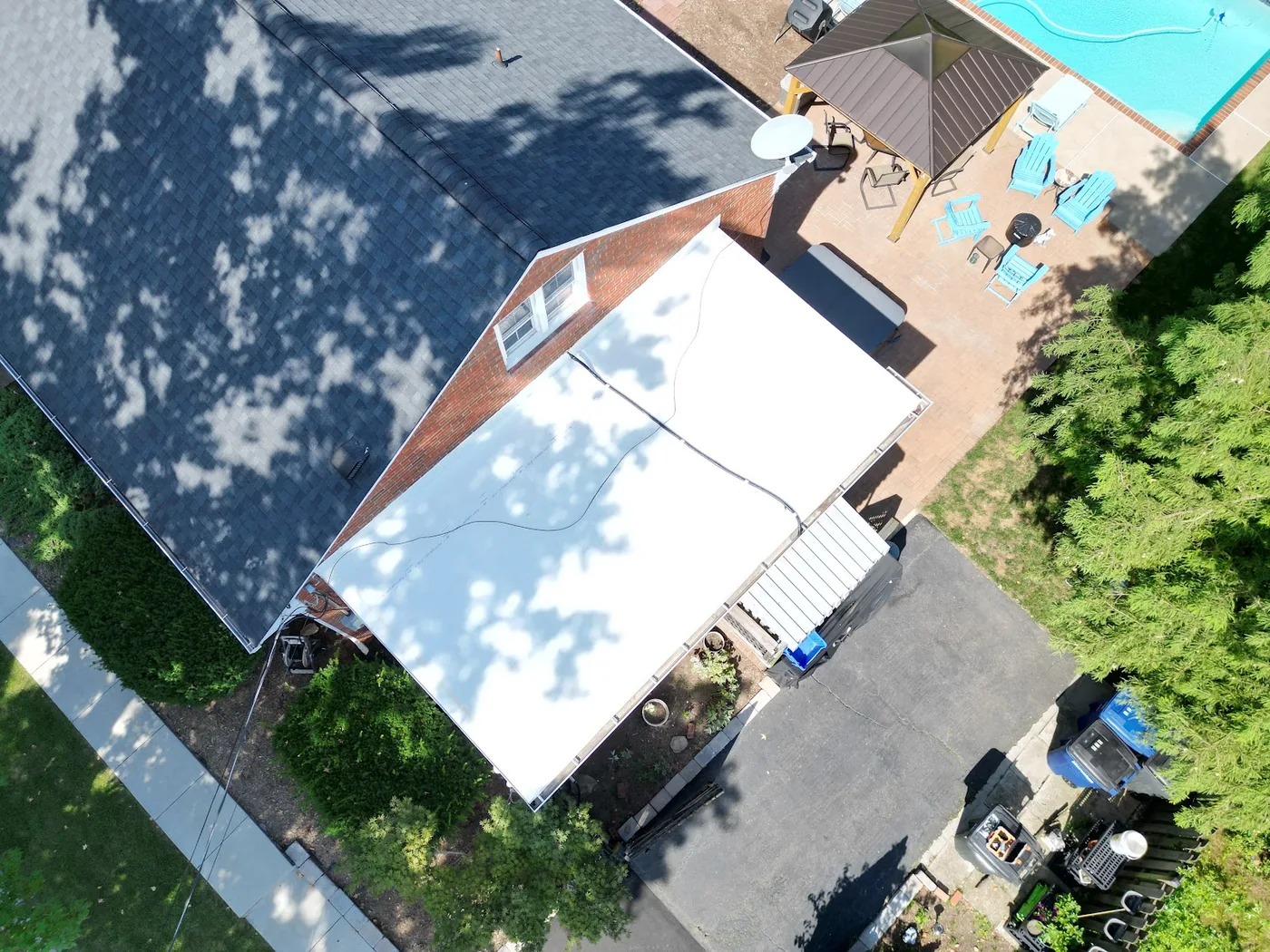
What we look at from the ladder
- The decking under the old covering. Soft or dark spots near the wall are where water has been getting in, and they decide how much plywood is replaced.
- The wall and parapet edges. Leaks on small flat roofs often begin at a flashing, not in the middle of the sheet.
- Every hole in the roof: plumbing stacks, bath fan vents, skylight curbs and solar mounts.
- The drain path. A scupper, gutter or downspout that spills onto the roof is a repeat leak waiting to happen.
- The old covering itself. Dark, rubbery patches matter most when the new sheet is PVC.
Reaching the roof is a practical matter too. Whether the crew comes in off Tall Cedars Parkway, Poland Road or Loudoun County Parkway, a townhouse row often has little room, so where the truck and the dumpster sit should be agreed before day one.
Two typical TPO projects
A deck cover on a 2000s townhouse
The flat roof is about 10 by 14 feet, set between two pitched sections, and the kitchen ceiling below has a stain along the shared wall. We would pull back the old covering, probe the plywood, and replace what is soft. If any decking turns out to be fire-retardant treated, Loudoun is asked before it is touched. Then comes a new 60 mil TPO sheet, welded seams and fresh wall flashing. The owner sees photos of the bare deck and the probed seams.
A sunroom roof on a 1990s detached house
About 14 by 18 feet, with a skylight curb whose sealant has cracked and a gutter that overshoots the edge. We would check for wet insulation, rebuild the curb flashing, change the gutter so water stays off the sheet, and install TPO with a walk pad where the owner reaches the skylight. The owner gets a written note on what was found and what was left alone.
Who has to say yes
The county and the community are separate. Loudoun does not review covenants, and the South Riding Proprietary does not issue building permits. The Proprietary's Community Standards department, at the Town Hall on Center Street, takes an Application for Exterior Modification, and its published process lists roof replacement among the applications staff can review. Standards differ by section, so confirm what yours needs, and have the sheet type, color and a photo of the area ready for the form.
Condominium buildings such as Amberlea at South Riding have a unit owners association with its own modification process on top of that. See our flashing guide for why the edge details get so much attention, and TPO versus EPDM for the side-by-side.
TPO Questions From South Riding Owners
My South Riding mailing address says Chantilly. Does Fairfax County review my TPO flat roof?
No. South Riding sits in unincorporated Loudoun County, and Loudoun's own permit reports list South Riding parcels under a Chantilly, VA 20152 mailing address. The postal name is a mail label, not a county line. Loudoun's Department of Building and Development is the permit office, and what your scope needs should be confirmed with it before work starts. The Fairfax County line lies to the east, so a parcel near that edge gets an extra look on the county map.
The flat roof over my deck has solar panels on it. Can new TPO go under them?
Panels and their mounts have to be planned before any membrane goes down, because each mount is a hole that needs flashing. Loudoun's permit reports list roof-mounted solar at South Riding addresses, so the question is a real one here. Whether the panels are lifted off and reset by the solar company or flashed around depends on the mounts. Tell us early and give us the installer's name, so the order of work is agreed in writing.
Which TPO thickness suits a deck roof that someone walks on once a season?
Makers sell 45, 60 and 80 mil sheet, and the thicker sheet posts higher puncture numbers in lab tests. Lab numbers are not field guarantees, so we match thickness to how the roof is used. A small section that only a gutter cleaner or HVAC technician crosses can often take the middle thickness with walk pads along the route. A roof people step on daily deserves the thicker sheet. The thickness goes into the written scope.
Will the South Riding Proprietary care about a white membrane I can hardly see from the street?
Check with the Proprietary first. Its published process asks for an Application for Exterior Modification before exterior changes and lists roof replacement among the applications its staff can review. Whether a low section behind a rear wall counts is for Community Standards to say, so phone them at 703-327-4390 before you order. Have the sheet type, the color and a photo of the area ready for the form.
What proof can I ask for that the seams on my TPO roof were welded properly?
Ask the scope to say three things: weathered or dirty sheet is cleaned before welding, the finished weld meets the width the maker specifies (one maker sets a 1.5 inch minimum), and every seam is probed with a tool and photographed. Probing finds an open edge that a glance misses. The maker's installation instructions govern the details, so they should be read for your sheet before the crew starts.
Related Services
Other roofing for South Riding houses and townhouses:
TPO in neighboring Loudoun communities:
Water showing up under a flat section of your townhouse roof?
Give us the street and the size of the flat section, and say whether panels or a skylight sit on it. We will tell you what we would check first and whether TPO is the right sheet. Call (571) 453-6515.
Book a Phone Consultation